
AI Support Agent by Industry: One Widget, Many Playbooks
An AI support agent by industry, tuned to your business. See how one website widget answers and acts across SaaS, ecommerce, agencies, real estate, and more.
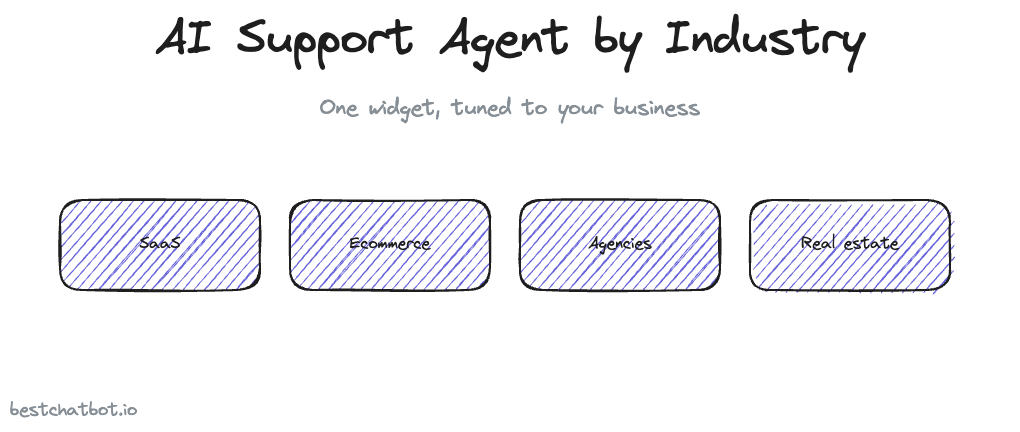
A support inbox for a SaaS app looks nothing like one for an online store, and neither looks like the front desk of a real estate office. SaaS gets billing and getting-started questions, a store gets "where is my order", a real estate team gets "is this listing still available". The questions differ, the tools behind them differ, yet every one of these teams reaches the same wall: people asking the same things over and over, answers that already exist somewhere, and a small team that cannot keep up. An AI support agent by industry meets each of these businesses on their own terms instead of handing them a generic chatbot and wishing them luck.
We built one website widget and made it bend to the shape of the business it sits on. The engine is the same everywhere: it answers from your real content and declines when a question falls outside it, and on the paid tiers it executes real actions through a small set of secure connections. What changes from a SaaS company to a law firm is the knowledge it reads, the connectors it uses, and the playbook for what counts as a good answer. This page is the map. It walks the eight kinds of business the widget serves well today, what each one actually gets out of it, and the parts that stay identical no matter your industry.
One honest scope note before the tour. The product is a website widget and nothing else. There is no phone line, no app to install, no chat platform bolted on. It is a single assistant living on your site, and that focus is the point: one surface done properly beats five done halfway.
Why the industry matters at all
A chatbot that treats a yoga studio and a B2B software company the same way will disappoint both. The difference is not the technology. It is what "resolved" means.
For a software company, a resolved question might be a customer finding the right setup doc or checking when their subscription renews. For a store, it is a shopper getting the real status of order 4821. For a real estate team, it is a buyer learning a listing's price and booking a viewing. Same widget, three completely different definitions of a job well done. Get the definition wrong and the bot answers confidently in the wrong lane, which erodes trust faster than no bot at all.
So the industry shapes three things. It decides which content the agent learns from, since a store's product pages and a consultancy's service descriptions are nothing alike. It decides which of the eight connectors matter, since a SaaS company leans on billing and tickets while a clinic-style local service leans on the calendar. And it sets the bar for grounded answering, because a made-up shipping date and a made-up legal fee both come back to bite, just in different ways. The piece on a no-hallucination AI support agent explains why declining beats guessing in every one of these lanes.
The eight industries the widget serves well
Here is the honest list. These are the business types where the widget's strengths, grounded answers plus a focused action set, line up with what the work actually needs. We left two big categories off, healthcare and fintech, because regulated patient data and payment-card rules deserve a product built for them, not a website widget stretched to cover ground it should not claim.
SaaS and software
New users asking how to get started, plan differences, billing self-service, and the "how do I do X" wall that every software product hits. The agent answers from your docs and help center, and on the paid tiers it can check a subscription or open a ticket when a person is needed.
Ecommerce and retail
Product questions, shipping, returns, and order lookups. The agent reads your store content and, once a shopper is verified, looks up their real order through your store connection. This is the most action-heavy lane, and the ecommerce AI support agent overview goes deep on it.
Agencies
Client-facing FAQs, scoping questions, and capturing new project inquiries before they go cold. The agent answers from your service pages and routes a qualified lead into your CRM instead of letting a contact form rot in an inbox.
Professional services
Law firms, accountants, consultancies. People ask about fees, process, and availability, and the answers live in your written material. The agent grounds every reply in that content and books a consultation through your calendar when someone is ready.
Real estate
Listing details, availability, neighborhood questions, and viewing requests. The agent answers from your listings and site content and books a showing on your calendar, so a late-night visitor does not bounce to a competitor.
Local services and appointments
Salons, studios, repair shops, anyone whose business runs on a booked slot. The agent answers hours, pricing, and policy questions, then checks the calendar and books the appointment without a phone call.
Education
Course details, enrollment steps, and the recurring questions a small admin team fields all term. The agent answers from your program pages and opens a ticket for the cases that need a human.
Subscription businesses
Boxes, memberships, and recurring plans where "pause", "skip", and "when does it renew" never stop coming. The agent reads your policy content and, on the paid tiers, handles the self-service billing questions through your billing connection.
What every industry gets, no matter the vertical
Strip away the industry-specific playbook and a shared core stays the same on every site. This is the part you are really buying.
The agent answers from your own knowledge. You feed it your documents, your site pages, or both, and it answers from that and only that. When a question falls outside what you gave it, it says so rather than inventing an answer. That grounding is industry-agnostic, and it is what separates a trustworthy assistant from a confident liar.
It can act, not just talk, on the paid tiers. The action library is eight connectors and twenty-nine actions covering scheduling, support tickets, CRM, payments, and e-commerce. A business picks one tool per category, one calendar, one help desk, one store, and the agent uses those to do real work. What an AI agent that takes action looks like in practice is its own write-up, and it is the same capability whether you sell software or sofas.
It keeps private actions private. Anything that touches a specific person's record needs a verified visitor identity, set from a signed token your site passes, not from whatever someone types in the chat. No identity means the action is blocked or runs on a safe anonymous path. This single rule travels across every industry, because a stranger fishing for someone else's order or appointment is a problem everywhere.
Answering versus acting: the line that holds everywhere
Across all eight industries the widget draws the same line, and it is worth understanding before you pick a plan.
On one side is answering. A general question, your hours, your return policy, your course outline, gets answered for anyone the moment they ask, straight from your content. No login, no friction. This runs on the lighter plans, so even a free or starter setup turns the widget into a grounded FAQ that never makes things up.
On the other side is acting. Looking up an order, booking an appointment, changing a subscription, creating a ticket. These touch real systems and real records, so they need a verified identity and a connected tool. The connected actions sit on the Pro and Business tiers, which is where the pricing guide draws the line. Whatever your industry, the split is identical: answers are open, actions are gated.
When a question genuinely needs a person, the widget does not pretend to be one. It opens a ticket in your help desk and routes it to your team's inbox, so nothing slips. There is no live agent takeover inside the chat, by design. The handoff is a clean, tracked ticket rather than a transfer, and that is true for a software company and a salon alike.
If you are weighing the widget against other tools for your sector, the AI support agent comparisons lay out where it fits and where it does not. And if you run lean, the AI support for startups pillar covers how a small team gets the most out of a grounded, acting agent without hiring a support department.
Find your industry and start
The fastest way in is to pick the lane closest to your business from the eight above and follow it. Each one shares the same engine: grounded answers from your content, a focused set of secure actions, and a hard line between what anyone can ask and what only a verified visitor can do.
Start with the AI support pricing guide to see which tier turns on the connected actions for your industry, then point the widget at the content you already wrote. The playbook changes by vertical. The trust and the grounding do not.
To see one vertical in depth, read the AI support agent for SaaS.
Listings, viewings and leads follow their own rhythm. See the AI support agent for real estate.
No-shows and missed calls hit booking-driven businesses hardest. See local services and appointments.
Admissions questions need an exact, sourced answer. See the AI support agent for education and schools.
Subscription and membership brands have retention-critical support needs of their own: see how an AI support agent for subscription businesses handles billing, renewals, and cancellations.
There is a dedicated guide for agencies managing client sites.
Consultants and firms should read the professional services.