
AI Support Agent for Education
An AI support agent for education that answers admissions and enrollment questions only from your real material, declines when it is unsure, and books advising sessions.
A prospective student reads on your chat that the application deadline is March 15. They relax, plan around it, and submit on March 12. The real cutoff was March 1. That single wrong sentence just cost someone a place, and it cost you a formal complaint you now have to answer. In education, a confident wrong answer is not an awkward moment. It is a missed enrollment, an angry parent, or a student who paid for the wrong course because the bot guessed at a prerequisite it had never actually read.
That is the risk that makes education different from most website chat. A school, an online academy, a coding bootcamp, a university department: they all field the same flood of questions about deadlines, tuition, entry requirements, class times, and refund policies, and almost every one of those answers has a right value that lives in a real document. Getting it wrong is not a style problem, it is a factual one. This post walks through what an AI support agent for education has to do to be trusted with those questions: answer only from your real material, decline the moment a question falls outside it, and take the few actions worth automating without ever inventing a fact to fill a gap. We build BestChatBot as an AI Support Agent for Business Websites, so the examples stay specific about what the widget does and, just as important, what it refuses to do.
The questions students ask, and why a wrong answer costs more here
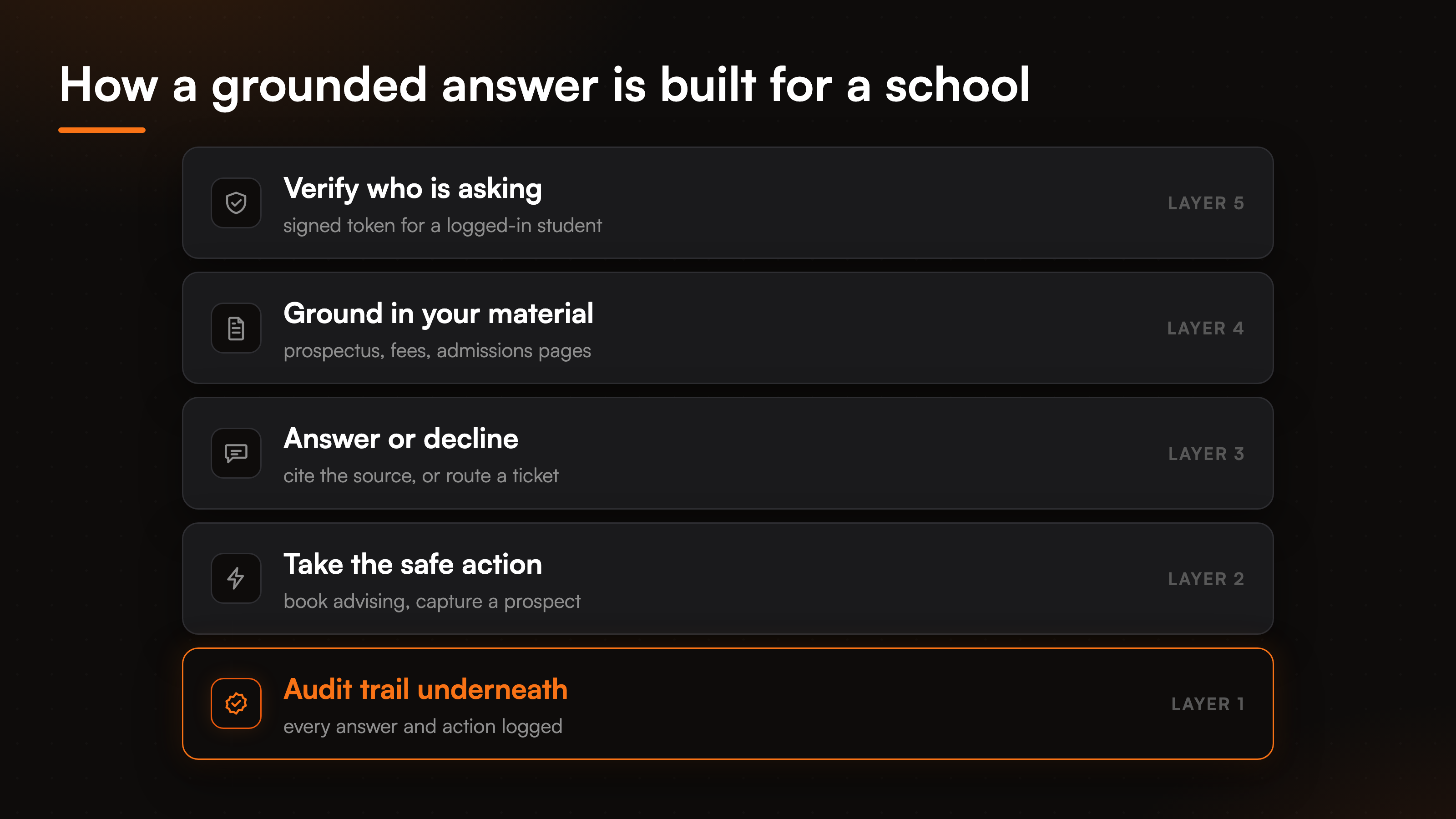
Sit with an admissions inbox for an afternoon and the pattern is obvious. When does the term start. What is tuition for the part-time track. Do I need a portfolio, or a specific grade, to apply. Is the course online or in person, and what are the class times. Can I get a refund if I drop in the first week. What is the difference between the certificate and the diploma. A busy prospect asks these at 9pm, long after your admissions team has logged off, and if a school website chatbot does not give a clean answer they move to the next school's page.
Every one of those questions has an exact answer sitting in your prospectus, your course pages, your fees table, or your refund policy. That is the good news, and it is also the trap a generic education chatbot falls into. A model trained loosely to "be helpful about a school" will cheerfully state a deadline it is not sure of, invent a tuition figure that sounds plausible, or confirm that a course has no prerequisites because a fluent, confident sentence is all it is built to produce. In most industries that is a nuisance. In education it decides whether a real person applies on time, pays the right amount, or shows up for a class they were never eligible to take.
Answer only from your real course material
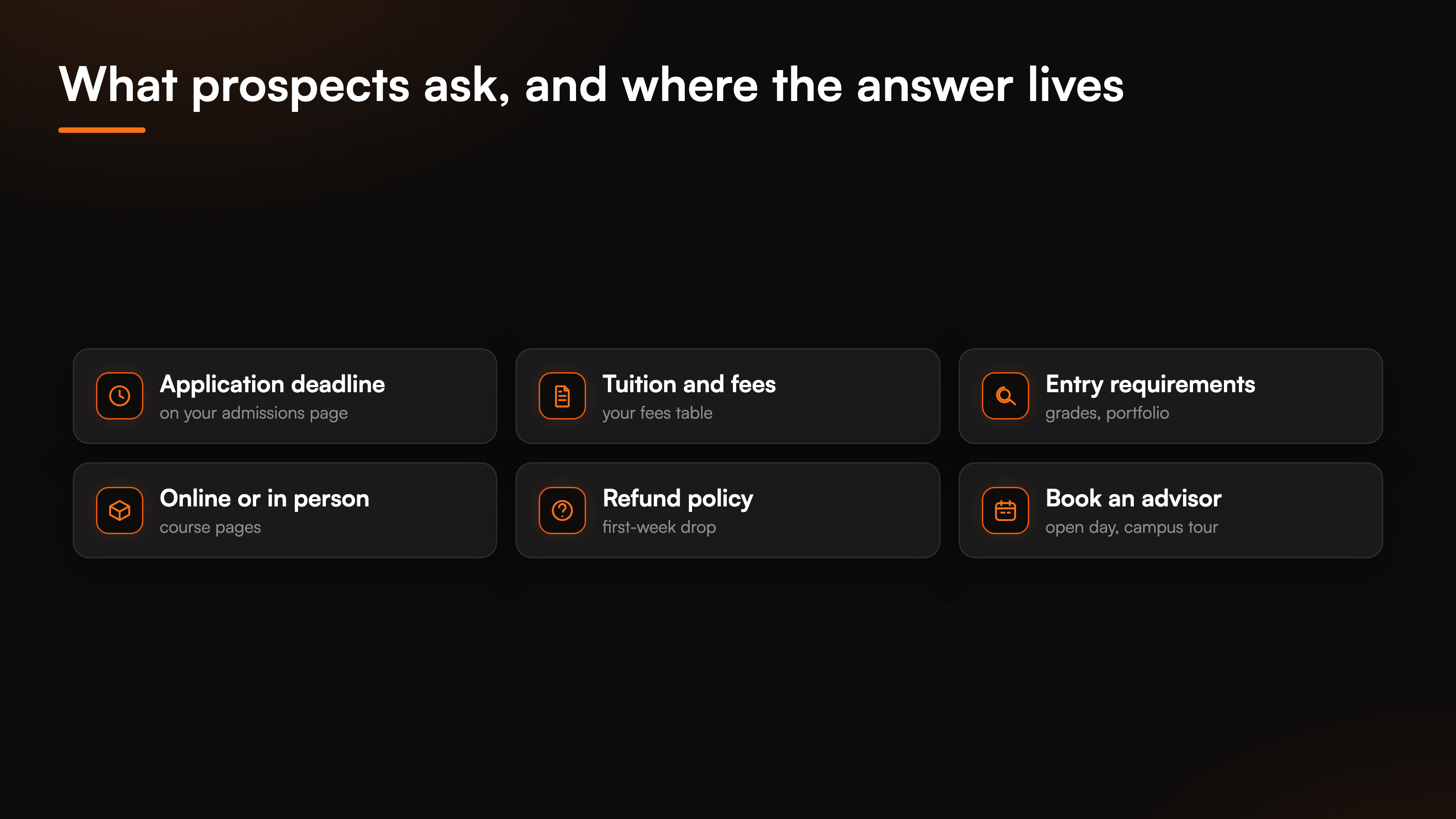
Here is the design idea that makes the difference, and it is the heart of the whole thing. A grounded answer comes from the content you gave the agent, your course catalog, your admissions pages, your fees and refund policies, your FAQ, and nowhere else. When a student asks "what is the deadline for the September intake," the agent pulls the date from your actual admissions page and answers with it, not with a number it composed to sound right. When they ask about tuition, it reads your fees table. We think grounding beats clever prompting for exactly this reason: a school cannot afford an assistant that sounds sure and is wrong, and the only safe way to sound sure is to be reading from your own document. Grounded answers for students are the whole point, not a bonus.
The agent can show its work, too. Source citations are a toggle you control, so an anxious applicant can see that the March 1 deadline came from your published admissions page rather than from thin air. That is a small feature with a large effect in education, where the person asking is often making a decision with money and a year of their life attached. Trust goes up when the answer points at the page it came from. The mechanism behind the grounding, and behind the decline, is laid out in our no-hallucination AI support agent write-up.
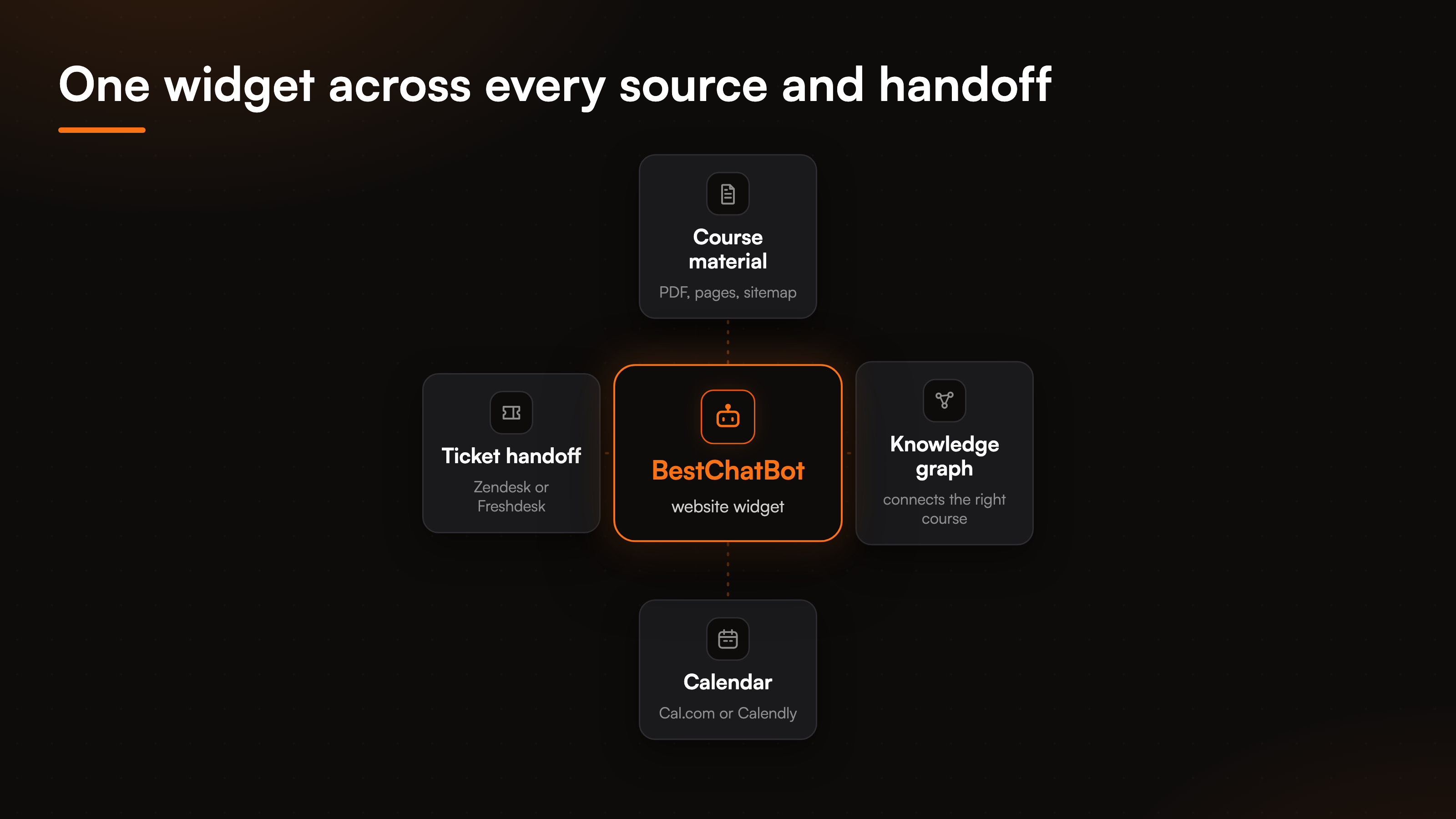
None of this asks you to build anything new. The material the agent answers from is the material you already publish. You upload your prospectus and policy PDFs, point the crawler at your public course pages, or edit an answer by hand, and the agent trains on that content. A knowledge graph sits on top so it can connect a question about "the online option" to the right course rather than the wrong one. An e-learning support agent runs on the same grounding approach that lets an e-learning SaaS product answer questions from its own docs.
What happens when the question is off the material
Grounding is only half the promise. The other half is what the agent does when a question has no answer in your content, and this is where a generic bot does the most damage. Ask a plain chatbot something your pages do not cover, "will this qualification be recognized for a visa," "can I defer for family reasons," "is there a scholarship for my situation," and it will often produce a confident, invented answer rather than admit the gap. In education that invented answer can send someone down an expensive wrong path.
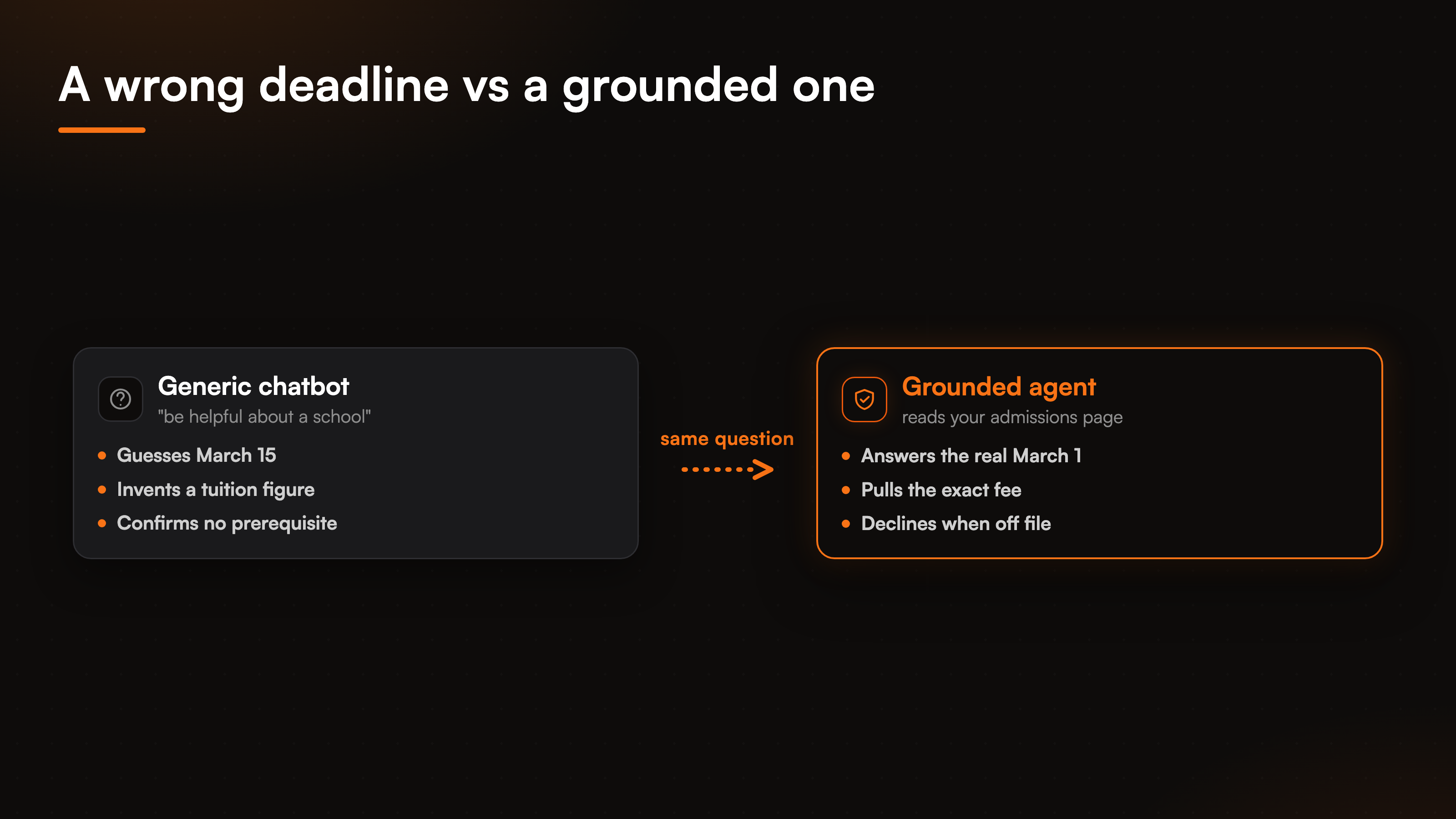
An AI support agent for education declines instead. When a question falls outside your material, it says plainly that it does not have that detail and offers to get the student to a person who does, rather than guessing. We hold a firm line here: an assistant that invents an answer about eligibility or fees is worse than no assistant, because a wrong "yes" about a refund or a prerequisite is far harder to walk back than an honest "let me connect you to admissions." Declining is not the agent failing. It is the agent doing the one thing a school most needs it to do.
When the agent hands off, it does not pretend to be a live person. Escalation opens a tracked ticket in Zendesk or Freshdesk and routes the full conversation to your admissions or student-support inbox. There is no real-time transfer to a human agent, that is a deliberate limit, but nothing gets dropped, and whoever picks it up sees the whole thread instead of starting from a cold "how can I help." The student gets a real answer from a real person, on a case the agent was right to escalate.
The actions worth automating for a school
Most of what an education chatbot should do is answer well and decline honestly. A few things are worth turning into real actions, and BestChatBot runs those through secure connections rather than link drops. The clearest one is booking. A prospect who wants to talk to an advisor, tour the campus, or join an open day should be able to book that from the chat. The agent checks your connected calendar for the slots that are genuinely open, offers the free times, and books the one the student picks. BestChatBot connects to one calendar, Cal.com or Calendly, and running that booking live is a Pro or Business feature. The check-book-cancel loop is broken down in the appointment booking piece.
The other action that earns its place is capturing a prospect who is interested but not ready to apply. When someone asks for the brochure or a callback about a specific program, the agent asks for a name and email at that natural moment and writes the contact to your CRM as a real record, tagged with the course they were looking at. Your admissions team gets a warm lead with context instead of an anonymous page view. One honest boundary sits across all of this: action execution is a paid tier, and customer-specific actions need a verified identity, which is the next section. On the free and starter plans the agent still answers and declines, it just does not run the connectors.
Identity, so "cancel my enrollment" cannot run for a stranger
Answering a public question about the September intake is safe for anyone to ask. Acting on a specific student's record is not. If the agent can look up what a returning student enrolled in, or cancel an advising slot they booked, it has to be certain it is talking to that student before it touches anything.
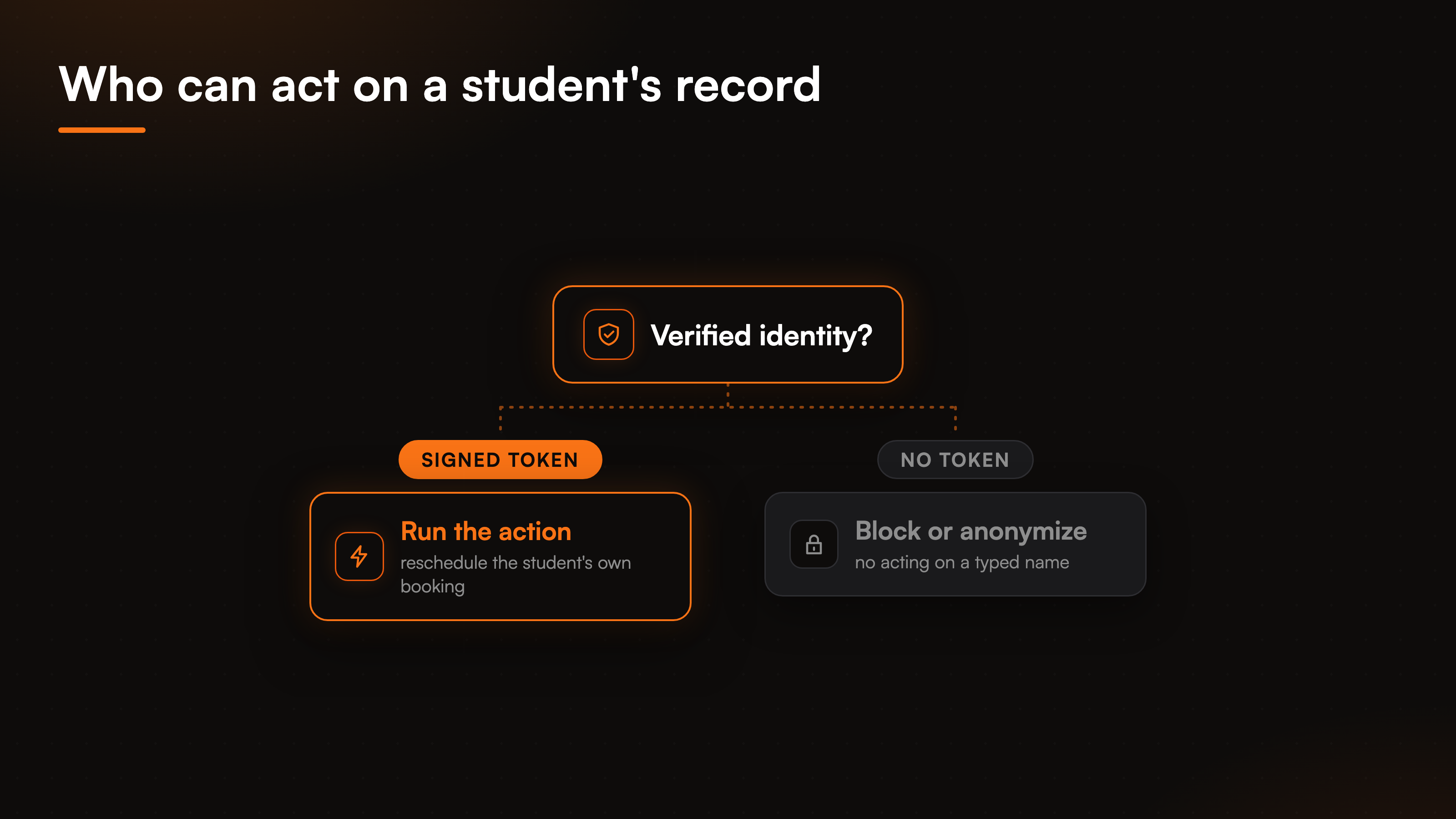
Identity gating is how that boundary holds. When your site passes a signed token (a JWT) for a logged-in student, the agent pins the name and email from that verified token, not from whatever the visitor types into the chat. So "reschedule my advising session" runs against the verified student's own booking, never a stranger who happened to type a common name. No verified identity means the customer-specific action is blocked or handled down an anonymous path, with no silent fallback to trusting chat input. The agent never holds your students' credentials either. A specialized provider stores the connection secrets encrypted and refreshes tokens over OAuth or an API key. For a school holding people's contact details and enrollment records, that boundary is not a nice-to-have. The full token flow lives on the identity verification page.
Keeping the answers current when your material changes
Education content moves on a calendar. Deadlines shift year to year, fees update each cycle, a course opens or closes, an intake fills. An agent grounded on last year's prospectus is exactly as dangerous as one that guesses, because it will answer an old deadline with total confidence. Keeping the material current is not optional in this vertical, it is the maintenance that keeps the whole thing honest.
The agent does not update itself, and we are direct about that. There is no autolearning here. When your deadlines or fees change, you refresh the knowledge: re-upload the new prospectus, re-crawl the updated course pages with change detection so only what actually changed gets re-indexed, or edit the answer by hand in the dashboard. A human stays in the loop, reviewing what the agent says in the Response Monitor and updating the source when something is off. For a school that is the right model. You would not want an assistant quietly rewriting its own answer about your tuition, and this one never does.
Where the AI support agent fits in an education business
Put the pieces together and the shape is clear. Routine admissions and enrollment questions get grounded answers from your real material, after hours and during application season, with a source the student can check. Anything outside that material gets an honest decline and a routed ticket, never an invented fact. A ready prospect books an advising session on the spot or becomes a tagged CRM contact. And any action on a specific student's record waits for a verified identity or does not run at all.
None of that replaces your admissions and student-support teams. It answers the routine questions they answer fifty times a week, hands them warm prospects and booked sessions, and refuses to make up the facts that would cause a complaint. The knowledge is the content you already publish, and you keep it current the same way you keep your website current. Education is one of a handful of verticals where a website assistant earns its place fast, and you can see the others on the industries hub or compare it with a team like a professional services firm that runs the same grounded play. When you want to see which actions sit on which plan, the pricing guide lays out Free, Starter, Pro, and Business side by side.
FAQ
Can an AI support agent for education answer admissions questions accurately?
Yes, because it answers only from your real material. The agent pulls deadlines, tuition, and entry requirements from your actual admissions pages, fees table, and policies rather than composing a plausible-sounding answer. It can also cite the source it used, so an applicant can see the deadline came from your published page and not from a guess.
What does the chatbot do when a question is not in our content?
It declines instead of inventing an answer. When a question falls outside the material you gave it, a scholarship edge case, a visa question, a personal deferral, it says it does not have that detail and offers to route the student to your team through a tracked ticket in Zendesk or Freshdesk. An honest "let me connect you" beats a confident wrong answer that a school would have to walk back.
Can it book an advising session or campus tour?
Yes, on the Pro and Business plans. The agent connects to one calendar, Cal.com or Calendly, checks the slots that are actually open, and books the time the student picks as a real action. The student gets a confirmed session on the spot and it lands on your calendar, instead of a form asking someone to follow up later.
How do we keep the answers current when deadlines or fees change?
You refresh the knowledge, and a person stays in the loop. There is no autolearning: when your material changes you re-upload the new document, re-crawl the updated pages with change detection, or edit the answer by hand in the dashboard. The agent then answers from the current version, which is what keeps a grounded assistant safe in a field where dates and fees move every cycle.
Is a student's enrollment record safe from other visitors?
Yes, because customer-specific actions need a verified identity. When your site passes a signed token for a logged-in student, the agent pins that person's name and email from the token and acts on their record alone. Without a verified identity, an action like "cancel my enrollment" is blocked or handled anonymously, never run on a name a stranger typed into the chat.