
Ecommerce AI Support Agent
An ecommerce AI support agent answers order, returns, and product questions and takes real actions in Shopify and WooCommerce. See how it resolves store support.
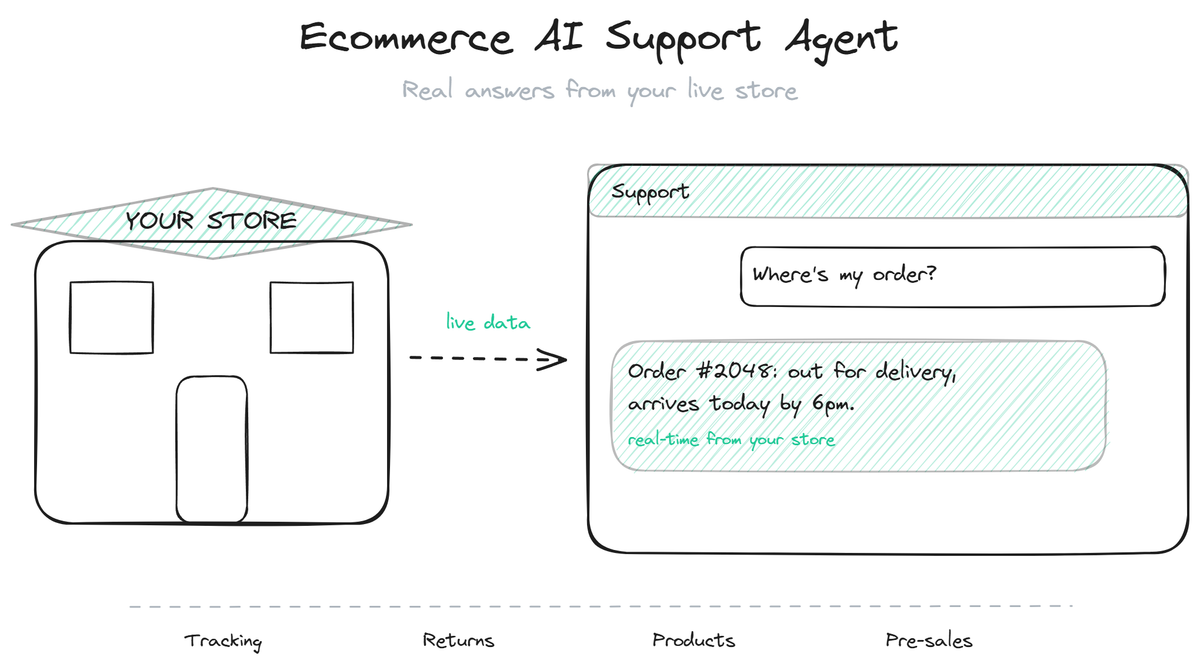
An ecommerce AI support agent is a support bot built for the questions online stores actually get: where is my order, can I return this, is this in stock, what size should I buy. The difference between an ecommerce agent and a generic chatbot is that the ecommerce one connects to your store and answers with real data, the actual order status, the actual stock level, rather than quoting a generic policy. This page covers what an ecommerce support agent does, the question categories it resolves, and how it fits into a store's support operation.
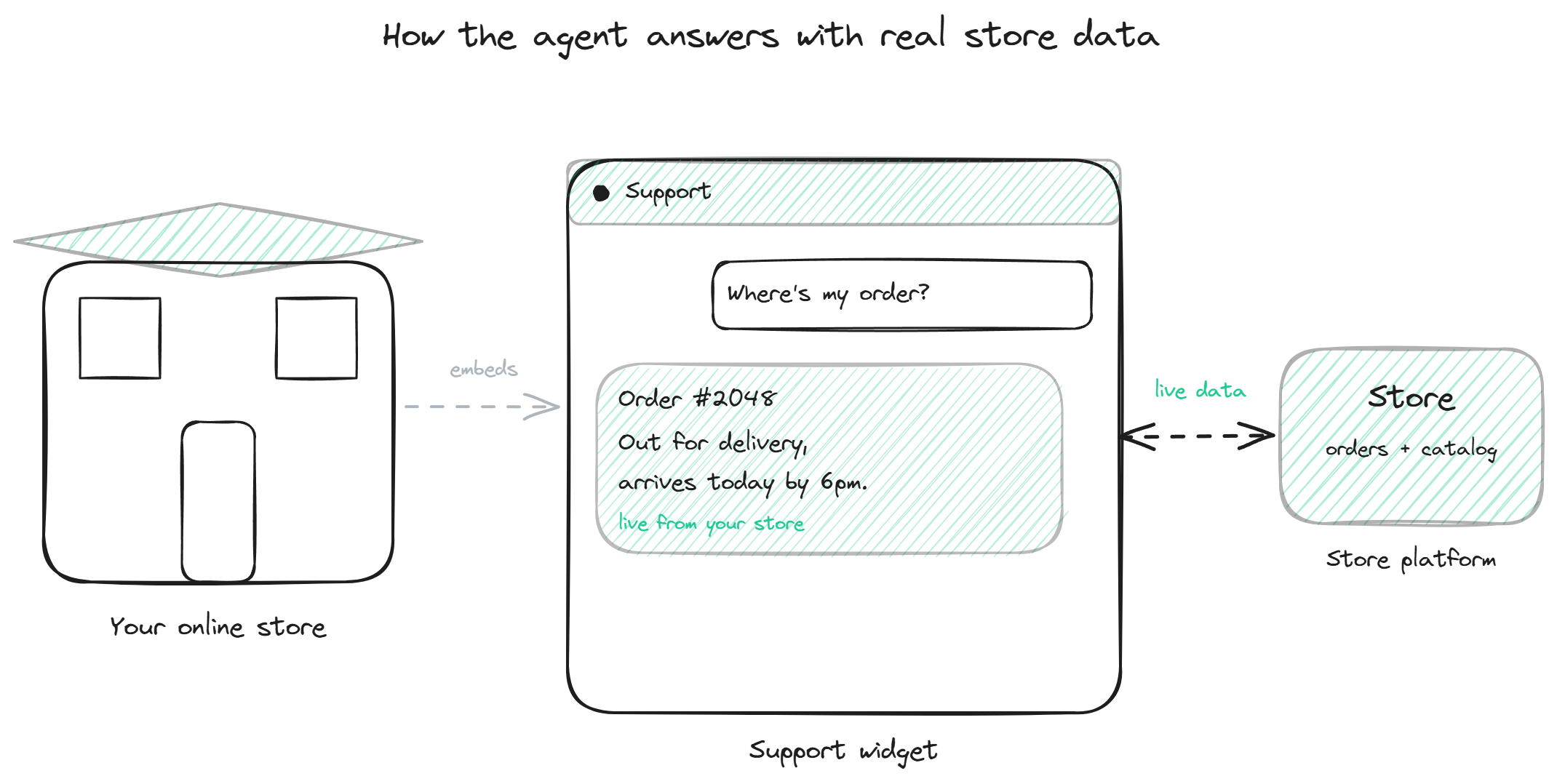
What an ecommerce AI support agent does
The agent sits as a widget on your store and handles the support load that would otherwise hit email or a human chat queue. It draws on two sources: your knowledge base (return policy, shipping info, FAQ, product guides) for general questions, and a live connection to your store platform (Shopify, WooCommerce) for order-specific and catalog-specific questions.
The combination is what makes it useful. A generic chatbot can tell a customer your return window is 30 days. An ecommerce support agent can tell that specific customer that their specific order is eligible for return until a specific date, and start the return. The first deflects; the second resolves.
For most stores the inbound support splits into a few high-volume categories, and the agent handles each differently depending on whether it needs general policy or live store data.
The question categories it resolves
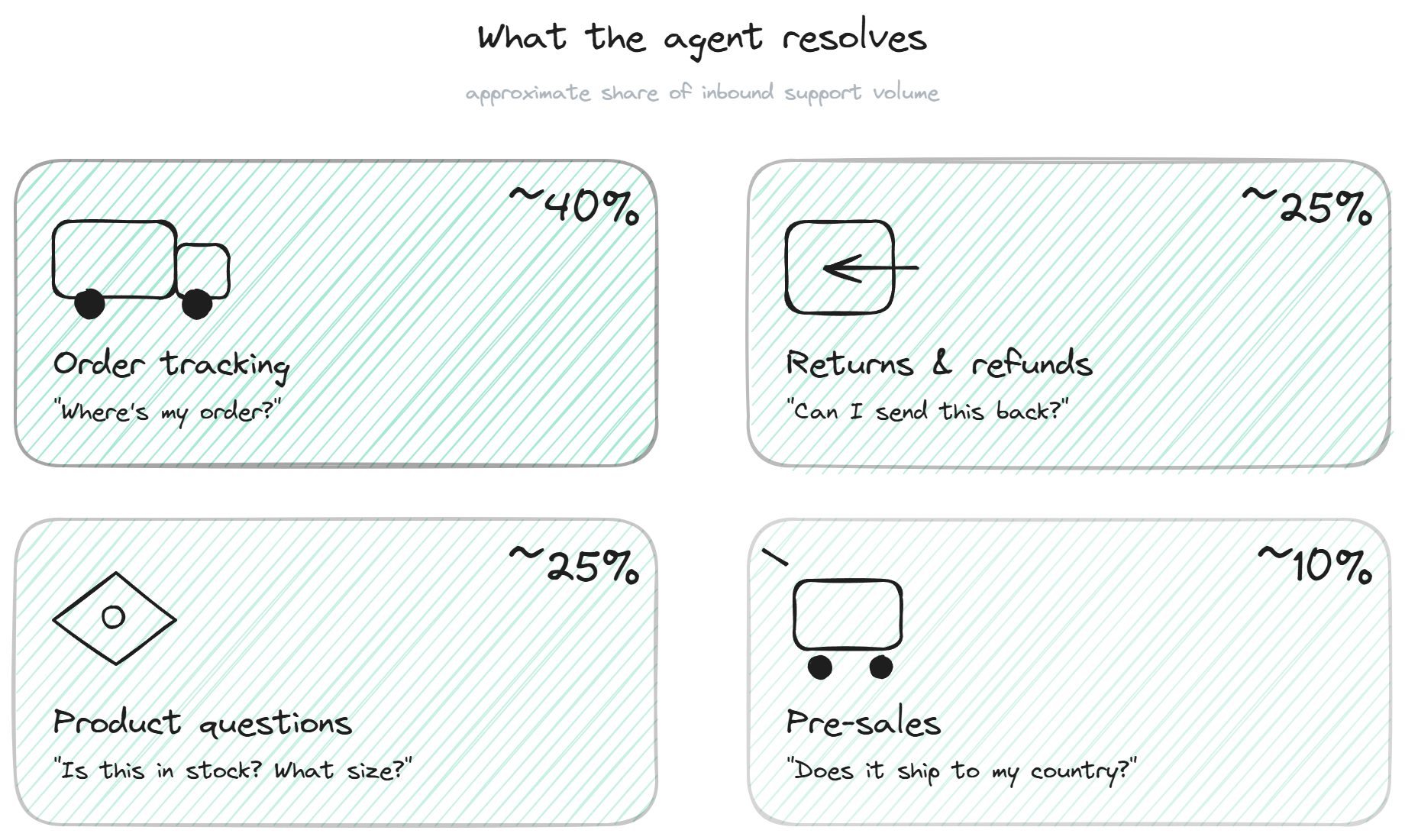
Order tracking is the highest-volume category in ecommerce support, the "where is my order" question. The agent looks up the order by number or by the authenticated customer's account, reads the fulfillment and tracking status, and answers with the real delivery state. The order tracking page covers this WISMO use case in depth.
Returns and refunds are the second-highest. The agent checks the order against your return window and policy, and either starts the return for eligible orders or routes the case to a human for the ones that need review. This keeps the routine returns off your team's plate while preserving human judgment for the edge cases.
Product questions cover both pre-purchase and post-purchase: availability, variants, sizing, compatibility, shipping estimates. The agent reads from your live catalog rather than a static doc, so the answers reflect current stock and pricing.
Pre-sales questions blend into product questions: does it ship to my country, what is the delivery time, is there a discount. These are conversion-adjacent, and a fast accurate answer at the moment of intent can turn a hesitant browser into a buyer.
How it fits into a store's support operation
The agent works as the first layer. It resolves the routine, high-volume questions outright and escalates the exceptions. For a store doing meaningful order volume, the order-tracking and product categories alone are usually most of the inbound, and automating them frees the team to handle the genuinely complex cases: damaged shipments, disputed charges, unusual requests.
The agent connects to a help desk (Zendesk, Freshdesk) for the escalations, creating a ticket with the full conversation transcript so the human picks up with context. It does not try to replace the help desk; it reduces how often the help desk is needed.
For stores on Shopify specifically, the Shopify AI support page covers the platform-specific setup and capabilities. BestChatBot connects to both Shopify and WooCommerce, grounds general answers in your knowledge base, and takes the order and return actions through the store connection, with honest refusal on anything it cannot confirm.
FAQ
- the agent work with my store platform? BestChatBot connects to Shopify and WooCommerce for live order, product, and return operations. For other platforms, the agent can still answer general questions from your knowledge base, and custom connections are possible through the API for platforms not natively supported.
- Can it actually process a return, or just explain the policy? With the returns action enabled and configured, it can start the return for eligible orders inside the chat, checking the order against your window and policy. Returns outside the window or above a value threshold you set route to a human instead.
- How does it know which customer it is talking to? Through identity verification: either order-number-plus-email matching for logged-out visitors, or a signed token for logged-in customers. It only shows order data after confirming the requester owns the order.
- Will it reduce my support tickets? For most stores, yes, because order tracking and product questions (the highest-volume categories) are exactly what the agent resolves well. The actual reduction depends on your question mix and how much of your inbound falls into those automatable categories.
- Is it accurate, or does it make things up? A well-configured ecommerce agent grounds general answers in your knowledge base and reads order data live from the store, and refuses honestly when it cannot confirm something. It does not invent order statuses or stock levels because those come from the live store connection. For pricing details, see plans.
For pricing details, see plans.
Read about handling returns with AI for online stores.
Learn about answering product questions automatically.
See how to combine sales and support together.
Running on WooCommerce? See the dedicated WooCommerce AI support chatbot guide.
To catch shoppers who hesitate at checkout, see abandoned cart recovery with AI chat.
Support does not end when an order ships. To handle returns, exchanges and where-is-my-order questions after checkout, see post-purchase support automation.
The questions a store gets also shift with the kind of business behind it. Compare how support changes by vertical.