
AI Returns Support for Online Stores
AI returns support handles the routine return questions and starts eligible returns, while routing the cases that need human review. How to automate returns safely.
AI returns support is the layer that handles the routine part of returns (the policy questions, the eligibility checks, the simple initiations) while leaving the judgment calls to humans. Returns are the second-highest support category for most stores after order tracking, and they are trickier to automate because they sit closer to money and emotion. A customer asking about a return is often already a little frustrated, and a wrong answer about a refund has a direct cost. The right approach uses AI as a first layer that resolves the clear cases and routes the rest, rather than trying to fully automate a process that sometimes needs a human. This page covers what to automate, what to escalate, and how to draw the line.
Why returns are harder to automate than order tracking
Order tracking is a pure lookup: read the status, report it, done. Returns are a decision. Is this order within the return window? Is this product category returnable? Has the customer already returned the maximum allowed? Is this a case where the policy says no but goodwill says yes? Those are not all lookups; some are judgment calls.
This is why returns automation has to be designed more carefully than order tracking. Fully automating returns, letting the bot approve or deny every case, produces two failure modes. The bot approves something it should have flagged (costing the store money), or the bot denies something a human would have approved as goodwill (costing the store a customer). Both are worse than a slower but correct human decision.
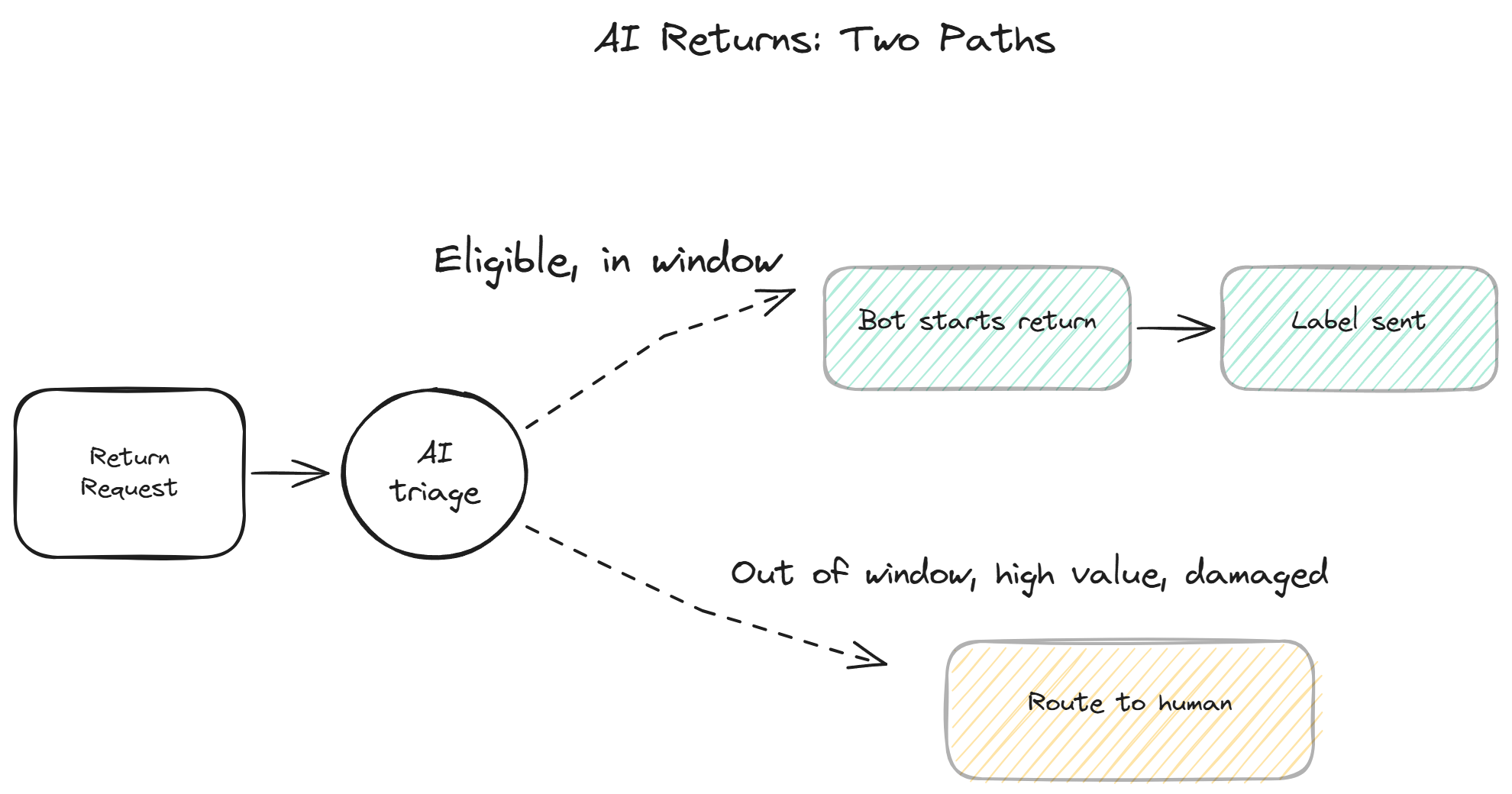
The right design treats AI returns support as a triage layer. The clear cases (in window, returnable category, standard value) get handled by the bot. The ambiguous cases (out of window, high value, damaged goods, repeat returner) get routed to a human with the context already gathered. This captures most of the volume while protecting the cases where judgment matters.
What to automate and what to escalate
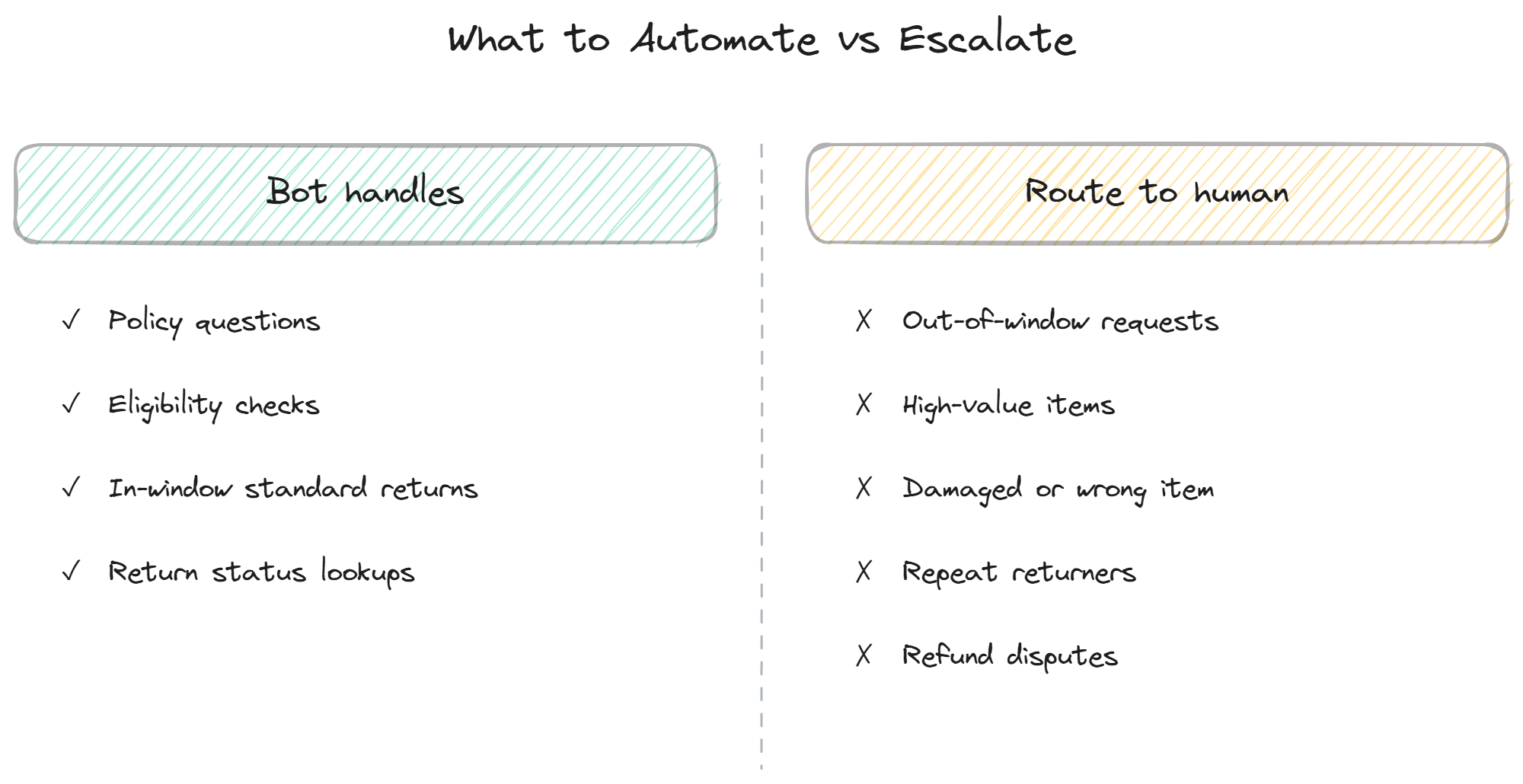
The bot should handle the questions and actions where the right answer is unambiguous. Return policy questions ("what is your return window?", "how do I return this?") are pure knowledge base answers. Eligibility checks ("can I return order #X?") combine the order data with the policy and produce a clear yes or no. Standard in-window returns of returnable items can be initiated by the bot directly, generating the return label or instructions. Return status lookups ("where is my refund?") are lookups like order tracking.
The bot should route to a human anything that sits near a judgment call. Out-of-window requests, where the policy says no but the store might make an exception. High-value items, where the cost of a mistake is large enough to warrant review. Damaged or wrong-item cases, which need someone to assess the situation. Repeat returners, where a pattern might indicate abuse. Refund disputes, which are emotional and need a human touch. In each case, the bot gathers the context (order details, reason, conversation) and creates a ticket so the human starts informed.
The line between the two columns is a configuration choice, and it should reflect your store's actual policy and risk tolerance. A store with a generous, no-questions return policy can automate more. A store selling high-value or fraud-prone items should automate less and route more.
How the returns flow works
When a customer asks about a return, the bot first answers any policy question from the knowledge base. If the customer wants to actually return something, the bot establishes identity (the same order-number-plus-email or token verification used for order tracking), looks up the order, and checks it against the return window and policy.
For an eligible standard return, the bot initiates it: generates the return authorization, sends the label or instructions, and confirms. For anything that hits an escalation trigger (out of window, high value, flagged category), the bot does not deny or approve, it routes sensitive issues to a human with the case pre-assembled.. The customer is told a team member will review and respond, and the agent picks up a ticket that already has the order, the reason, and the conversation attached.
This preserves the speed of automation for the routine cases and the judgment of a human for the ones that need it. For the order-status side that often precedes a return (a customer checking where a package is before deciding to return it), the order tracking flow connects directly. For pre-purchase questions that reduce returns in the first place (accurate sizing, clear product info), the product questions page covers how good answers upstream cut return rates downstream.
BestChatBot handles the policy and eligibility layer, starts eligible returns through the Shopify or WooCommerce connection, and routes the judgment cases to your connected help desk with full context.
FAQ
- Can the bot actually process a refund? It can start the return and, where configured, initiate the refund for clearly eligible cases. Refunds that involve a judgment call (out of window, disputed, high value) route to a human. Whether the bot processes refunds directly or only initiates returns is a configuration choice based on your risk tolerance.
- How does it prevent return abuse? By routing the patterns that suggest abuse (repeat returners, unusual frequency, high-value items) to a human rather than auto-approving them. The bot handles the clear standard cases and flags the ones that need a person to assess.
- What if the customer is angry about a return? The bot should recognize emotional or dispute-heavy cases and route them to a human quickly rather than trying to resolve them with policy answers. A frustrated customer needs a person, and the bot's job there is to hand off fast with context, not to argue policy.
- Does it work with my return policy? Yes. The return window, eligible categories, value thresholds, and escalation triggers are all configured to match your actual policy. The bot enforces what you set; it does not impose a generic policy.
- Will it reduce returns or just handle them faster? It handles them faster and more consistently. Reducing the return rate itself comes from upstream work like accurate product information and sizing, which good pre-purchase answers support. The returns bot makes the returns you do get cheaper to handle. For pricing details, see plans.
For pricing details, see plans.
See our ecommerce support guide.
On the pre-purchase side, the same widget powers cart recovery flows that answer doubts before checkout.
Returns are one part of what happens after the sale. For the complete picture, read about the full post-purchase support workflow.