
Abandoned Cart Recovery With AI Chat: Answer the Doubt in the Moment
Abandoned cart recovery with AI chat that answers the shipping, returns, and stock doubts stopping a checkout, and looks up real orders for verified shoppers.
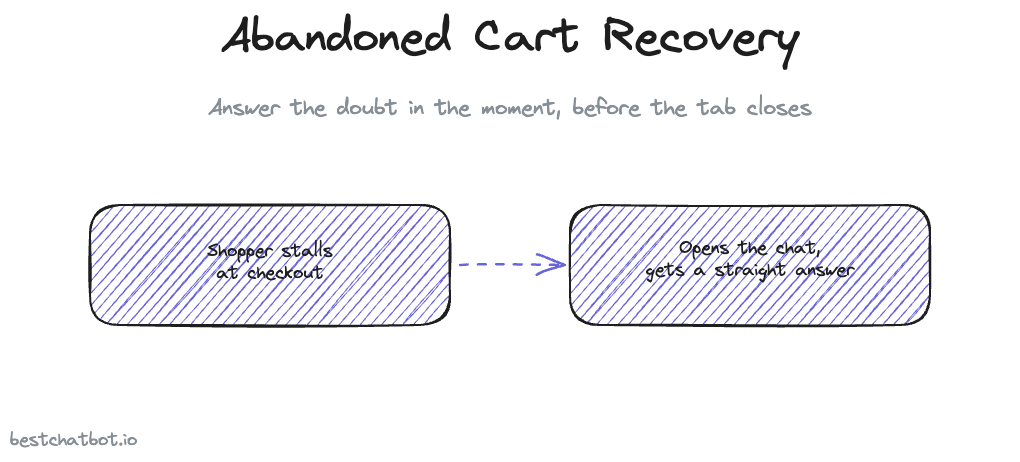
A shopper fills a cart, lands on the checkout page, and stops. The reasons rarely have anything to do with the product. Will this arrive before the weekend. What if it does not fit. Is shipping really that much. Can I send it back if it is wrong. Those doubts sit in the shopper's head with nobody around to answer them, so the tab closes and the cart goes cold. Abandoned cart recovery with AI chat works on that exact gap: a support widget on your storefront that the shopper opens, asks the question, and gets a straight answer before the doubt wins.
Let me be precise about what this is and is not, because the phrase "cart recovery" usually means email blasts. The widget does not chase anyone. It does not send a follow-up email, a text, or a push notification a day later. It is reactive. When a hesitating shopper opens the chat and types a question, the widget answers from your real store content, and for a verified shopper it can look up a real order. The recovery happens inside that session, while the shopper is still on the page, because the objection got resolved instead of festering.
One scope note before we go further. The product is a website widget and nothing else. No app to install, no second channel, no outbound campaigns. One surface on your storefront, built to catch the shopper at the moment of doubt.
Why carts go cold at the checkout
To reduce cart abandonment you have to treat it as a confidence problem, not a pricing problem. The product was good enough to add. Something between the cart and the confirmation page made the shopper pause, and a paused shopper with no answer becomes a closed tab.
Walk through the usual stoppers. Shipping cost and speed top the list, and the answer already lives on your shipping page. Return policy comes next, because nobody wants to gamble forty dollars on a guess about fit. Stock and restock dates matter for anything that sells out. Discount and promo confusion stalls people who saw a code somewhere and cannot get it to apply. Every one of those has a real answer sitting on your site, and the shopper at checkout has no patience to go dig for it.
That is the case for an assistant that answers in place. Instead of sending the shopper off to hunt through a footer link, the ecommerce AI support agent pulls the answer into the chat where the question got asked. The doubt gets closed in seconds, on the same page, with the checkout button still in view.
How the widget answers the doubt, grounded in your store
Here is the part that keeps an ecommerce chatbot from backfiring when it doubles as AI chat for checkout. The widget answers from your store's own content, not from a guess. We built it to read your shipping page, return policy, sizing charts, and product docs into a knowledge base, then answer the shopper from that material. When a question falls outside what you have written, the bot says so rather than inventing a shipping promise you never made.
That distinction matters more at checkout than anywhere else on the site. A made-up "ships in two days" or a wrong return window does not just lose the sale, it creates a chargeback or an angry ticket after the box arrives late. A grounded answer protects the recovery instead of poisoning it. The shopper hears the real shipping window, the real return rule, and decides with the truth in front of them. For the mechanics of why the widget declines instead of guessing, the write-up on a no-hallucination AI support agent lays it out.
Most checkout doubts are content questions, and content questions get the same answer for anyone who asks. "What is your return window" needs no proof of identity, so the widget replies the instant a shopper types it. The deeper questions about a specific product, like "does this run small" or "what is it made of", land the same way, answered from the product questions you already wrote.
When the doubt is about a real order
Some shoppers hesitate not on a new purchase but on a repeat one. They are about to buy again, and the thing nagging them is the last order. Did my refund go through. Where is the package from two weeks ago. Until that resolves, the new cart sits frozen.
This is where the widget crosses from answering to acting. It connects to your store, Shopify or WooCommerce, and reads the real order status when a shopper asks about theirs. If you run on WooCommerce, the WooCommerce store setup covers the specifics. There is a hard line here, and the line is identity. A general question gets answered for anyone. An account-specific lookup reads private data tied to one buyer, so the widget will not run it for an unverified stranger. Your store passes a signed token that proves who the visitor is, and the lookup gets pinned to that token's verified email, set from the token and not from whatever someone types into the chat. No token means the action is blocked or runs on a safe anonymous path, so nobody fishes for another shopper's order history by typing in a known email.
WooCommerce and Shopify are the two e-commerce connectors, and you pick one, because a store runs on one platform. The order-lookup side belongs to the action library, which sits on the paid tiers: grounded answering from your content runs on the lighter plans, while connected actions like order lookups need Pro or Business. The split is drawn out on the pricing guide. For the lookup flow itself, the order tracking chatbot for ecommerce page goes deeper.
When recovery needs a person, not a bot
Not every stalled cart resolves in chat. Sometimes the shopper hits a genuine problem: a broken discount code, a payment that will not go through, a return that needs a manual decision. The widget does not fake its way through those.
When a question needs a human, the widget opens a ticket in your help desk, Zendesk or Freshdesk, and routes it to your team's inbox. There is no live agent takeover inside the chat, by design. The handoff is a clean, tracked ticket, so the shopper's problem reaches a person and nothing slips through the cracks. A returns question that needs judgment follows the same path the AI returns support for online stores page describes.
So the recovery story is not "the bot saves every cart". It is narrower and more honest than that. The widget answers the answerable doubt on the spot, looks up the real order for a verified shopper, and hands the rest to your team as a ticket. That is how the widget helps recover abandoned carts: the one going to die over a thirty-second question gets a chance, and the one that needs a human gets one too.
FAQ
Does the widget send abandoned cart emails or follow-up messages?
No. The widget is a reactive website assistant, not an email or campaign tool. It does not send follow-up emails, texts, or push notifications. Recovery happens when a hesitating shopper opens the chat and asks a question, and the widget answers in the moment, inside that session, while they are still on your page.
How does AI chat actually recover an abandoned cart?
It removes the doubt that stalls the checkout. A shopper pausing over shipping speed, return policy, stock, or a discount opens the widget, asks, and gets a grounded answer from your real store content. The objection gets resolved on the same page with the checkout button still in view, so the shopper completes the purchase instead of closing the tab.
Where do the answers come from?
From your store's own content. The widget reads your shipping page, return policy, sizing charts, and product docs into a knowledge base and answers from that material. When a question falls outside what you have written, it declines rather than inventing a shipping window or return rule, which protects you from chargebacks later.
Can the widget look up a shopper's real order?
Yes, once the shopper is verified. It connects to Shopify or WooCommerce and reads the real order status, pinned to a signed token's verified email. Without a token the lookup is blocked or runs anonymously, so a stranger cannot read another buyer's orders. Order lookups belong to the action library on the Pro and Business tiers.
What happens when a stalled cart needs a human?
The widget opens a ticket in your help desk, Zendesk or Freshdesk, and routes it to your team's inbox. There is no live agent handoff inside the chat. The escalation is a tracked ticket, so a broken code or a tricky return reaches a real person without getting lost.
Want to see where cart-saving chat fits the bigger picture? Start with the full ecommerce support setup, then check which plan unlocks order lookups to see when the connected actions turn on.