
Ecommerce Chatbot for Sales and Support
An ecommerce sales chatbot answers buyer questions, recovers hesitation, and handles support in one widget. How it works across the buying and post-purchase journey.
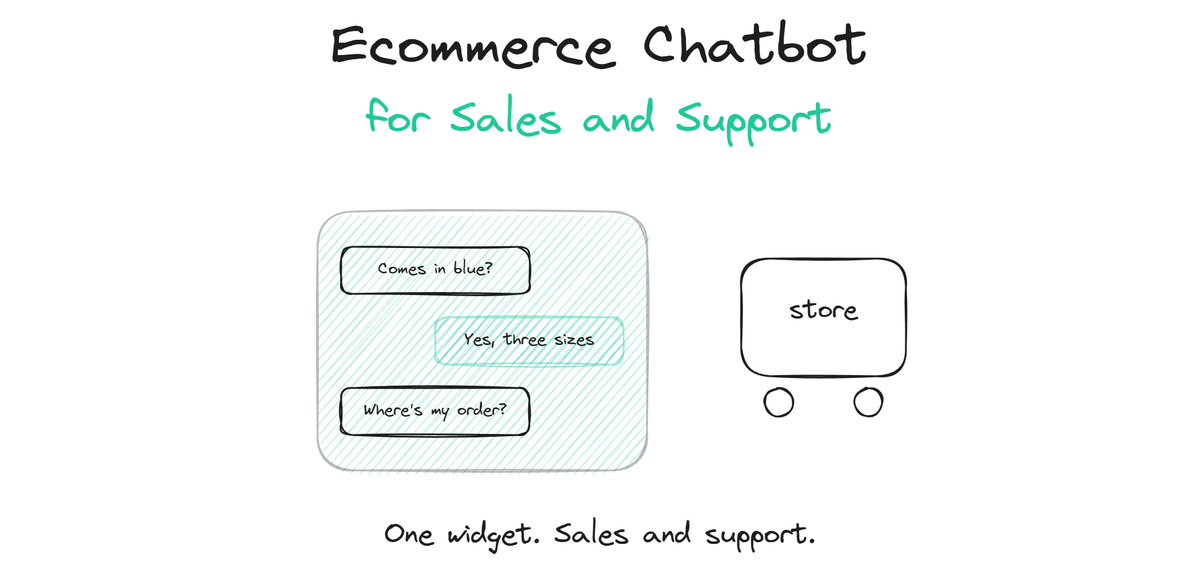
An ecommerce sales chatbot blurs the line between selling and supporting, because in a store the two are the same conversation. A customer asking "does this come in blue?" is both a support question and a sales moment. Answer it fast and accurately and you might close the sale; ignore it and they leave. The most useful ecommerce chatbots handle both jobs in one widget: pre-purchase questions that drive conversion and post-purchase questions that drive satisfaction. This page covers how a sales-and-support chatbot works across the buying journey, where it adds revenue versus where it saves cost, and how to keep it from overstepping into pushy territory.
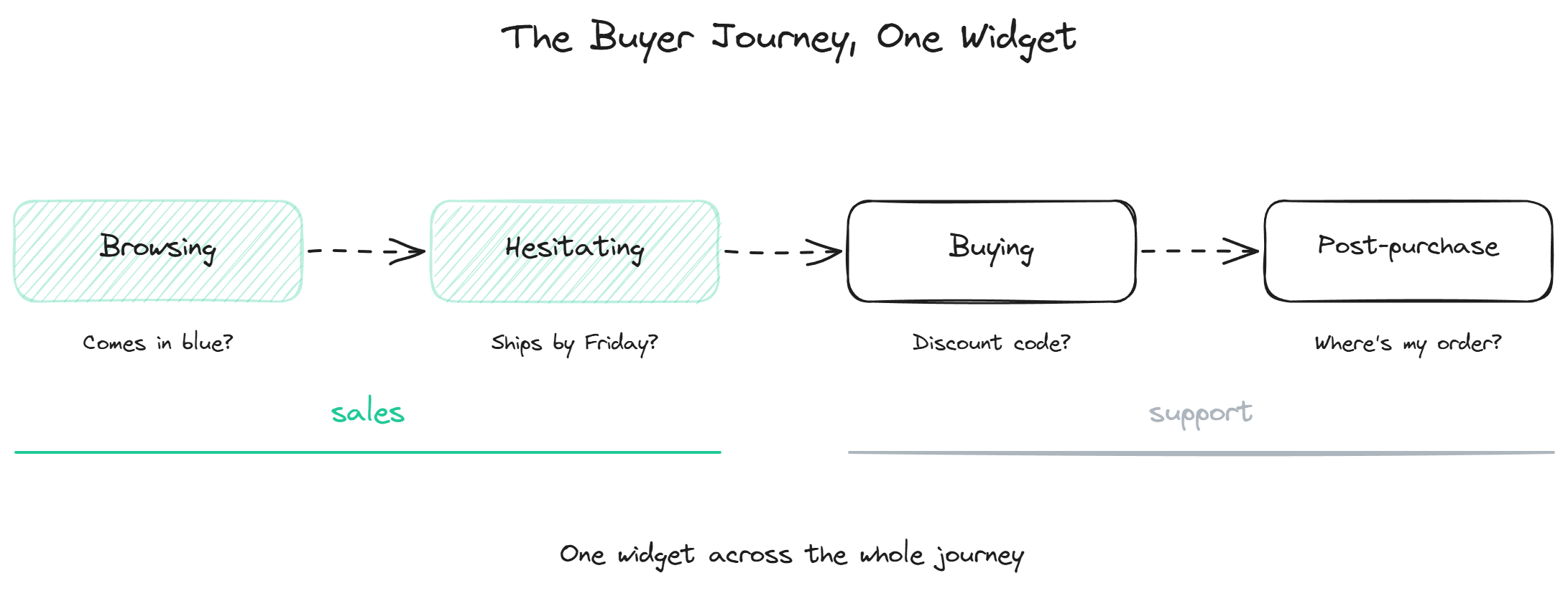
Why sales and support are the same conversation in a store
In a SaaS context, sales and support are usually different teams talking to different people at different times. In ecommerce, they collapse into a single chat window. The same customer, on the same product page, asks a question that is simultaneously a buying signal and a support need. "Will this ship before Friday?" is a logistics question and a purchase-intent signal at once.
This is why splitting an ecommerce chatbot rigidly into "sales bot" and "support bot" misses the point. The customer does not know or care which category their question falls into; they just want an answer so they can decide. A single widget that handles both, drawing on the catalog for product and shipping data and the knowledge base for policy and how-to content, matches how customers actually shop.
The practical upside is that the same automation that deflects support tickets also recovers sales. A question answered in 10 seconds on a product page is a question that does not become an abandoned cart, and the bot that answers it is doing conversion work even though it looks like support.
Where it adds revenue versus saves cost
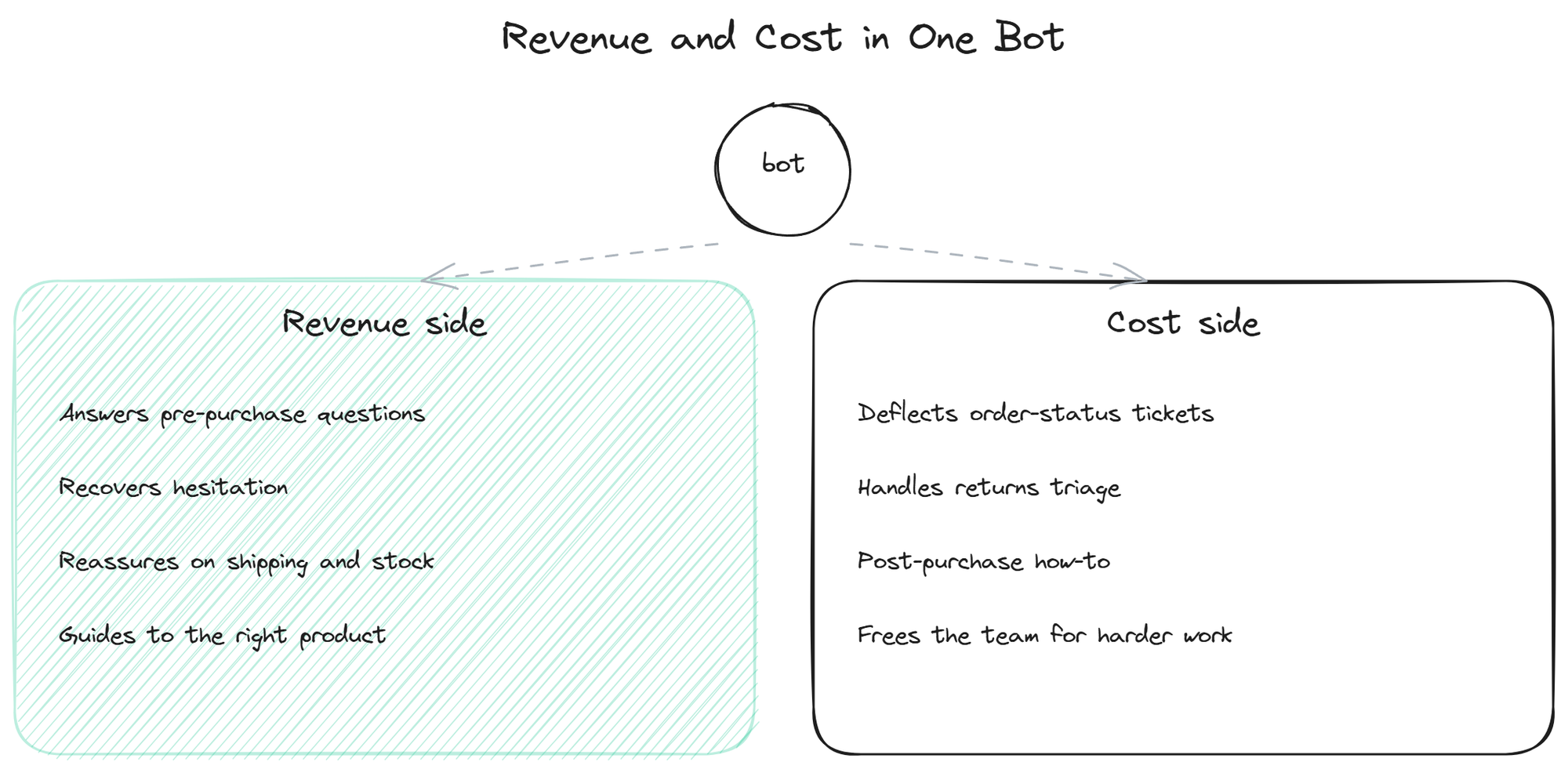
On the revenue side, the chatbot earns its place by removing friction at the point of decision. It answers the pre-purchase questions that hesitation hangs on: availability, sizing, shipping time, compatibility, what is included. It reassures the customer who is one question away from buying. For stores where pre-purchase questions are a meaningful share of inbound, this conversion lift can outweigh the support savings.
On the cost side, it deflects the high-volume routine support: order tracking, return policy, post-purchase how-to. This is the same work covered across the ecommerce silo, the order tracking flow and the returns triage, consolidated into the one widget. The broader sales-support discipline that spans beyond ecommerce lives in its own silo; the AI for sales teams pillar covers lead qualification, demo booking, and the B2B side of sales automation.
The key design decision is to let one widget do both jobs without making it feel like two bots stapled together. The customer experiences a single helpful assistant; the store gets both the conversion and the deflection.
Keeping it helpful, not pushy
The risk with a sales-and-support chatbot is tipping into pushy territory: aggressive upsells, popups that interrupt, a bot that tries to sell when the customer just wants help. This backfires. The most effective ecommerce chatbots lead with helpfulness and let the sale follow from a good answer, rather than forcing it.
The configuration that works: answer the question first, accurately and fast. Offer a relevant next step only when it genuinely helps (the in-stock variant, the related item that completes the purchase, the shipping upgrade that meets their deadline). Never auto-open aggressively on every page; trigger on intent (lingering on a product page, exit intent on the cart) rather than on a timer. A bot that helps first and sells second converts better than one that sells first, because trust drives the purchase.
BestChatBot handles both sides in one widget: it answers pre-purchase and post-purchase questions from your catalog and knowledge base, takes the order and return actions through the store connection, and refuses honestly rather than inventing a product claim to make a sale.
FAQ
- Is this different from the order tracking or product questions bots? It is the same underlying widget framed around the combined sales-and-support job. Order tracking and product questions are specific capabilities; this page is about using them together across the full buying journey rather than as separate tools.
- Will the chatbot push products on customers? Only if you configure it to, and aggressive selling usually backfires. The effective setup leads with helpful answers and offers relevant next steps only when they genuinely fit. Helpfulness drives conversion better than pressure.
- Can it recover abandoned carts? It can answer the questions that cause abandonment (shipping time, availability, sizing doubt) at the moment of hesitation, which prevents some abandonment. Triggering on exit intent at the cart with a relevant offer to help is one pattern; whether to use it depends on your store and how intrusive you want to be.
- Does handling both jobs confuse the bot? No. The bot answers based on the question, not on a rigid sales-or-support mode. A product question gets a product answer whether it comes before or after purchase. The customer experiences one assistant, not two.
- How do I measure whether it is working? Track both sides: conversion lift on sessions that used the chat (revenue side) and ticket deflection on the routine support categories (cost side). A sales-and-support bot should show movement on both. For pricing details, see plans.
For pricing details, see plans.
Discover ecommerce AI support.