
AI Support for Startups
AI support for startups lets a lean team handle growing volume without hiring. How fast setup, ticket deflection, and 24/7 coverage work for early-stage SaaS.
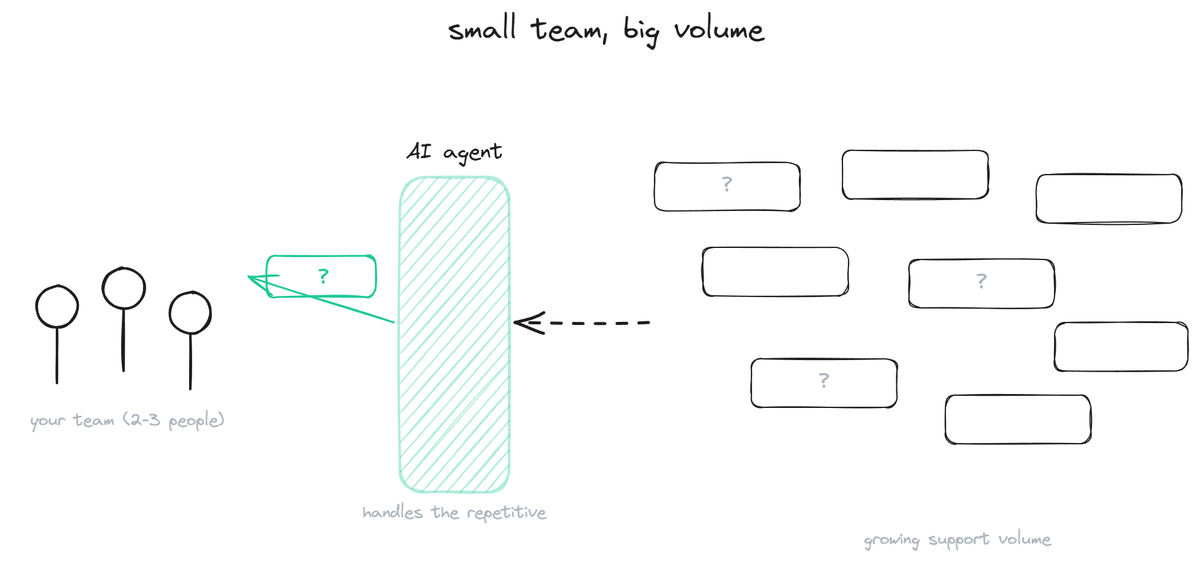
AI support for startups solves a specific bind: support volume grows with your user base, but a startup cannot hire a support team fast enough or afford to. The founder answers tickets at midnight. The one support hire drowns. Every new customer is good for revenue and bad for the inbox. AI support breaks this link between growth and support headcount by handling the repetitive volume automatically, so a lean team covers far more users than its size suggests. This page covers why startups hit the support wall, what AI changes, and how an early-stage team should approach it.
Why startups hit the support wall
The support wall is a predictable stage in a startup's growth. Early on, support is the founder answering a handful of questions personally, which is fine and even valuable for learning. As the user base grows, the volume climbs linearly while the team stays flat. The founder's personal support does not scale, the first support hire gets overwhelmed, and the quality drops just as the company can least afford unhappy customers.
The traditional answer is to hire, but hiring support has problems for a startup. It is expensive relative to a startup's budget. It is slow relative to how fast volume can spike. And it scales linearly: double the users, double the support headcount, which is exactly the cost structure a startup is trying to avoid. A startup that solves growth by hiring support proportionally has not solved the problem; it has just paid to defer it.
The deeper issue is that most of the volume is repetitive. The same setup questions, the same billing questions, the same how-to questions, asked by each new cohort of users. A human answering these is doing valuable-feeling work that is actually low-value and infinitely repeatable, which is the precise profile of work that should be automated. The reduce tickets page covers the deflection math in detail.
What AI changes for a lean team
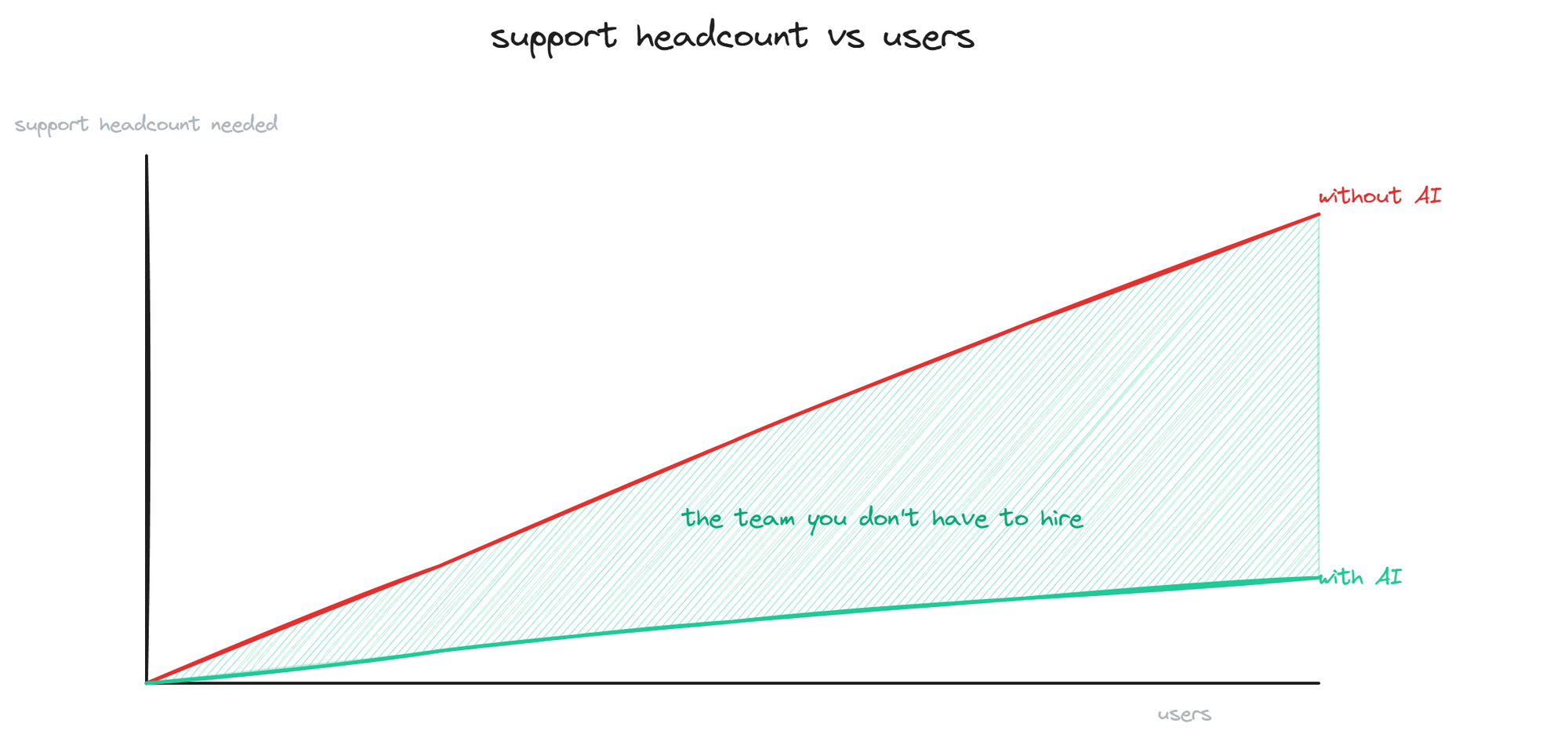
AI support breaks the link between user growth and support headcount. The bot handles the repetitive volume, which is most of it, so the human team only touches the cases that genuinely need a person. Double the users, and the bot absorbs most of the increase; the team grows slowly if at all.
Three things matter most for a startup specifically. Speed of setup: a startup cannot spend three months on an implementation, and a grounded widget that installs in days fits the pace. Cost structure: flat pricing that does not scale linearly with users matches what a startup can afford and budget. And 24/7 coverage: a startup team cannot staff around the clock, but the bot covers nights, weekends, and the timezones where the founders are asleep, which is when a surprising amount of support demand arrives.
The combination lets a 3-person startup deliver support that feels like a much larger team: instant answers, around the clock, consistent quality, in multiple languages if needed. The SaaS support chatbot angle covers how this plays out for the smallest teams specifically.
How an early-stage team should approach it
The approach that works for a startup is to start narrow and grow with the content. Point the bot at whatever documentation you have, even if it is thin, launch it on the highest-volume question category, and expand from there. A startup does not need a polished 200-article help center to start; it needs the bot answering the 15 questions that make up most of the inbound.
The autolearning side matters more for startups than for anyone else, because startups change fast and do not have time to manually maintain documentation. A bot that captures the questions it could not answer and feeds them back into the knowledge base does the documentation work the startup never has time for. The founders answer a new question once, and the bot handles it forever after.
The pricing approach should match the stage. A startup should start on a tier that fits current volume and grow into higher tiers as it scales, rather than overcommitting early. The startup pricing page covers the tiers; most startups start small.
BestChatBot fits the startup profile: fast widget setup, flat tiered pricing that does not scale linearly with users, 24/7 coverage, multilingual out of the box, and a supervised autolearning loop that builds the knowledge base from real questions so the team does not have to maintain it manually. For pricing details, see plans.
FAQ
- Is AI support worth it for a very small startup? Often yes, because the alternative (founders answering repetitive questions at all hours) has a real cost in time and focus that a small team cannot spare. Even a free or low tier that handles the top 15 questions frees meaningful founder time. The value scales with how much repetitive volume you have.
- How fast can a startup get it running? Days, not months. Point the bot at your existing docs (even thin ones), launch on the highest-volume question category, and expand. A startup does not need a complete help center to start.
- Won't the bot give bad answers if our docs are incomplete? A well-configured bot refuses honestly when it does not have the answer, rather than guessing. Incomplete docs mean the bot deflects more and answers less, which is safe. The autolearning loop then fills the gaps from the questions that come up.
- Does it scale as we grow? Yes, that is the point. The bot absorbs most of the volume increase as your user base grows, so support headcount does not have to scale linearly with users. You move to higher pricing tiers as volume grows, but far more slowly than you would add human headcount.
- What about complex questions a startup's product generates? The bot handles the repetitive factual layer and routes the genuinely complex cases to the team. For an early-stage product with edge cases, the human still handles the hard problems; the bot just stops those humans from drowning in the easy ones. For pricing details, see plans.
For pricing details, see plans.
Set up a SaaS onboarding chatbot for new users.
Follow our launch checklist before going live.
Browse our support playbooks for startups.
The playbook shifts with the kind of company you run. See the breakdown of support built for your industry.
If you are building software, the support stack is specific. See AI support for SaaS products.