
AI Support for Lean Teams
AI support for lean teams gives a small support team the coverage of a much larger one. How automation, 24/7 answers, and deflection work when every hour counts.
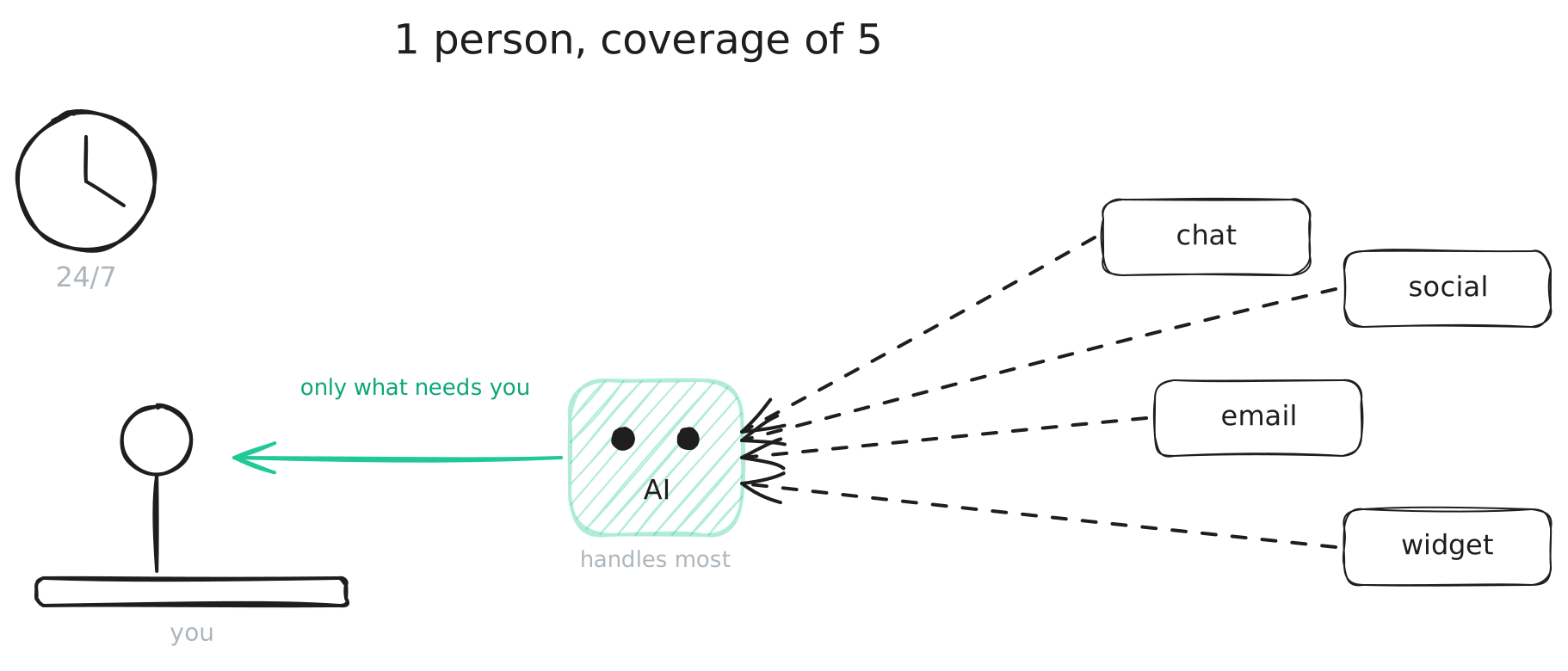
AI support for lean teams is about coverage, not replacement. A lean support team (one person, or a few people wearing multiple hats) cannot be everywhere: not across timezones, not at 2am, not on weekends, not in five languages. The work does not stop when the team logs off, so the choice is between leaving customers unanswered and somehow being always on. AI support gives a small team the coverage of a much larger one by handling the repetitive volume automatically, so the humans focus their limited hours on the cases that need them. This page covers what "lean" actually means for support, where AI extends a small team's reach, and how to set it up when nobody has spare time.
What "lean" means for a support team
A lean support team is defined by constraint, not size alone. One person doing support alongside other responsibilities. A two-person team covering a global user base. A founder still personally handling escalations. The defining feature is that there is not enough human time to cover the demand, and there is no budget or appetite to fix that by hiring proportionally.
Lean teams face a specific set of problems. Coverage gaps: the team is offline more than it is online, especially across timezones, so a large share of demand arrives when nobody is there. Context-switching cost: a lean team member juggling support with other work loses time every time they switch into the inbox, so interruptions are expensive. And burnout: a small team carrying a growing load without relief burns out, and replacing a burned-out support person is slow and expensive.
The instinct to solve this by hiring runs into the startup constraint: hiring is slow, expensive, and scales the cost linearly with the demand. A lean team that stays lean needs leverage, not headcount, and that is what AI support provides.
Where AI extends a small team's reach
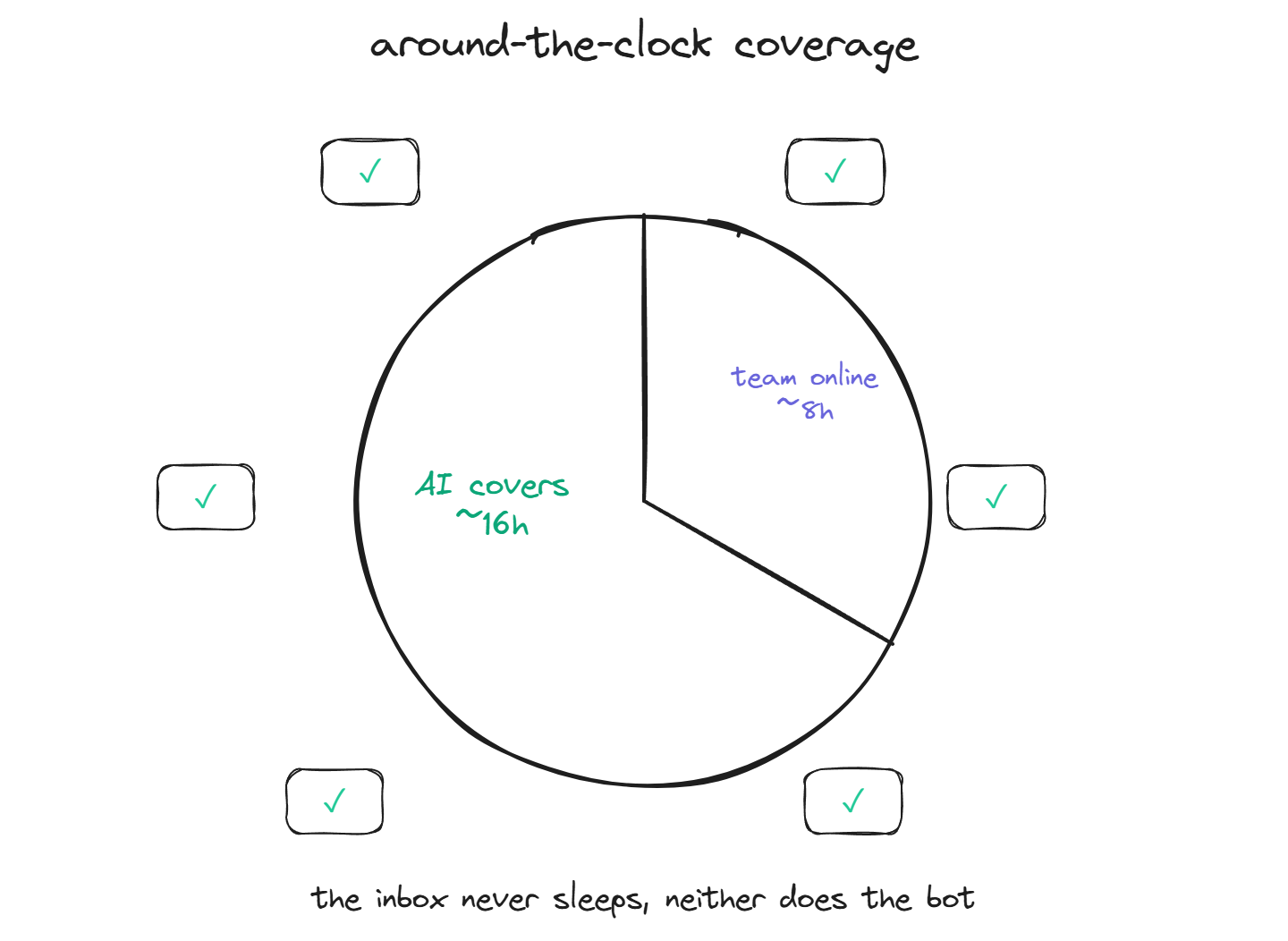
AI extends a lean team along the dimensions where the team cannot stretch. Time coverage: the bot answers around the clock, so the hours the team is offline are covered instead of accumulating into a backlog the team faces every morning. Language coverage: the bot answers in the languages the team does not speak, so a lean English-speaking team can support a global user base. Volume coverage: the bot absorbs the repetitive questions, so the team's limited hours go to the cases that actually need them.
The deflection side is where the math gets compelling. If the bot handles a large share of the repetitive questions, the human team's effective capacity multiplies. A single support person who used to spend most of their day on repetitive answers now spends it on the hard cases, which means one person covers what used to take several. The ticket deflection page covers how to calculate this for a specific team.
The context-switching benefit is underrated. A lean team member interrupted constantly by easy questions never gets into deep work. A bot that handles those interruptions protects the team's focus, which matters as much for the non-support work a lean team is also responsible for.
How to set it up with no spare time
The constraint that defines a lean team (no spare time) also shapes how they should set up AI support. The approach has to be low-effort to start and self-improving over time, because a lean team cannot run a months-long project or maintain documentation manually.
Start with whatever content exists. A lean team rarely has a polished help center, but it has something: a FAQ, some docs, a few canned email responses. Point the bot at that, launch on the highest-volume question, and let it start deflecting immediately. Perfect is the enemy of started.
Lean on autolearning to do the maintenance the team has no time for. When the bot cannot answer something and a team member handles it, the autolearning loop captures the answer and adds it to the knowledge base after validation. The team answers each new question once; the bot handles it from then on. This turns the team's unavoidable support work into permanent bot coverage without a separate documentation effort.
Watch the cost closely, because lean teams are cost-sensitive. The cost of AI support page covers how to think about pricing at a small scale, where the right tier is usually the smallest one that covers current volume.
BestChatBot fits the lean-team profile: fast setup on thin content, 24/7 and multilingual coverage out of the box, honest refusal so the bot does not create problems, and an autolearning loop that builds the knowledge base from the team's own answers so nobody has to maintain it manually. For pricing details, see plans.
FAQ
- How small a team can benefit from AI support? Even a team of one. The smaller the team, the more valuable the coverage, because a one-person team has the largest gaps (timezones, nights, weekends) and the least slack to absorb volume spikes. A solo founder doing support is often the clearest case for it.
- Will AI support feel impersonal to our customers? Not if it is configured well. A bot that answers accurately and fast, and hands off cleanly to a human when needed, often feels more responsive than a slow human-only team where customers wait hours for a reply. The personal touch is preserved where it matters (the cases that reach a human) and removed where it does not (the repetitive lookups).
- What if our documentation is thin? Start with what you have and let autolearning fill the gaps. A thin knowledge base means the bot deflects less initially, which is safe, and the autolearning loop builds coverage from the real questions that come up. A lean team should not wait for perfect docs to start.
- Does this let us avoid hiring support? It lets you avoid hiring support proportionally to user growth. You will still want humans for the complex cases and the relationship work, but the bot absorbs most of the volume increase, so the team grows far more slowly than the user base.
- How much time does it take to maintain? Minimal, if you use autolearning. The traditional answer is a weekly review of the gap log, maybe 30 minutes. With autolearning capturing answers automatically, even that shrinks. The setup is designed for teams with no spare time. For pricing details, see plans.
For pricing details, see plans.
Browse all startup support resources.