
How Startups Can Reduce Support Tickets
A practical look at how startups reduce support tickets with AI: the deflection math, which categories deflect best, and how to measure it without fooling yourself.
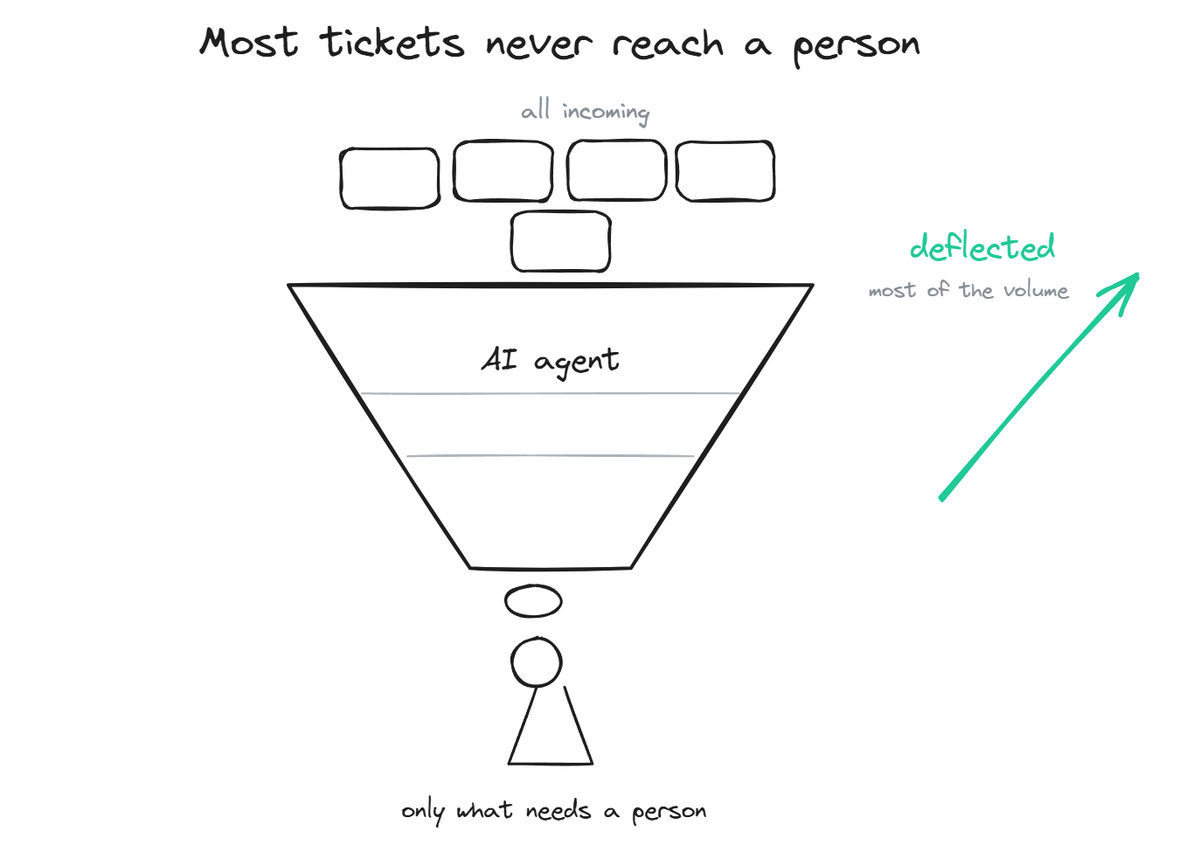
Reducing support tickets is the clearest, most measurable thing AI does for a startup, and the math is more favorable than most founders expect. The reason is that support volume is dominated by repetition: the same handful of questions, asked by each new user, over and over. A startup that answers these manually is paying (in founder time or support headcount) for work that is infinitely repeatable and therefore automatable. This page covers the deflection math, which ticket categories deflect best, and how to measure deflection honestly rather than fooling yourself with a vanity number.
The deflection math
Ticket deflection works because of a skewed distribution. In most support inboxes, a small number of question types make up a large share of the volume. The top 10 or 20 questions, the password resets and billing lookups and basic how-tos, account for most of the tickets, while the long tail of genuinely unique problems is a minority. Zendesk's 2025 CX Trends research reported that AI agents were resolving around 44% of support requests across the businesses studied, and for startups with a tight, repetitive question set the deflectable share is often higher.
The math that matters for a startup is simple. If the bot handles a meaningful share of incoming tickets, that share never reaches a human. A team drowning at 100% of volume becomes a team comfortably handling the fraction that genuinely needs them. The effect compounds as you grow: the deflected percentage holds roughly steady as volume climbs, so the human load grows far more slowly than the user base. This is the link between growth and headcount that the startup support pillar covers breaking.
The honest version of the math accounts for the questions the bot should not try to answer. A startup should not aim for 100% deflection; it should aim for high deflection on the deflectable categories and clean routing on the rest. Chasing total deflection pushes the bot to guess on questions it should escalate, which creates worse problems than the tickets it deflects.
Which categories deflect best
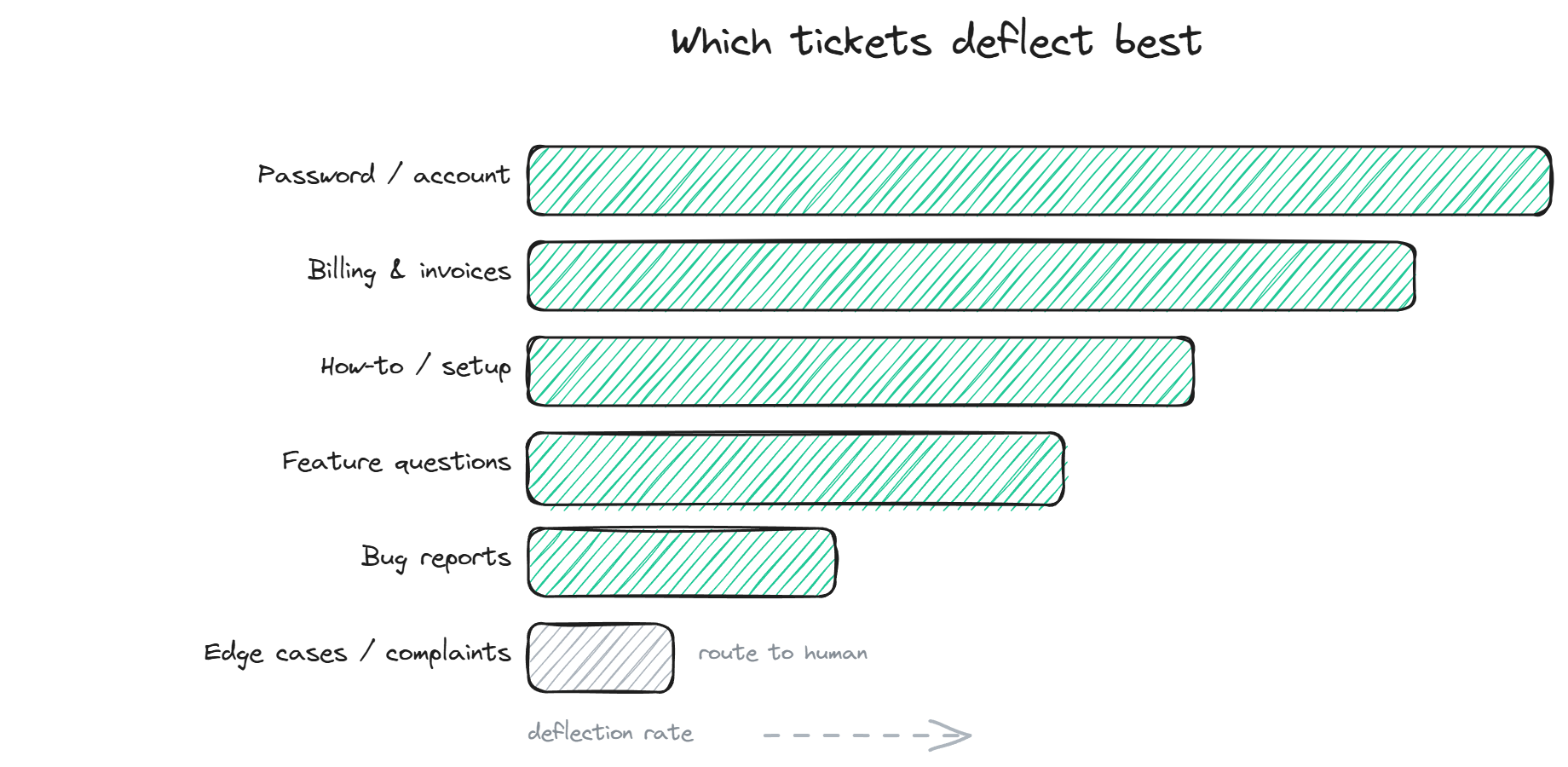
Not all ticket categories deflect equally, and a startup should target the high-deflection ones first.
Account and access questions (password resets, login issues, account settings) deflect almost completely. They have a single correct answer, they are pure lookups or instructions, and the bot handles them perfectly. This is usually the single highest-volume category and the easiest win.
Billing and invoice questions (what was I charged, how do I update payment, when does my plan renew) deflect well when the bot can read the relevant account data through a connection or answer from clear billing documentation. These are high-volume and high-frustration, so deflecting them helps twice.
How-to and setup questions deflect well when your documentation covers them. "How do I do X in your product" is exactly what a grounded bot answers from your docs. The autolearning loop matters most here, because the how-to questions the bot cannot yet answer become the documentation it learns next.
Feature questions ("does it do X") deflect at a medium rate, limited by how well your docs describe capabilities. The bot answers honestly (yes, no, not yet), which is correct even when the answer is no.
Bug reports and complaints deflect poorly and should not be forced. The bot can gather the details and route, but the resolution needs a human. Trying to deflect these is where bots damage trust.
How to measure deflection honestly
The temptation with deflection is to report the flattering number: percentage of conversations the bot handled without escalation. That number is easy to inflate, because a bot that confidently guesses on questions it should escalate shows a high "deflection rate" while quietly creating wrong answers and follow-up tickets.
The honest measurement tracks resolution, not just containment. A deflected ticket is only deflected if the customer got a correct answer and did not come back with the same question through another channel. The metrics worth watching: the share of conversations resolved without a human, the rate at which customers re-contact about the same issue (a high re-contact rate means false deflection), and the satisfaction signal on bot-handled conversations.
The other honest metric is what happens to the team. Real deflection shows up as the team handling fewer repetitive tickets and having more time for the hard cases, measurable in their ticket mix shifting toward complex work. If the team's repetitive load drops and re-contact stays low, the deflection is real. The lean teams page covers what to do with the freed capacity.
BestChatBot deflects the repetitive categories by answering from your knowledge base and connected data, refuses honestly on questions outside its scope rather than guessing, and feeds the questions it could not answer back into the knowledge base through a supervised autolearning loop, so deflection rises over time without manual documentation work. For pricing details, see plans.
FAQ
- What deflection rate should a startup expect? It varies by how repetitive your question set is and how good your docs are. A startup with a tight, repetitive set and decent documentation often sees a large majority of the deflectable categories handled automatically. Chasing a single headline number is less useful than tracking real resolution on the categories you target.
- Can the bot deflect tickets if our docs are thin? Partially, and the autolearning loop fills the gaps. Thin docs mean lower initial deflection (which is safe, because the bot refuses rather than guesses), and the loop builds coverage from the real questions that come up. Deflection rises as the knowledge base grows.
- Isn't high deflection bad for customer relationships? Only if it is false deflection (the bot guessing instead of escalating). Real deflection (correct answers to repetitive questions, instantly, around the clock) usually improves the relationship, because customers get faster answers and the humans have time for the cases that need care.
- How do I avoid fooling myself with deflection numbers? Track resolution and re-contact, not just containment. A conversation the bot "handled" that produces a follow-up ticket about the same issue was not deflected. Watch the re-contact rate and the team's shifting ticket mix to confirm the deflection is real.
- Does deflection scale as we grow? Yes, that is the main benefit. The deflected percentage holds roughly steady as volume grows, so the human load grows far more slowly than the user base. This breaks the link between user growth and support headcount. For pricing details, see plans.
For pricing details, see plans.