
Revenue Chatbot for Sales and Support
A revenue chatbot connects support and selling: it answers questions, recovers hesitation, and surfaces buying moments. How conversational AI moves revenue, not just cost.
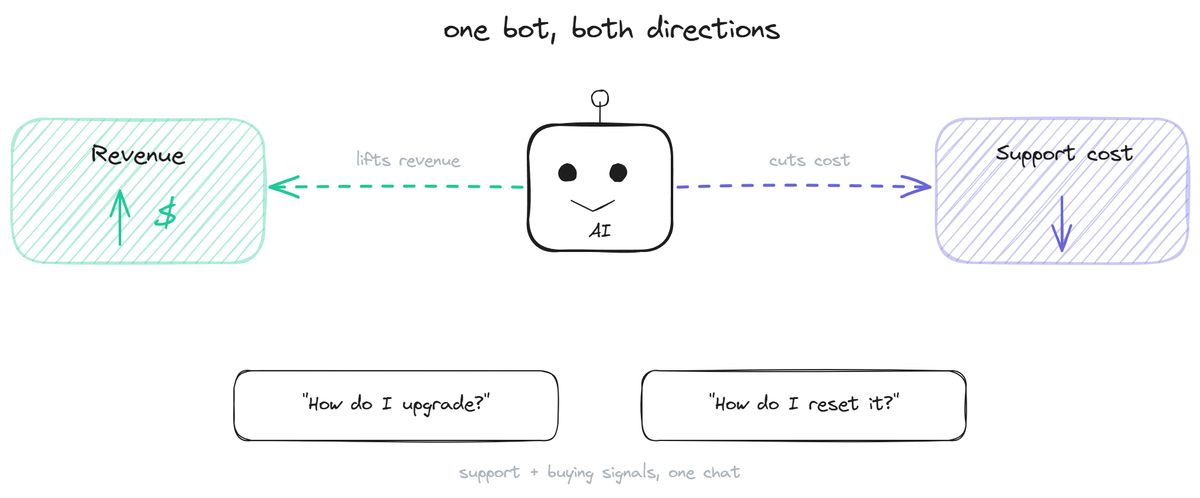
A revenue chatbot is a support bot evaluated by what it earns, not just what it saves. Most chatbot conversations are framed around cost: deflect tickets, reduce headcount, cut handle time. That framing misses half the value. Every support conversation is also a touchpoint with someone who might buy more, renew, upgrade, or refer, and a chatbot positioned to recognize those moments moves revenue, not just cost. This page covers what makes a chatbot a revenue driver rather than a cost center, the buying moments it can surface, and how to measure the revenue side honestly.
Why support conversations are revenue conversations
The wall between "support" and "sales" is an org-chart artifact, not something customers experience. A customer who contacts support is engaged, has a need, and is talking to you. That is the same profile as a sales prospect, just at a different point in the relationship. Treating every support conversation as purely a cost to be minimized leaves the revenue on the table.
Consider what happens in a routine support conversation. A customer on a starter plan asks about a feature that only exists in a higher tier. A customer asks how to do something the product does not do yet but a complementary product does. A customer mentions they are scaling up. Each of these is a buying signal wrapped in a support question, and a chatbot tuned only for deflection answers the literal question and misses the opportunity.
A revenue chatbot is configured to recognize these moments and respond to them, not by being pushy, but by surfacing the relevant option when it genuinely fits. The customer asking about a higher-tier feature learns that the feature exists and how to get it. The point is not to turn every support chat into a sales pitch; it is to stop throwing away the buying signals that walk in through the support door.
The buying moments a revenue chatbot surfaces
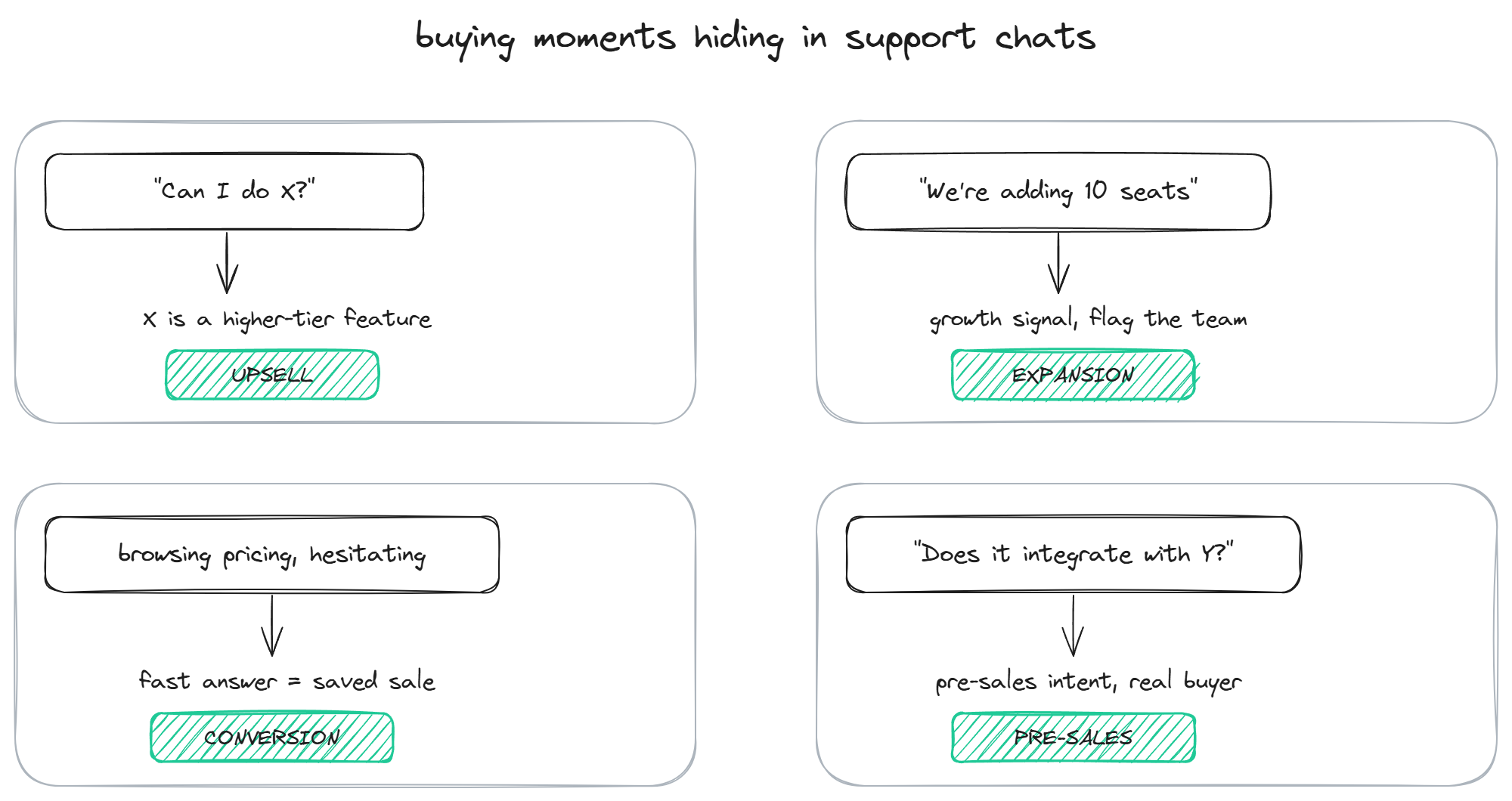
Several buying moments recur across products. Upsell moments, where a customer hits the boundary of their current plan and asks about something the next tier includes. The chatbot can surface the upgrade path naturally as the answer to their question.
Expansion moments, where a customer signals growth: more seats, more usage, a new use case. These are the highest-value signals because expansion revenue is cheaper to win than new revenue, and the chatbot can flag them for the account team.
Conversion moments, where a prospect is hesitating on a pricing or product page and a fast answer to their specific question is the difference between a sale and an abandoned session. This overlaps with the pre-sales work; the lead qualification flow covers turning that hesitation into a qualified lead.
Retention moments, where a customer is frustrated in a way that signals churn risk, and a fast, helpful resolution keeps them. The revenue here is the revenue you do not lose, which is harder to measure but just as real.
For the ecommerce-specific version of this sales-and-support overlap, the store sales chatbot page covers how the same dynamic plays out in a storefront.
How to measure the revenue side honestly
The revenue framing only works if you measure it, and measuring revenue from a chatbot is harder than measuring cost savings. Deflection is easy to count; influenced revenue requires attribution.
The honest metrics track movement on both sides. On the cost side, ticket deflection and handle time, the usual support metrics. On the revenue side, conversion rate on sessions that used the chat versus those that did not, upgrade and expansion events that touched a chat conversation, and recovered sessions where a hesitating visitor got an answer and then converted. None of these is perfectly clean attribution, but the directional signal is real and worth tracking.
The revenue impact tool gives a starting framework for modeling both sides together. The key discipline is not over-claiming: a chatbot rarely deserves full credit for a sale, but it deserves some, and ignoring the revenue side entirely undervalues the tool.
BestChatBot handles both directions in one widget: it answers and deflects support questions, recognizes the buying moments in those conversations, surfaces relevant options without being pushy, and refuses honestly rather than overpromising to make a sale. For pricing details, see plans.
FAQ
- Isn't a revenue chatbot just a pushy sales bot? No, if configured well. The effective version leads with helpful answers and surfaces relevant options only when they genuinely fit the customer's stated need. Pushy bots that pitch regardless of context convert worse, because they erode the trust that drives the purchase.
- How do I attribute revenue to a chatbot? Imperfectly, but usefully. Track conversion rate on chat-touched sessions versus untouched, upgrade and expansion events that involved a chat conversation, and recovered sessions. The attribution is directional rather than exact, but it captures the revenue side that pure deflection metrics miss.
- Does this work for SaaS or ecommerce? Both, with different buying moments. SaaS sees upsell, expansion, and conversion moments around plans and seats. Ecommerce sees conversion recovery and cross-sell around products. The underlying principle (support conversations are revenue touchpoints) holds across both.
- Will it annoy customers who just want support? Not if it answers the support question first and only surfaces an option when relevant. A customer asking how to reset a password should get a password reset answer, not an upsell. The revenue behavior should trigger on genuine buying signals, not on every conversation.
- Does it replace the sales team? No. It surfaces and qualifies buying moments and hands the real selling to humans. Expansion and upgrade conversations of any size still benefit from a person; the bot's job is to catch the signal and route it, not to close the deal. For pricing details, see plans.
For pricing details, see plans.
Browse the full sales support overview.