
Pre-Sales FAQ Chatbot
A pre-sales FAQ chatbot answers buyer questions about pricing, features, security, and contracts the moment they come up. How it accelerates evaluation without overpromising.
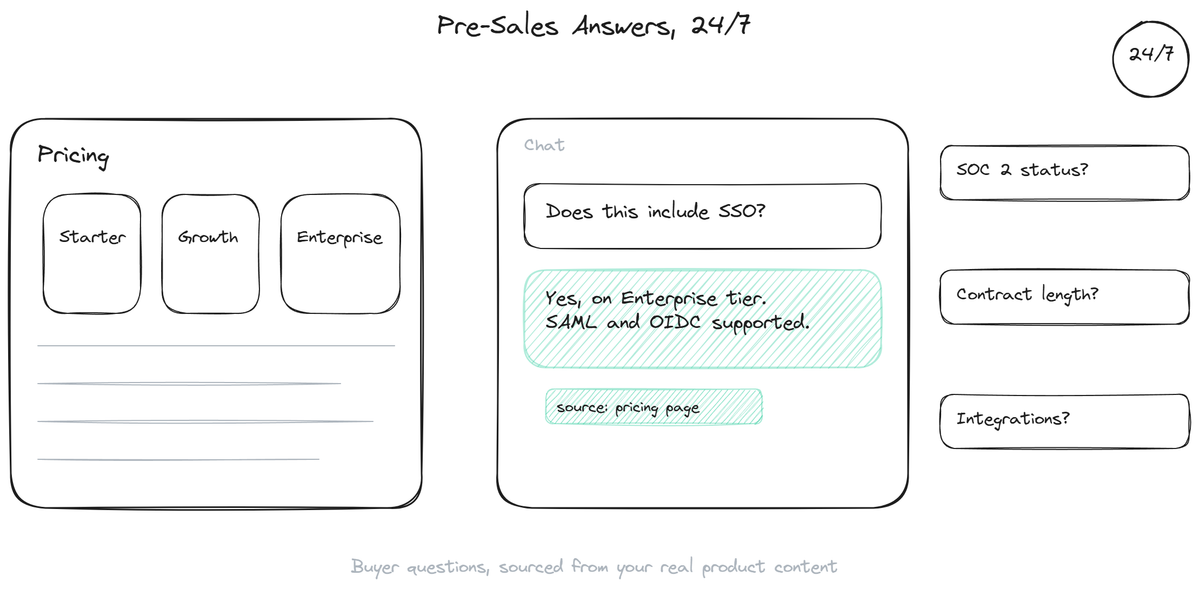
A pre-sales FAQ chatbot answers the questions a prospect needs answered before they will commit to talking to a rep or signing up for a trial. Pricing structure, contract length, security posture, integrations, deployment timeline, what is included in each tier. These are the questions that determine whether the prospect advances or drops, and they often surface late at night, on weekends, and in the moments when no human is around to answer them. A pre-sales chatbot grounded in your real product content answers these accurately at the moment they come up. This page covers what makes a pre-sales bot useful, which questions it handles well, and where the line sits between answering and overpromising.
What makes a pre-sales FAQ chatbot different
A pre-sales chatbot is structurally a knowledge base chatbot pointed at sales-relevant content. The architecture is the same as any grounded support bot: retrieval over your documentation, language model for generation, refusal when the answer is not in scope. What changes is the content it grounds on and the stakes of getting it right.
The content side covers pricing pages, feature lists, security and compliance documentation, integration directories, contract templates, and any one-pagers your sales team uses. These are the documents that answer real evaluation questions, and the chatbot should pull from the same source the reps would cite.
The stakes side is where pre-sales is different from routine support. A wrong answer in support creates a complaint. A wrong answer in pre-sales either loses the deal (if the prospect catches it) or wins the deal on false premises (if they do not), and the second outcome is worse because it surfaces as churn or escalation later. The bot has to be accurate, and when it cannot be accurate it has to refuse cleanly. The grounded support AI page covers the refusal-versus-guessing default that matters most here.
The questions it handles well
The pre-sales questions that map cleanly to AI answering share three properties: they have a factual answer, the answer is documented somewhere on your side, and the answer is the same for every prospect of a given segment.
Pricing structure questions. Which tier includes which features, what counts toward usage limits, what the per-seat or per-volume rates are, what triggers a tier upgrade. These have answers; the bot just needs to be able to read them accurately from your pricing content.
Feature and capability questions. Does the product do X, does it integrate with Y, does it support Z deployment model. The bot grounds on the feature list and answers honestly: yes if you have it, no or "not yet" if you do not. Overpromising a feature is the most expensive lie in pre-sales.
Security and compliance questions. SOC 2 status, data residency options, encryption practices, GDPR compliance, what the data processing agreement looks like. These are increasingly asked early in B2B evaluation, and a fast accurate answer from documentation that has been vetted by your security team prevents weeks of back-and-forth.
Contract and procurement questions. Minimum terms, payment options, how billing works, what happens at renewal. These are dry but they determine whether a prospect can actually buy through their procurement process. Clear answers move deals.
Implementation and timeline questions. How long does setup take, what does deployment look like, what resources does it need from the customer side. The honest answer here builds trust; vagueness costs you the deal.
Where it stops being useful
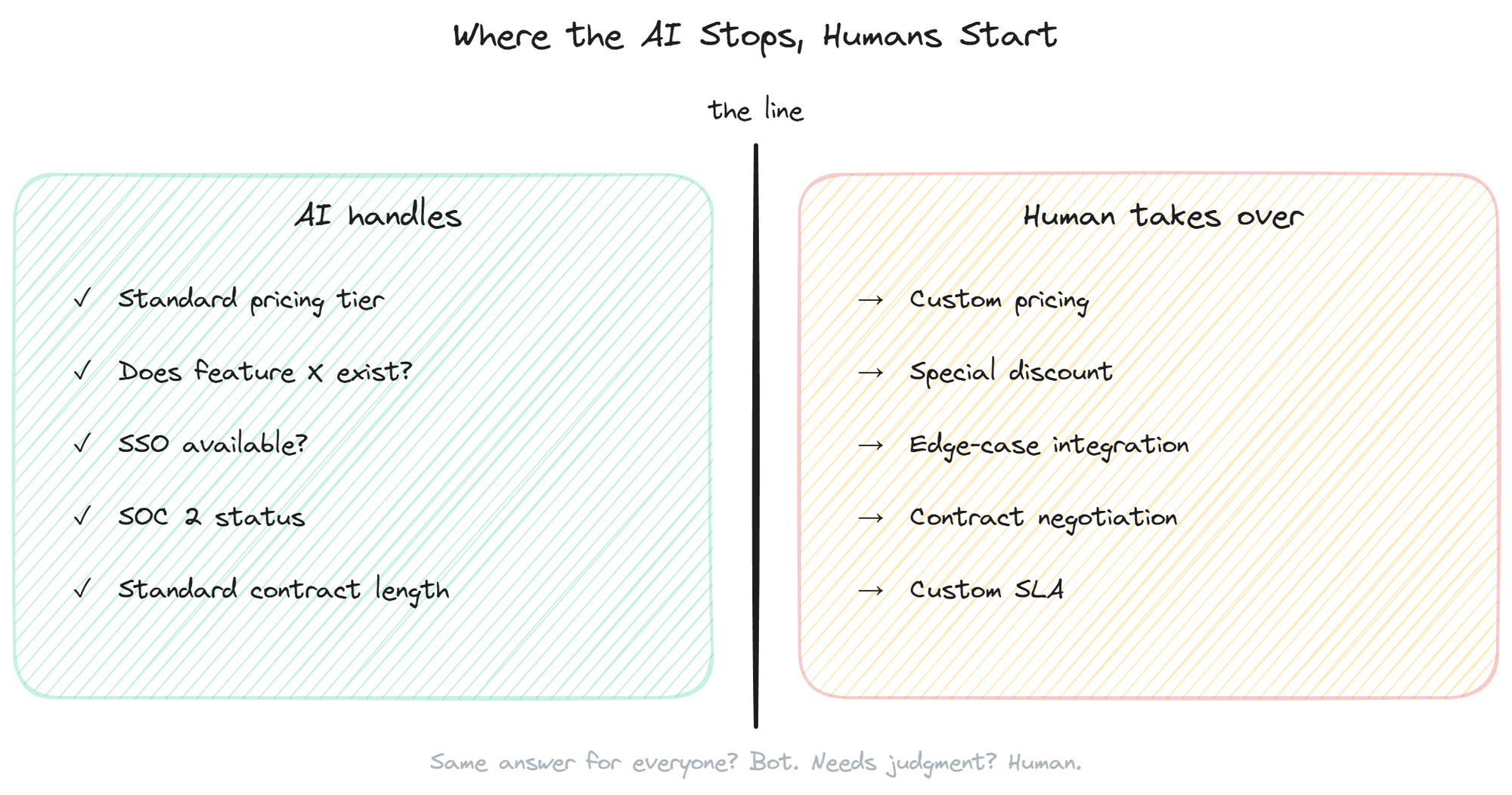
The bot's job ends where the answer stops being the same for every prospect. Standard pricing for a standard tier? Bot handles it. Custom pricing for a specific enterprise deal? That is a human conversation, and the bot should route, not negotiate.
The same applies across categories. Standard SOC 2 status? Bot answers from documentation. Custom security review for a regulated industry? Human. Standard contract terms? Bot answers. Modified MSA with specific liability terms? Human, with full context handed off from the chat.
The discipline is recognizing the line and routing cleanly. A bot that tries to handle custom enterprise negotiations does damage; a bot that says "let me get the right person on this" preserves the deal. The Intercom alternative and similar comparison pages cover how this triage compares across vendors.
BestChatBot grounds pre-sales answers in your product content, refuses honestly on questions outside what is documented, and routes prospects to a rep with the full conversation context for anything that needs negotiation or custom judgment. For pricing details, see plans.
FAQ
- How is this different from a general FAQ chatbot? A general FAQ chatbot answers any documented question. A pre-sales FAQ chatbot is scoped to sales-relevant questions: pricing, features, security, contracts, implementation. The content focus is what makes it useful for the buyer evaluation context.
- Can the bot give a custom quote? No, and it should not try. Standard pricing for a standard tier, yes; custom enterprise quotes need a human who can negotiate based on the specific deal. The bot's job there is to recognize the request and route cleanly.
- What about competitive comparison questions? The bot can compare on factual, verifiable points (we have feature X, they do not; we are SOC 2 compliant, status of competitor Y is public information). It should not make claims it cannot back up, and it should not invent flaws in competitors. Honest comparison builds trust; manufactured comparison damages it.
- Does the bot replace the SDR? No. It handles the high-volume factual questions that occupy SDR time and routes qualified, informed prospects to the SDR or AE who can do the actual selling work. The SDR has more time for the conversations that need a human, with prospects who arrive better informed.
- What about international prospects with regional questions? The bot can answer general regional questions (we support EU data residency, we serve customers in X region) from documented content. Country-specific contract or tax questions usually need a human. For pricing details, see plans.
For pricing details, see plans.
Learn more about AI sales support.