
AI Objection Handling for Sales
AI objection handling answers common buyer concerns with grounded, accurate information at the moment they come up. Where it helps reps and where humans still own the call.
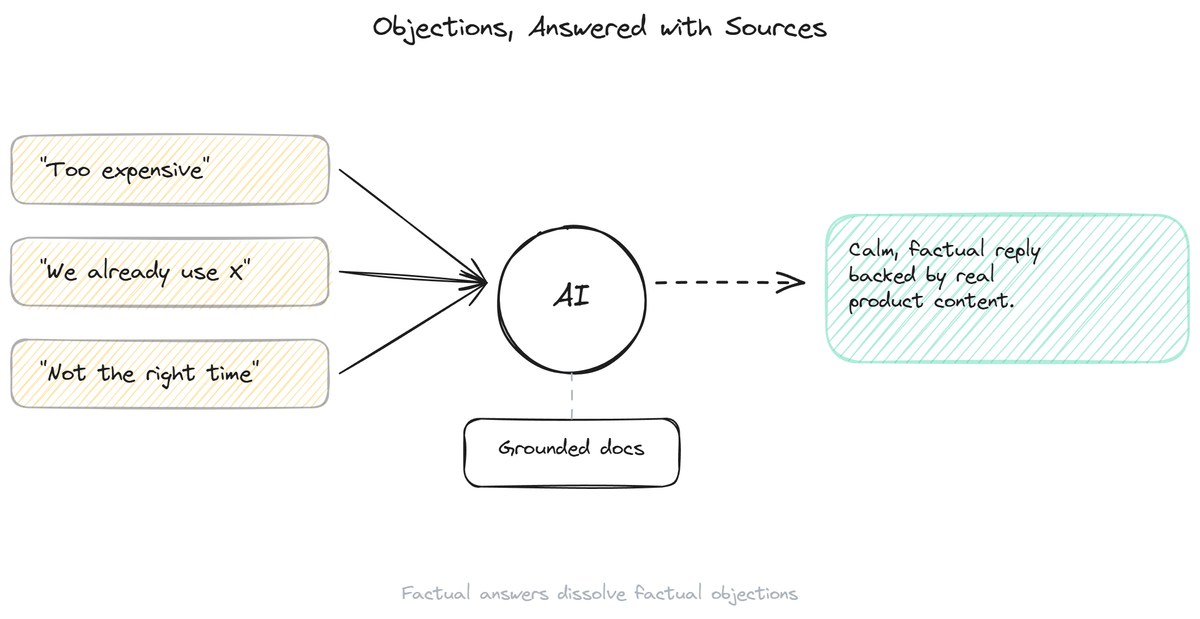
AI objection handling is the layer that addresses the common, predictable buyer concerns at the moment they come up in a conversation, before they harden into reasons to walk away. A prospect asking "isn't this expensive compared to X?" is raising an objection that has a real answer; if the answer comes in the next message, the objection often dissolves. If it comes two days later in a follow-up email, the prospect has already moved on. This page covers where AI handles objections well, where it should hand off to a human, and why grounded accuracy matters more here than anywhere else in the sales flow.
Why grounded accuracy matters most in objection handling
Objection handling is the moment where a sloppy bot does the most damage. A pre-sales question answered slightly wrong loses you a deal. A pricing claim that turns out to be inaccurate destroys trust before the rep ever talks to the prospect. An overpromise about a feature you do not actually have becomes a churn event later, after the customer realizes.
This is why the no hallucinations discipline matters more in objection handling than in routine support. In support, a wrong answer creates a complaint. In sales objection handling, a wrong answer either loses the deal outright or sets up a worse outcome by closing a sale on false premises. Both are expensive in different ways.
The right design grounds every objection response in the same product content your reps use. Pricing rationale comes from the actual pricing logic. Comparison points come from real, verifiable differences with competitors. Feature claims come from features that actually exist. The bot's job is not to be persuasive; its job is to be accurate, fast, and consistent with what the rep would say if asked the same question.
The objections AI handles well
Some objections are factual and have a clear answer. These are where AI earns its place.
Pricing objections often dissolve when the prospect understands what the price includes, what tier matches their needs, or the ROI math at their volume. A bot that walks through your pricing structure accurately, with the relevant tier for the prospect's segment, resolves a meaningful share of pricing pushback. The buyer FAQs page covers this overlap between pricing questions and pre-sales FAQs.
Competitive objections ("we already use X", "Y is cheaper") respond well to factual comparison when the comparison is genuine. A bot grounded in honest, verifiable differences (where your product is better, where it is not, where the gap matters for the prospect's use case) handles this better than vague claims. The cross-page work here, comparing against specific tools, lives in the compare silo.
Timing and process objections ("not the right time", "we need to evaluate longer") often respond to information rather than persuasion. A clear explanation of trial terms, migration timelines, or what happens after sign-up addresses what the prospect is actually worried about.
Feature gaps that turn out to be misunderstandings ("doesn't your product do X?") resolve when the bot accurately describes what the product does. Some apparent gaps are real gaps; the bot should say so honestly rather than pretending otherwise.
Where humans still own the call
Other objections need a human, and a bot that tries to handle them poorly makes the situation worse.
Emotional or trust-based objections are not factual. A prospect who has been burned by a previous vendor, or who is anxious about switching, needs reassurance from a person, not a policy answer from a bot. A rep can hear the underlying concern; a bot only hears the words.
Negotiation belongs to humans. Discount discussions, contract terms, custom arrangements: all of this requires judgment about what to offer for this specific deal. A bot quoting standard list pricing while a prospect negotiates is worse than a bot saying "let me get a rep" and routing the conversation.
Complex objections that mix facts and feelings ("your product looks good but my CTO is skeptical about AI vendors") need a human to address both layers. The bot can capture the context and route the prospect to a rep who can handle the nuance.
The split is the same principle that applies across the sales flow: AI for the factual, repeatable layer; humans for the parts that need judgment, negotiation, or empathy. The handoff should be smooth, with the rep receiving the full objection context rather than starting cold.
BestChatBot handles factual objections grounded in your product content, refuses to overpromise on features or invent comparisons it cannot back up, and routes the negotiation and emotional cases to a human with the conversation attached. For pricing details, see plans.
FAQ
- Can the chatbot actually change a prospect's mind? On factual objections, often yes: accurate information at the right moment dissolves objections that come from misunderstanding. On emotional or trust-based objections, no, and trying to is worse than handing off to a human who can.
- What if the prospect's objection is genuinely accurate? The bot should acknowledge it honestly rather than spinning. If your product is more expensive, the bot explains what justifies the price (or routes to a rep if the answer is "we have flexibility on this"). Pretending a real gap does not exist closes deals that fall apart later.
- How is this different from the pre-sales FAQ? Pre-sales FAQ covers the questions a prospect needs answered to evaluate your product. Objection handling covers the concerns that come up specifically because the prospect is considering not buying. Overlap is real; most pre-sales FAQ content is also objection-handling content depending on framing.
- Does the bot use persuasion techniques? No, and it should not. The bot's job is accurate information at the moment the prospect asks, not persuasion. Persuasion is the rep's work, and it works better when the prospect is already informed. A bot that tries to manipulate creates the trust problem the rep then has to repair.
- What about reps using the bot themselves? Some teams use the same grounded content as an internal tool for reps preparing for objection-heavy calls. The bot becomes a research assistant rather than a customer-facing layer. This is a separate use case from public deployment but uses the same underlying knowledge base.
For pricing details, see plans.
See our complete sales support guide.