
Demo Booking Chatbot for Sales Teams
A demo booking chatbot lets qualified prospects pick a slot on your rep's calendar without leaving the chat. How instant booking lifts conversion versus follow-up sequences.
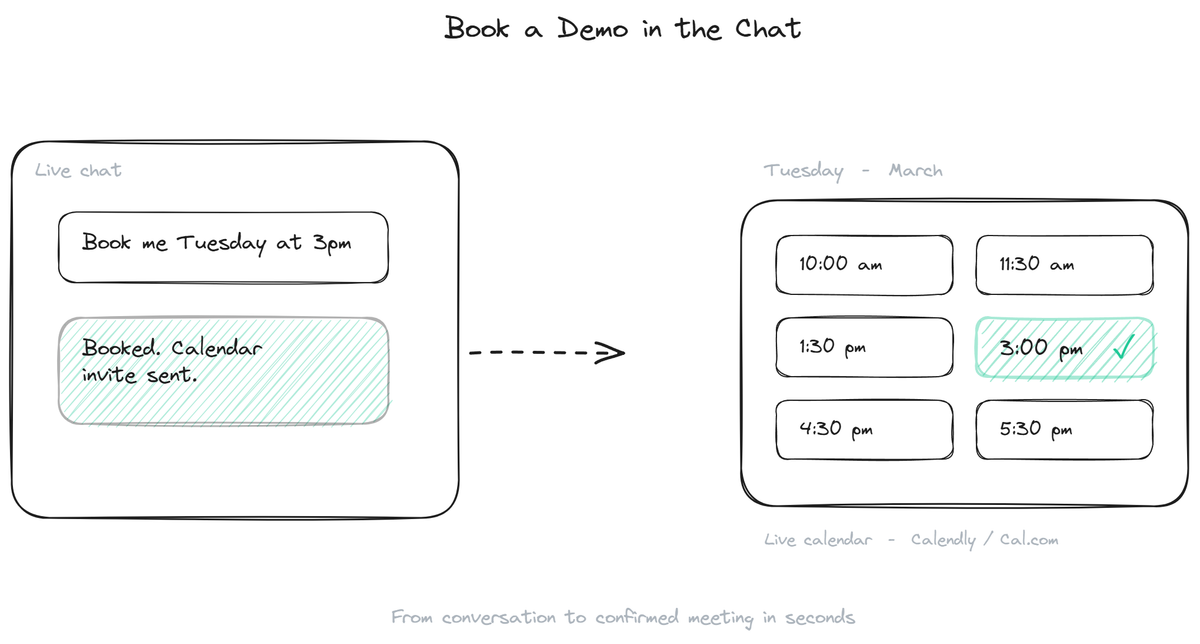
A demo booking chatbot turns a qualified, interested prospect into a confirmed meeting before they leave your site. The alternative is the traditional flow: contact form, lead score, rep follow-up, calendar back-and-forth, meeting booked three days later if the prospect is still interested. Most are not, because intent decays fast. A booking chatbot collapses that whole sequence into the conversation that already happened: the prospect picks a slot from the rep's real calendar, confirms, and walks away with a meeting on the books. This page covers how instant booking works, why it converts better than follow-up sequences, and how to set it up without giving up control of your reps' calendars.
Why instant booking beats follow-up
Sales intent has a half-life. A prospect who asks about pricing on a Tuesday afternoon is interested on Tuesday afternoon. By Thursday they have moved on, looked at competitors, or forgotten why they were curious. Every hour between intent and a booked meeting is a chance to lose them.
The traditional follow-up pattern accepts this loss. Contact form, rep reviews, rep emails, prospect responds (or does not), calendar links exchanged, meeting eventually booked. Each step shaves a percentage off the conversion. By the time a meeting is on the calendar, most of the original intent is gone, and the meetings that do happen have a higher no-show rate because the moment has passed.
Instant booking inverts this. The prospect picks a slot during the conversation that produced the interest, while everything that made them curious is still fresh. The meeting is on the calendar before they close the tab. No-show rates drop because the prospect chose the time themselves, in the moment, on their own initiative.
The qualification side of the flow matters here too. A booked meeting from an unqualified lead is worse than no meeting; it wastes a rep's hour. The booking chatbot should only offer the calendar to prospects who have cleared qualification, which the lead qualification page covers in detail. Qualification first, booking second.
How the booking flow works
The booking step is short by design. Once the prospect is qualified and interested, the bot offers to book a meeting. It reads availability live from the rep's connected calendar (Calendly or Cal.com), shows the prospect a handful of options that match their stated timezone, and the prospect picks one. The bot confirms, adds the meeting to the rep's calendar, and sends the calendar invite to both parties.
Two implementation details matter. The bot should read live availability rather than caching it, because a slot offered and then revealed to be taken kills trust instantly. And the booking should be routed to the right rep based on the qualification context: a prospect asking about enterprise pricing should not land on a rep who handles SMB. The scheduling integration page covers the developer-side options for more complex routing logic, including round-robin and territory rules.
The follow-up after booking matters as much as the booking itself. A meeting booked with no preparation is a cold call rebranded. The rep should walk into the meeting with the conversation transcript, the qualification context, and any specific questions the prospect asked, so the conversation picks up where the chat left off rather than restarting from zero.
Where it fits in the sales stack
The booking chatbot lives at the bottom of the qualification funnel. Visitors arrive, ask questions, qualify themselves through the conversation, and the warm ones flow into booking. This is a meaningful percentage of inbound traffic but not all of it: some visitors are not ready to book, some need to talk to a rep first via a different channel, and some are too early in their evaluation to commit to a meeting.
The booking chatbot should know which is which. A clearly hot, qualified prospect goes straight to the calendar. A warm prospect who is interested but not ready might get an offer to be contacted later. A cold or poorly qualified visitor should not be pushed into a meeting they will skip. The configuration that works treats booking as the right next step for a specific subset of conversations, not as the goal of every conversation.
BestChatBot qualifies through conversation, reads live availability from a connected Calendly or Cal.com calendar, books meetings for qualified prospects directly in the chat, and sends the rep the full conversation context with the meeting. For pricing details, see plans.
FAQ
- Which calendar tools does the chatbot connect to? Calendly and Cal.com are the main native connections. Other calendar tools can be connected through the developer API if needed. The bot reads live availability rather than caching, so the slots offered are the slots actually available at the moment of booking.
- Can I control which reps the bot books to? Yes. Routing rules tie qualification context to specific reps or teams: enterprise leads to enterprise reps, segment leads to the right territory, and so on. Round-robin within a team is also supported for fair distribution.
- What if the prospect changes timezone or needs to reschedule? The booking includes a reschedule link from the calendar tool, so the prospect can move the meeting through the standard flow. The bot does not need to handle reschedules directly because the calendar tool already does.
- Does this work for B2C, not just B2B? Booking patterns differ in B2C. The same technical setup works (book a consult, a fitting, a service appointment), but the qualification and timing logic shifts. For B2C and ecommerce the conversion lift is real but the bot is typically configured around the specific service or appointment type rather than a sales demo.
- What if my reps' calendars are full? The bot offers what is available. If genuine availability is days out, the booking still completes (with the prospect picking the earliest realistic slot), but a chronic calendar-full problem is a capacity issue the bot cannot solve. The conversation transcript still captures the lead for human follow-up.
For pricing details, see plans.
You can also visit the full sales support hub.