
What Is AI Customer Service
AI customer service is the use of AI across support: conversational agents, ticket automation, routing, and agent assist. What it covers and where humans still fit.
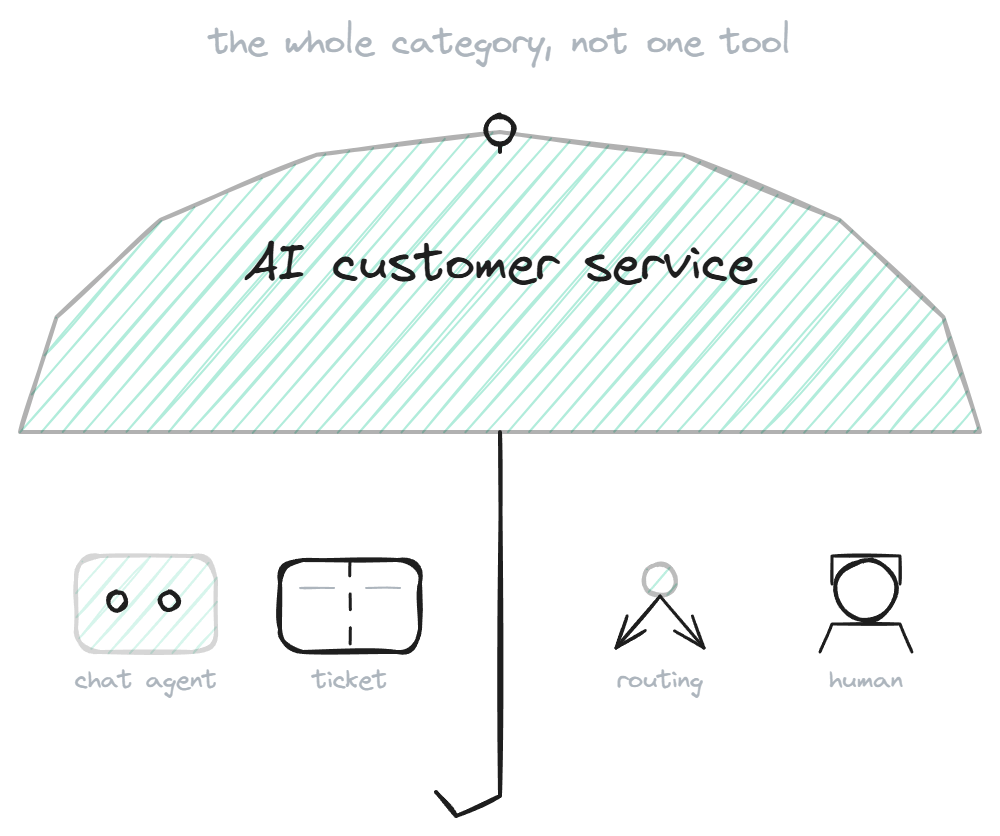
AI customer service is the broad use of artificial intelligence across customer support, from the conversational agents customers talk to directly, through the behind-the-scenes automation that routes and triages tickets, to the tools that help human agents work faster. It is a category, not a single product, and confusing the category with one tool inside it (usually the chatbot) is the most common mistake people make when they start evaluating it. This guide lays out what AI customer service actually covers, what it does well and badly, and where human teams still fit, so you have the full picture rather than a piece of it.
What AI customer service covers
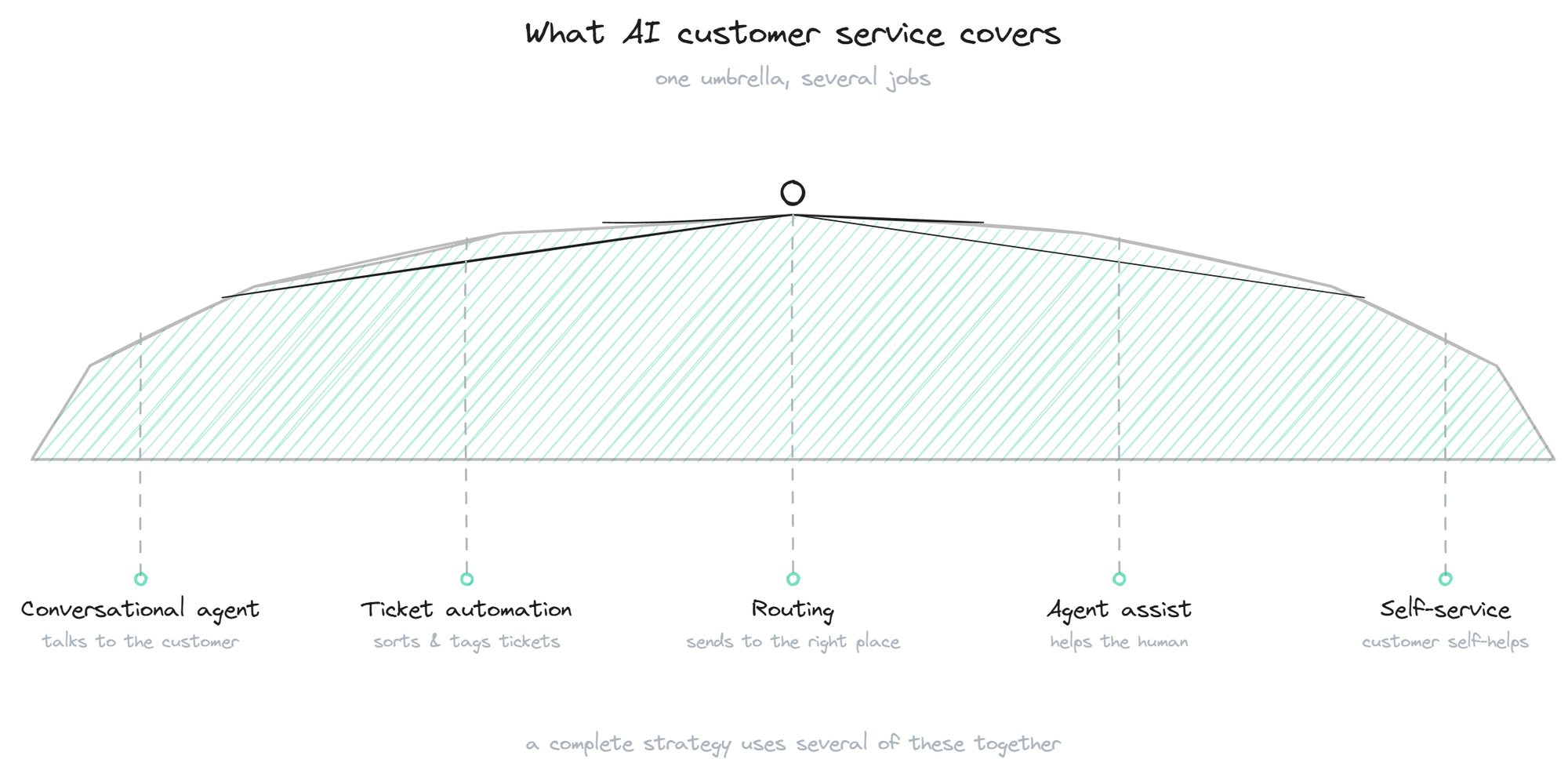
The category spans several distinct uses of AI, and most "AI customer service" offerings are really one or two of these, not all.
Conversational agents are the most visible: the AI that talks directly to customers, answers their questions, and increasingly takes actions on their behalf. This is what most people picture, and it is the part this site focuses on, but it is one segment of the category.
Ticket automation works behind the scenes: AI that reads incoming tickets, classifies them by type and urgency, tags them, and sometimes drafts a response for a human to review. The customer may never see it, but it shapes how fast their issue gets handled.
Routing is the dispatch layer: AI that decides which team or person an issue should go to, based on its content, so a billing question reaches billing and a technical one reaches technical without a human triaging every ticket.
Agent assist points inward at the human team: AI that suggests answers, surfaces relevant knowledge, and drafts replies for human agents, making the humans faster rather than replacing them. The agent stays in control; the AI does the lookup work.
Self-service is the customer-facing knowledge layer: AI that powers help centers and search so customers find answers themselves without contacting anyone. The best self-service deflects the question before it becomes a ticket.
A complete AI customer service strategy uses several of these together. A tool that does one of them well is useful but is not the whole category, which is worth remembering when a vendor presents their slice as the entire thing.
What it does well and what it does not
AI customer service is strong at a specific profile of work and weak at another, and knowing the line keeps expectations realistic.
It does well with volume and repetition. The high-frequency, factual, repetitive work (answering common questions, classifying tickets, routing, surfacing knowledge) is exactly what AI handles at scale, around the clock, consistently. This is where most of the value is, because most support volume is repetitive.
It does well with speed. AI responds instantly, which removes the waiting that makes support frustrating, and it works across timezones and languages without staffing for each.
It does poorly with the genuinely complex, the emotional, and the novel. A frustrated customer in an unusual situation, a sensitive complaint, a problem no one has seen before: these need human judgment, empathy, and creativity that AI does not have. A strategy that tries to automate these does damage, because it applies a volume tool to work that needs a person.
The honest framing is that AI customer service handles the repetitive majority so humans can focus on the complex minority, which is the reduce tickets dynamic applied across the whole support operation rather than just one channel.
Where humans still fit
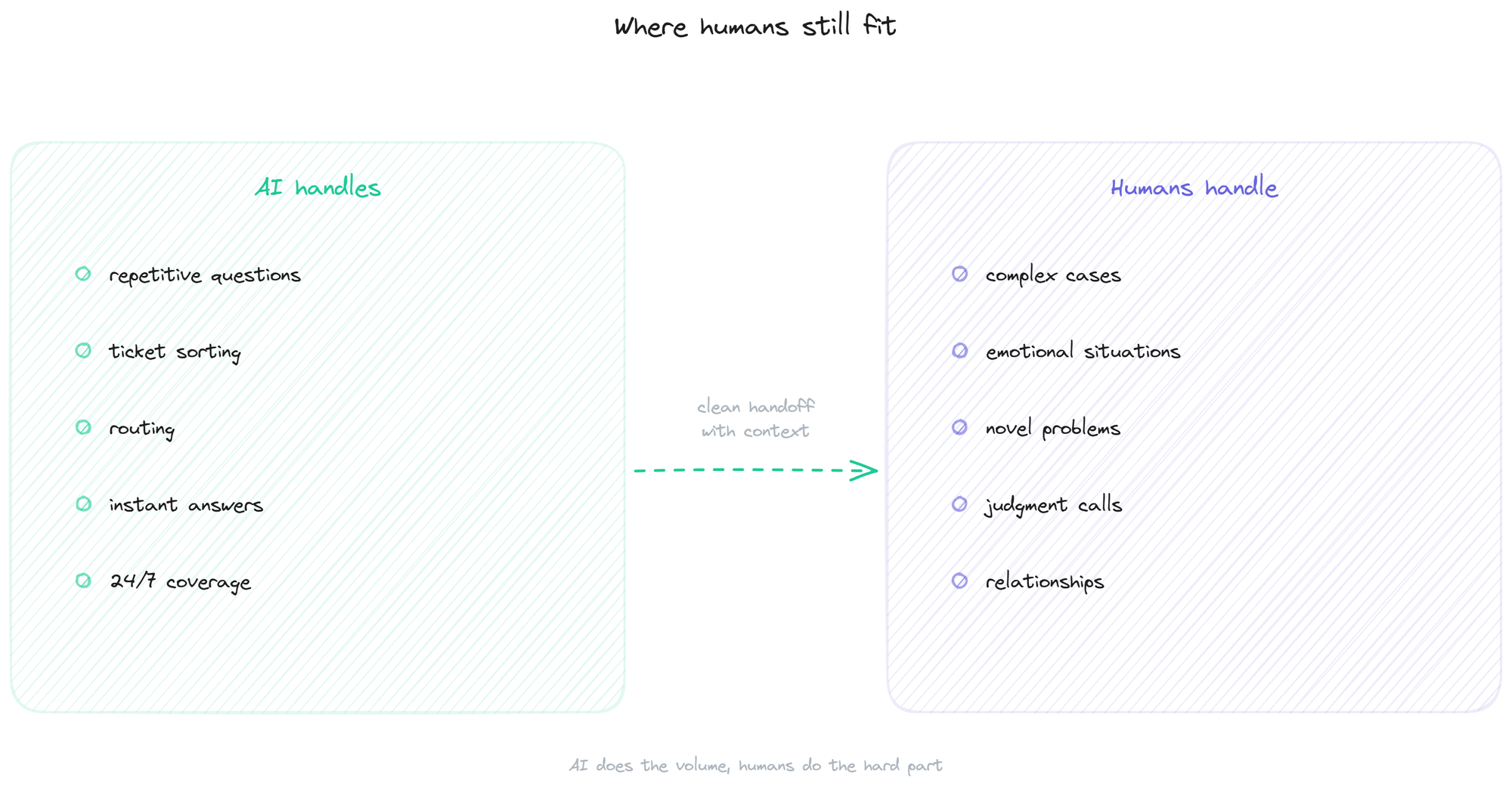
The future of customer service is not AI replacing humans; it is AI and humans doing the parts each is better at. The repetitive, high-volume, factual work goes to AI. The complex, emotional, judgment-heavy work stays with humans, who now have the time for it because they are not buried in repetitive tickets.
This division changes the human role rather than eliminating it. A support team running good AI customer service spends less time on password resets and more time on the hard cases that actually need a person, which is better work and better outcomes for the customers who need real help. The team gets smaller relative to volume, but the work that remains is higher value.
The piece that makes this work is the handoff: when AI reaches its limit, the transition to a human has to be clean, with the context carried over so the customer does not start again. A broken handoff strands exactly the customers the AI correctly decided it could not help, which is the worst failure in the whole system.
BestChatBot sits in the conversational-agent segment of this category: it talks to customers, answers from your real content, takes actions, and routes the cases it should not handle to your human team with the conversation context attached. When you are ready to compare tools across the category, the compare AI support tools silo lines up the options, and the AI support for startups silo covers the lean-team angle.
FAQ
- Is AI customer service the same as a chatbot? No. A chatbot (or conversational agent) is one part of AI customer service, the customer-facing one. The category also includes ticket automation, routing, agent assist, and self-service, much of which the customer never sees. Confusing the chatbot for the whole category is the common mistake.
- Will AI replace customer service teams? Not replace, reshape. AI handles the repetitive volume so human teams focus on the complex, emotional, and novel cases that need judgment. The team gets smaller relative to volume, but the remaining work is higher value, and humans stay essential for the hard cases.
- What can AI customer service not do? The genuinely complex, emotional, and novel. A frustrated customer in an unusual situation, a sensitive complaint, a never-seen-before problem: these need human empathy and judgment. AI is strong on volume and repetition, weak on the cases that need a person.
- Do I need all five segments to start? No. Most teams start with one or two (commonly a conversational agent and self-service) and add more over time. A tool that does one segment well is a valid starting point; you do not need the whole category at once.
- How does this relate to AI support agents? An AI support agent is a tool in the conversational-agent segment of AI customer service. AI customer service is the category; the agent is one tool within it. The "what is an AI support agent" guide covers that specific tool.
The agents that resolve a request rather than deflect it are powered by how agentic AI works, the underlying shift behind this whole category.
Two metrics shape AI service quality: containment and deflection.
The strongest setups use a hybrid AI and human support model.
Keep an eye on the right AI support metrics.
It all builds on conversational AI.