
Ticket Deflection vs Containment
Ticket deflection vs containment: what each metric really counts, how they mislead on their own, and how to measure both honestly in AI support.
A support dashboard can show a chatbot containment rate of 92% and still hide a growing problem. The bot handled almost every chat without escalating, the number looks great in the weekly review, and yet the shared inbox keeps filling up. The metric said the conversations stayed with the bot. It never said the customers got what they came for.
Ticket deflection and containment sound like the same idea, and plenty of teams report one while thinking they measured the other. They answer different questions. This piece separates the two, shows how each one flatters a bot that is quietly failing, and walks through measuring both honestly for a grounded support agent you install as a web widget, where the only escalation path is a ticket in your team's inbox.
The two numbers people treat as one
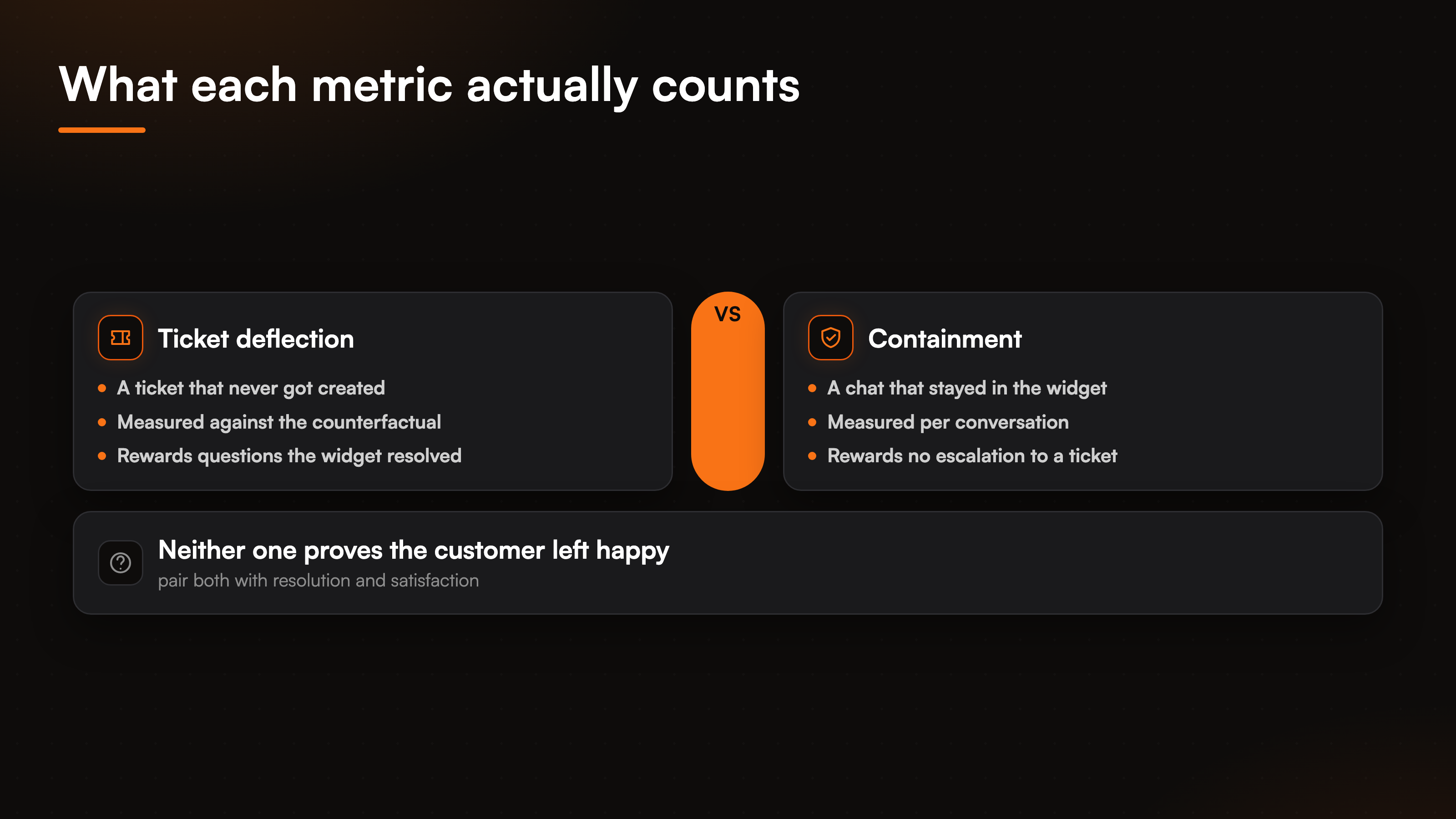
Containment answers one question: did the conversation stay inside the widget? Count the chats the agent handled from start to finish without creating a ticket, divide by every chat in the window, and that share is your containment rate. It measures where the work happened.
Ticket deflection answers a different question: did a ticket that would otherwise exist get avoided? A shopper who would have emailed support asks the widget instead, gets a grounded answer, and never opens a ticket. That avoided ticket is a deflection. Deflection is a business number measured against a counterfactual, the ticket you did not receive.
The deflection rate vs containment rate overlap is real, which is why teams fuse them. In this product the only way to break containment is to file a ticket, so a contained conversation is usually also a deflected one. The gap shows up at the edges, and the edges are where the interesting failures live.
How each metric misleads on its own
Containment as a headline number rewards a bot for never giving up, even when giving up is the right move. A customer with a genuine billing dispute the widget cannot resolve should get a ticket filed and routed to a person. A bot tuned to protect its containment score keeps that customer in a loop instead, answering around the question, and the dashboard reads 100% contained while the experience falls apart. High containment sitting next to rising tickets somewhere else, or a falling satisfaction score, is the classic tell.
Deflection has the opposite weakness. It counts absence, the ticket that did not appear, so it climbs whenever people stop asking, for good reasons or bad. A visitor who bounces off an unhelpful bot and gives up deflected a ticket on paper and got nothing in reality. Worse, they might resurface by email a day later, so the ticket was delayed, not deflected. A deflection rate read without a resolution rate next to it tells you almost nothing about whether anyone got helped.
My view is that both metrics are honest guardrails and dishonest headlines. They describe motion, not outcome. Track them to understand where conversations go, not to prove the bot is working.
Where deflection and containment split in a grounded agent
The split becomes concrete once you look at how the agent decides what to do. Every conversation runs through the same gate. The widget answers from the business's own knowledge, and when a question sits outside that knowledge it declines rather than inventing a policy, which is the whole point of a no-hallucination support agent. If the request needs an action, the agent runs one of 29 prebuilt actions across 8 connectors, checking an order or starting a return, and reports the result. When it can neither answer nor act, it files a ticket in Zendesk or Freshdesk and routes it to your team.
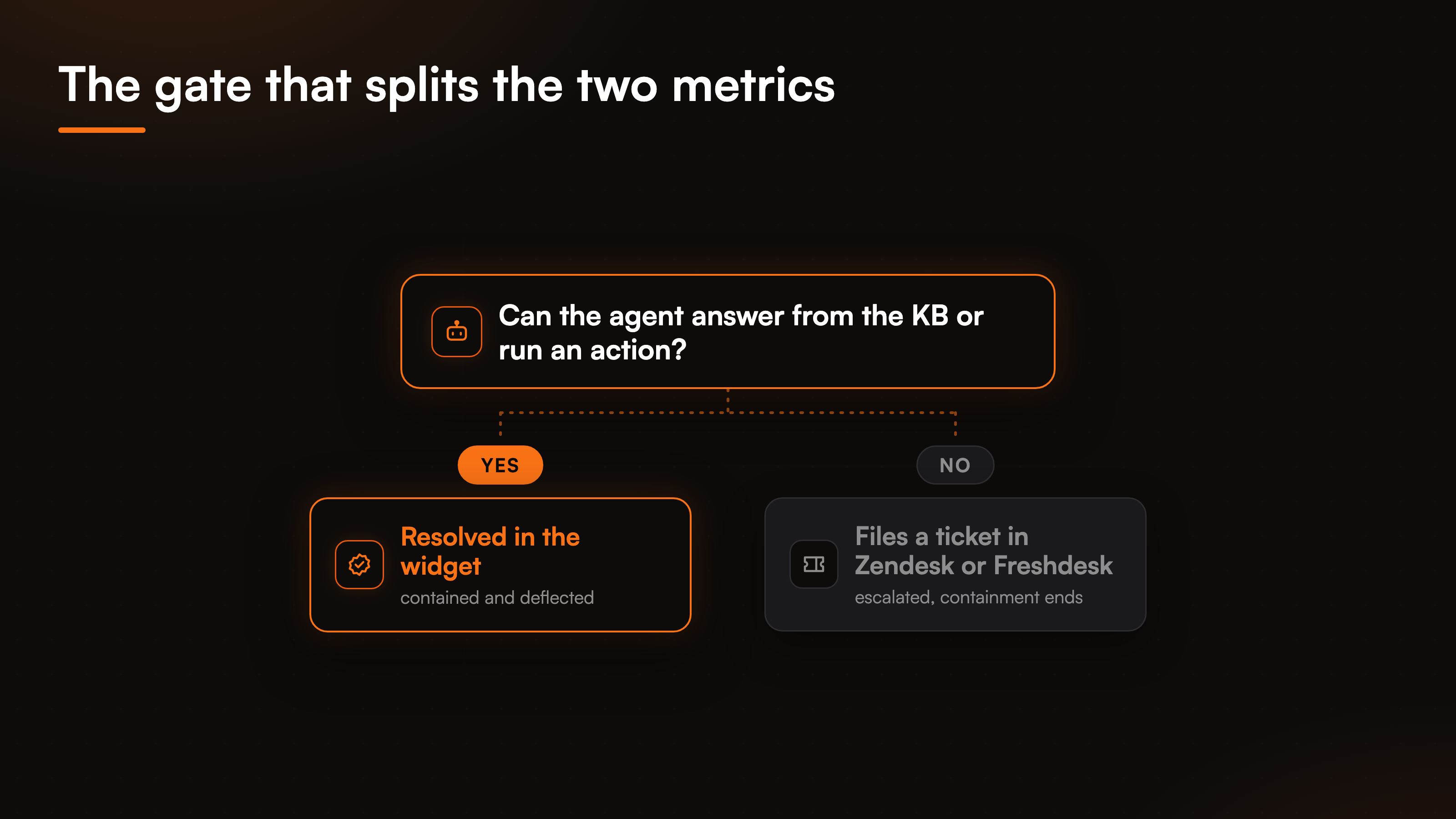
That single gate is where the two metrics part ways. A grounded answer or a completed action keeps the chat contained and deflects the ticket at the same time. A filed ticket ends containment on purpose, and it is not a deflection, it is an honest escalation. Grounding is what makes deflection real instead of accidental, because the widget only claims to have handled a question it could actually ground in your content. Account-specific actions add one more condition: they run only behind a verified visitor identity, with the email and name pinned from a signed token, so the agent acts for the right person or files a ticket instead of guessing.
How to measure both in the Response Monitor
You do not need a separate analytics stack to get these numbers, you need a consistent definition and a place to review conversations. The Response Monitor is where the human-in-the-loop review happens: you read what the agent said, see whether it answered, acted, escalated, or lost the visitor, and update the knowledge base when an answer was weak. Reviewing outcomes there is also how you measure containment and deflection without fooling yourself.
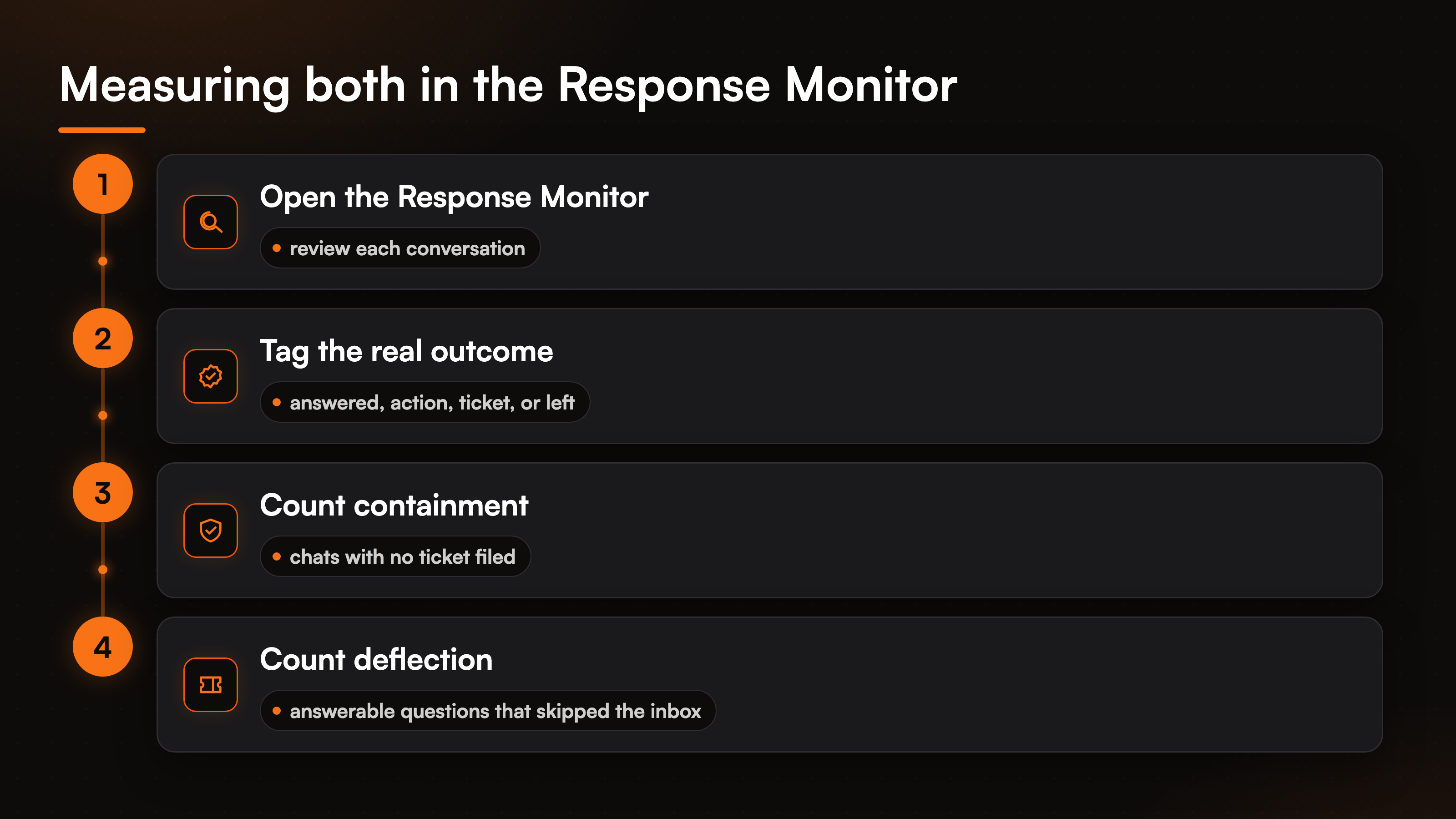
Work one window at a time. Tag each conversation with its real ending: a grounded answer, a completed action, a filed ticket, or an abandoned chat. Containment is the share with no ticket filed. Deflection is narrower and more honest when you scope it to repeat, answerable questions, the ones that would have hit the inbox, that the agent resolved instead. Keep filed tickets in their own column so an escalation can never sneak into either number as a win, and note when a repeat question keeps coming back, because that is a knowledge gap the review is meant to catch.
Which number belongs on the wall
If a team asked me which of the two to pin on the wall, I would say neither, at least not alone. Containment and deflection belong in the diagnostics, next to the two numbers that actually describe the customer: resolution and satisfaction. Resolution asks whether the problem got solved. Satisfaction asks whether the customer agreed. A resolution rate climbing while satisfaction slips is the same warning that high containment with rising tickets gives you, read from a different angle.
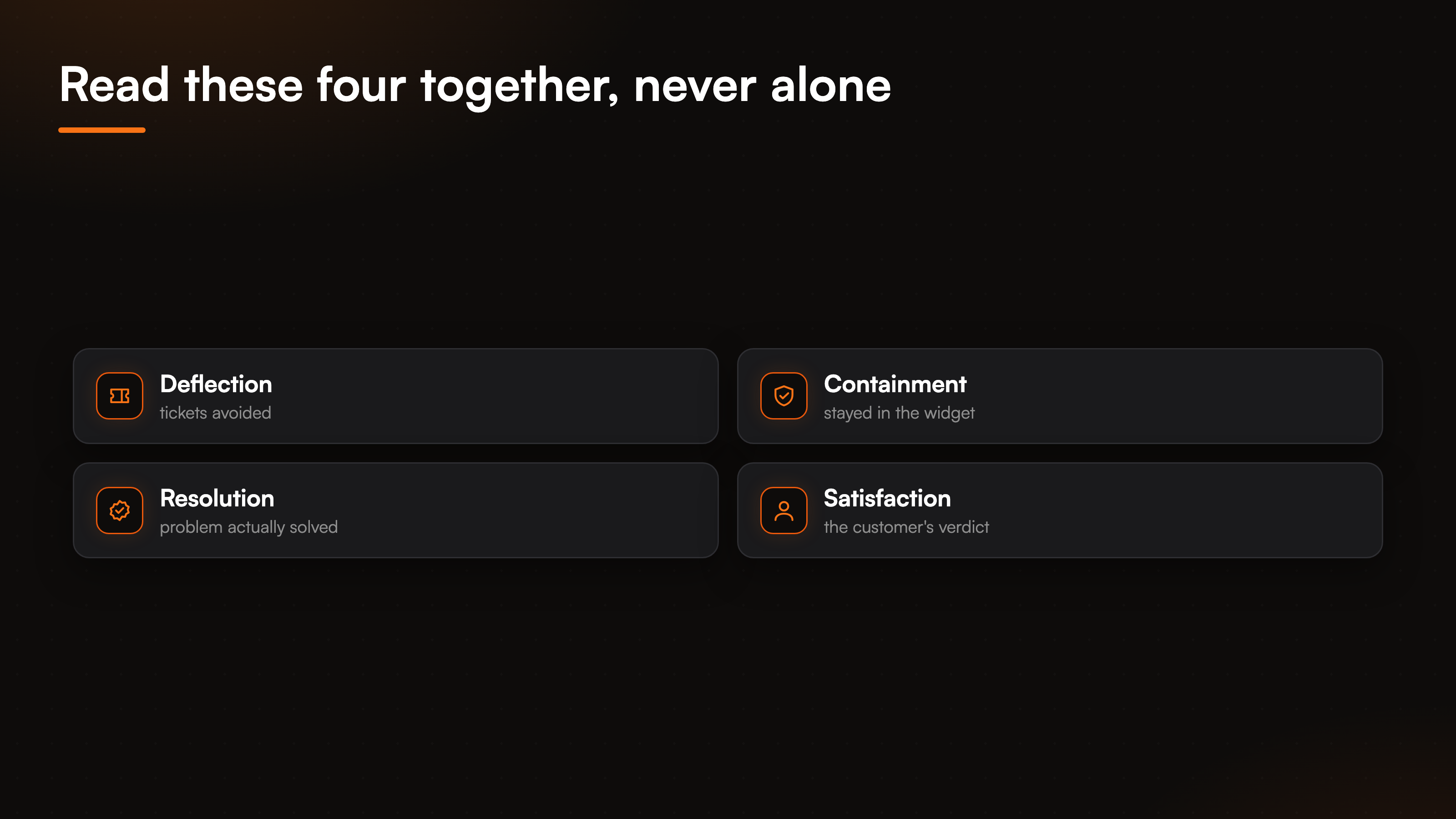
Grounded answering is available from the Free tier up, and it deflects the repetitive questions that clog a queue, the backbone of any real customer support automation program. The agentic actions, the 8 connectors and 29 actions, come with Pro and Business, and they let the agent resolve requests an answer-only bot could only deflect. Put the four numbers together and the picture stops lying. Read on their own, containment says the bot stayed busy and deflection says the inbox stayed quiet, and a customer can still have left unhappy behind both.
FAQ
What is the difference between ticket deflection and containment?
Containment measures whether a conversation stayed inside the widget without an escalation. Deflection measures whether a ticket that would otherwise have been created got avoided. In a grounded agent the only way to break containment is to file a ticket, so most contained chats are also deflected, but they answer different questions: one is about where the work happened, the other about the ticket you never received.
Can a containment rate be too high?
Yes, and a very high containment rate can be a warning rather than a win. A bot tuned to never escalate will keep customers in a loop instead of filing the ticket they need, which reads as 100% contained while satisfaction drops. A healthy containment number sits next to a resolution rate and a satisfaction score, never on its own.
Does filing a support ticket count as deflection?
No. When the agent cannot answer or act and files a ticket in Zendesk or Freshdesk, that is an honest escalation to your team, not a deflection. Deflection only counts the questions the widget resolved so completely that no ticket was ever needed.
How do I measure deflection without overcounting?
Support ticket deflection is only honest when you scope it to repeat, answerable questions that the agent resolved, and keep abandoned chats and filed tickets in separate columns. A visitor who gave up did not get deflected, they got lost, and folding them in inflates the number. Reviewing outcomes in the Response Monitor one window at a time keeps the definition honest.
Is deflection or resolution the better metric to report?
Resolution maps more directly to a customer who left helped, so it makes a better headline. Deflection and containment are useful for understanding where conversations flow, but they describe motion, not outcome. Track all of them, and read deflection and containment as diagnostics under resolution and satisfaction.
Deflection and containment earn their place once resolution and satisfaction sit beside them and the definitions hold up week to week. To match a plan to your conversation volume, and see where free grounded answering ends and paid actions begin, start with the AI support pricing guide, or work through the rest of our AI support agent resources.