
Resolution Rate Explained
Resolution rate explained: what it measures, how to calculate it without fooling yourself, how it differs from deflection, and what really moves it in AI support.
Almost every support tool shows a resolution rate somewhere, and almost nobody agrees on what it counts. One vendor calls a conversation resolved the second the bot sends any reply. Another only counts it when the customer says thanks. A third quietly counts a handed-off ticket as a win. Same phrase, three different numbers, and a support lead left guessing whether 68% is good or garbage.
So this piece pins down what resolution rate actually measures, how to work it out without lying to yourself, and where it gets tangled up with deflection and containment. Then we look at what genuinely moves the number inside a grounded, action-taking support agent, the kind you install as a web widget, where resolved should mean the customer's problem got solved and not just talked at.
What resolution rate actually measures
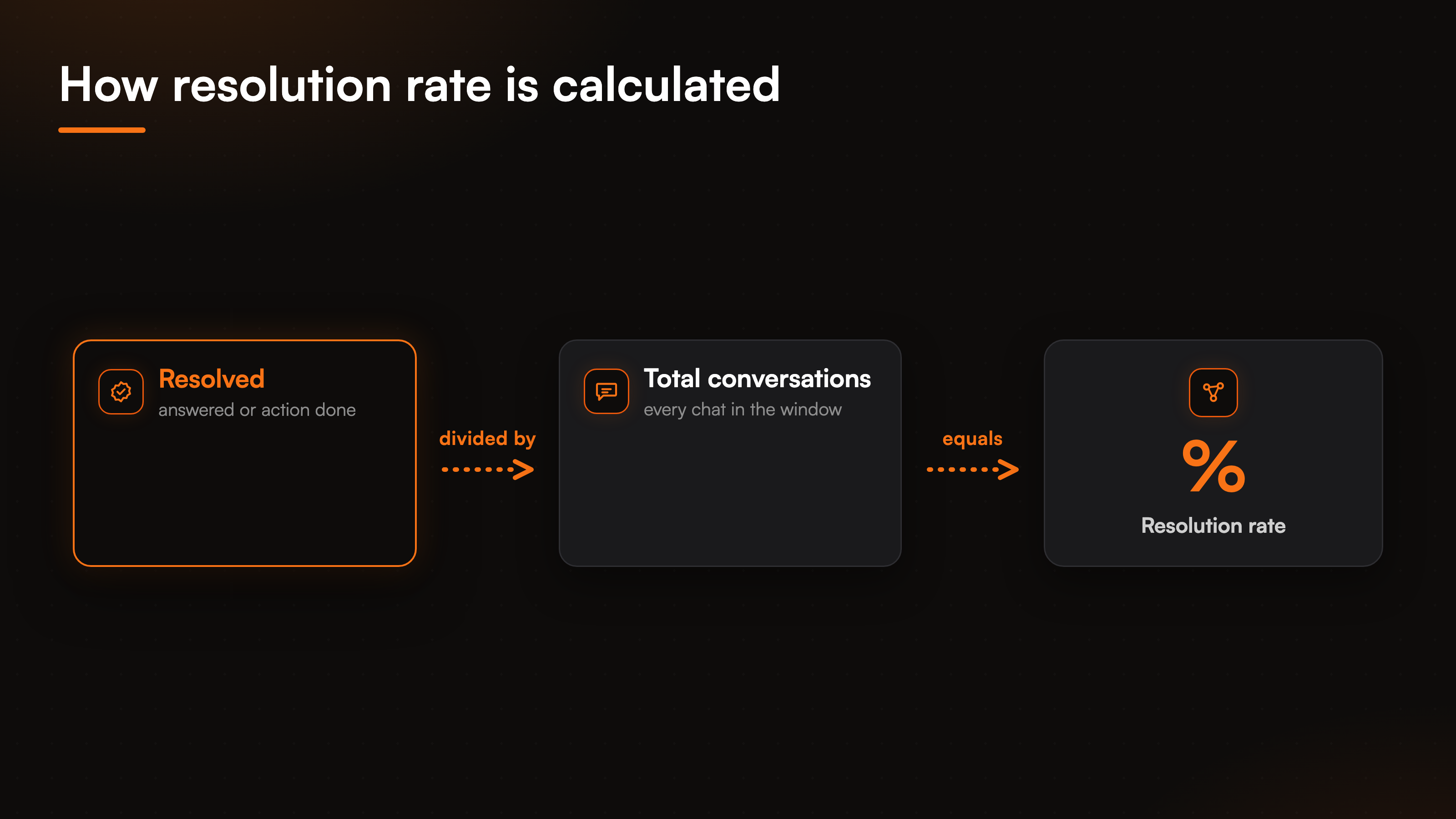
Resolution rate is the share of support conversations that reach a real outcome without a person stepping in. Take every conversation in a window, count the ones that ended with the customer's need met, and divide. Here is how to calculate resolution rate in its plainest form: resolved conversations divided by total conversations, over a fixed period.
The formula is easy. The judgment hides inside the word resolved. A rate of 70% is supposed to mean seven in ten chats ended with the automation handling the request end to end. The moment you count anything softer, a reply that got sent, a link that got pasted, a ticket that got created, the number puffs up and stops describing reality. Your customer support resolution rate is only ever as honest as your definition of resolved.
That is why I treat the metric as a definition problem first and a math problem second. Two teams can run the exact same bot on the exact same traffic and report wildly different rates purely because they drew the line in different places.
What counts as resolved, and what does not
Inside a grounded support agent, two outcomes deserve to be counted. The first is a grounded answer: the widget replies from the business's own content and declines when a question sits outside it, rather than inventing a policy. That discipline is the whole point of a no-hallucination support agent, and it is what turns a repeated question into a clean first-contact resolution. The second is a completed action. The agent runs one of 29 prebuilt actions across 8 connectors, checks a live order, books a slot, starts a return, then confirms the result back to the customer.
Two outcomes should not be counted. When the agent cannot resolve a request, it files a ticket in Zendesk or Freshdesk and routes it to your team's inbox. That is an honest handoff and a fine result for the customer, but it is an escalation, not a resolution by the agent. Counting escalations as resolutions is the single most common way support teams flatter their own dashboard. A chat where the visitor simply gave up and left should not count either.
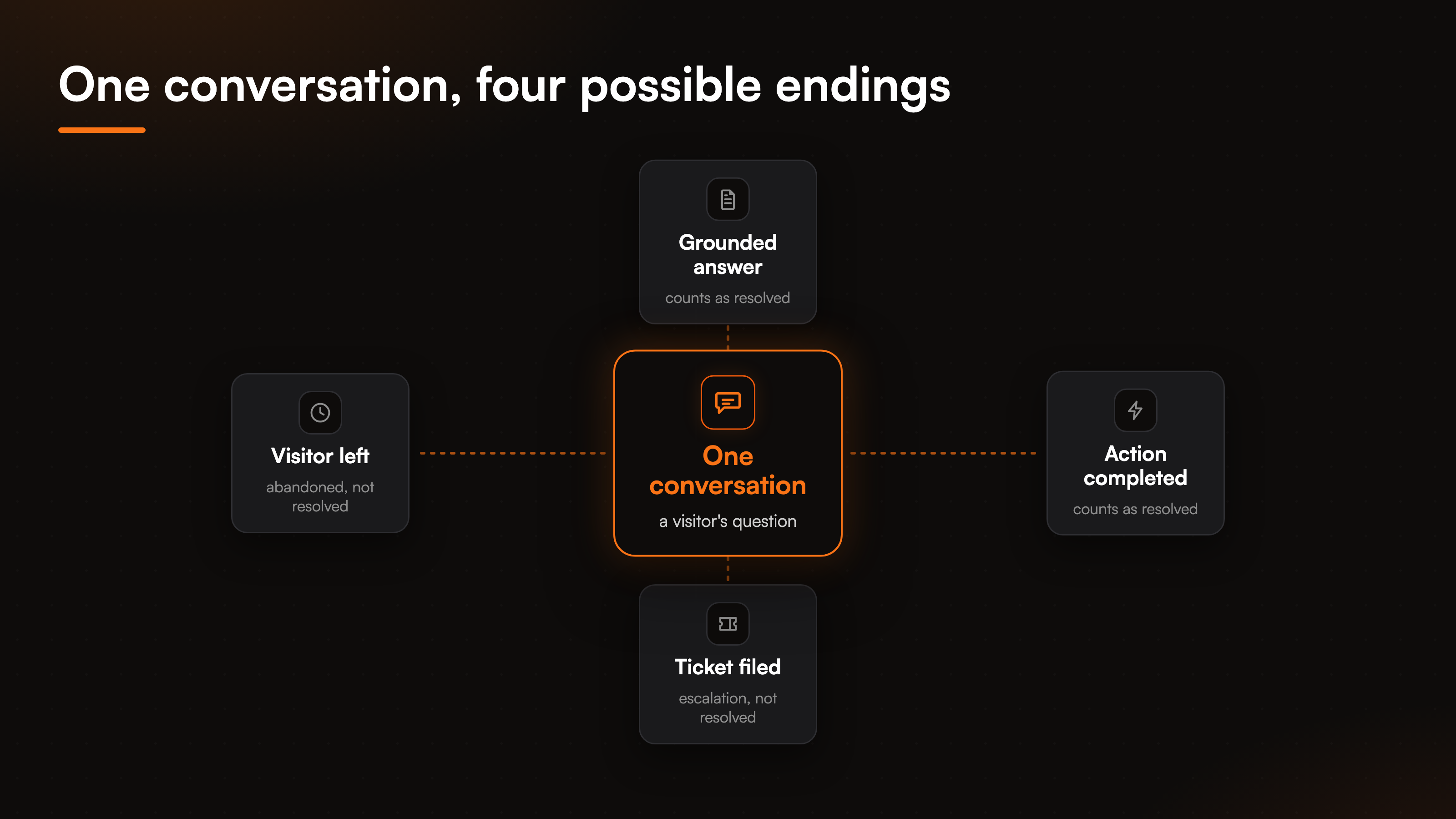
Draw the line there and the number gets useful. A resolved conversation is one the agent finished on its own, by answering or by acting, and you can point to the moment it happened. Everything else belongs in a different bucket.
Resolution rate vs deflection rate vs containment
Three metrics get used as if they were the same thing, and they are not. Resolution rate vs deflection rate is the mix-up that costs teams the most clarity. Deflection rate measures how many visitors never opened a ticket at all, so it rewards silence. Containment measures how many conversations stayed inside the bot and never routed to a human. Resolution measures whether the underlying problem actually got solved.
Here is the trap. A chatbot resolution rate of 80% sitting next to a deflection rate of 95% usually means the bot is deflecting far more than it resolves. Visitors are bouncing off it and giving up, which looks like success in the deflection column and quietly rots the resolution column. High containment can hide the same failure: a customer stuck in a loop with a bot that will not admit defeat is contained and unresolved at the same time.
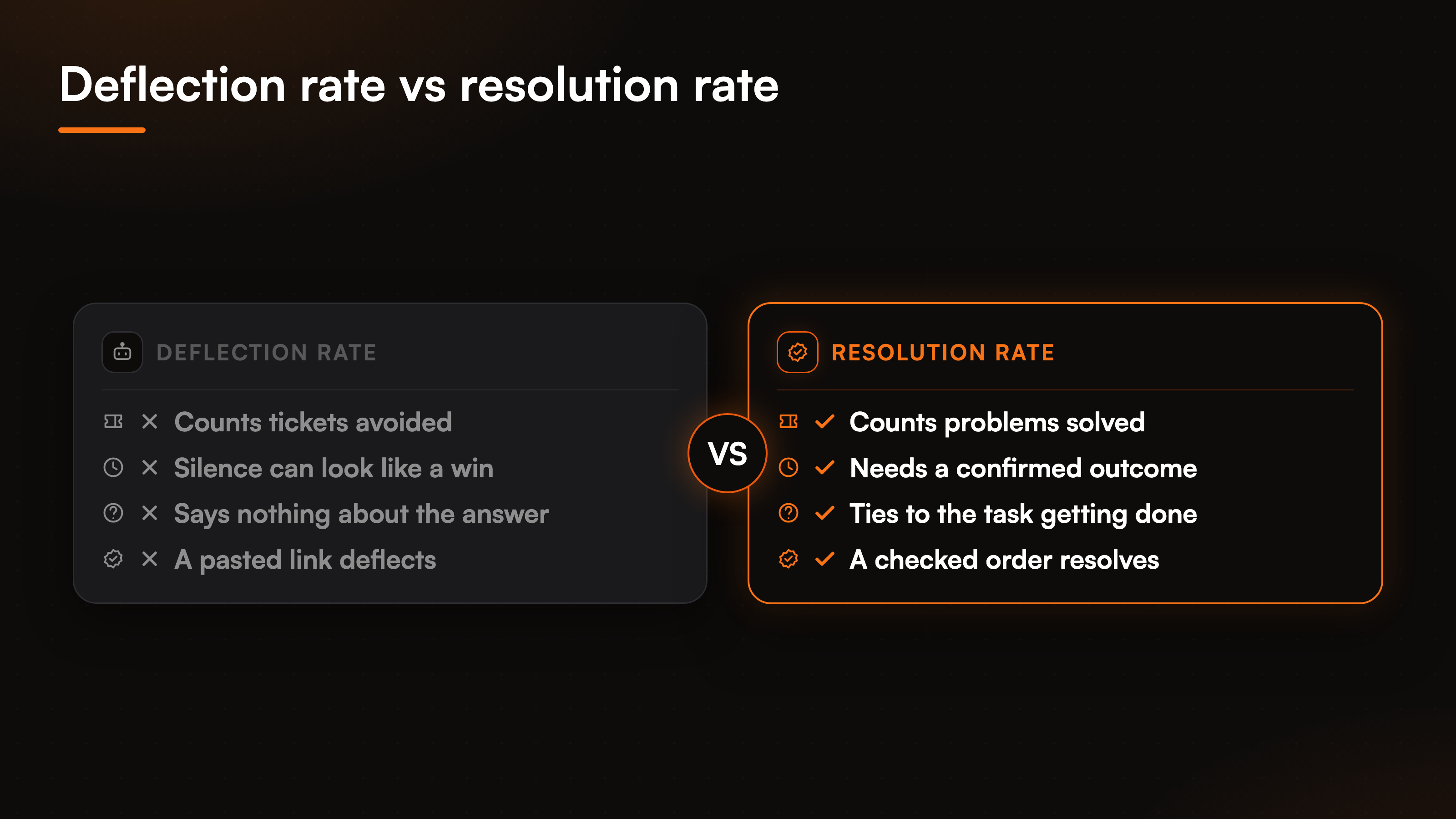
My take is that deflection and containment are useful guardrails but terrible headline numbers. They tell you where the work went, not whether it landed. Resolution is the one that maps to a customer who left happy, which is why we build toward it rather than toward a bigger deflection figure.
What actually moves the number
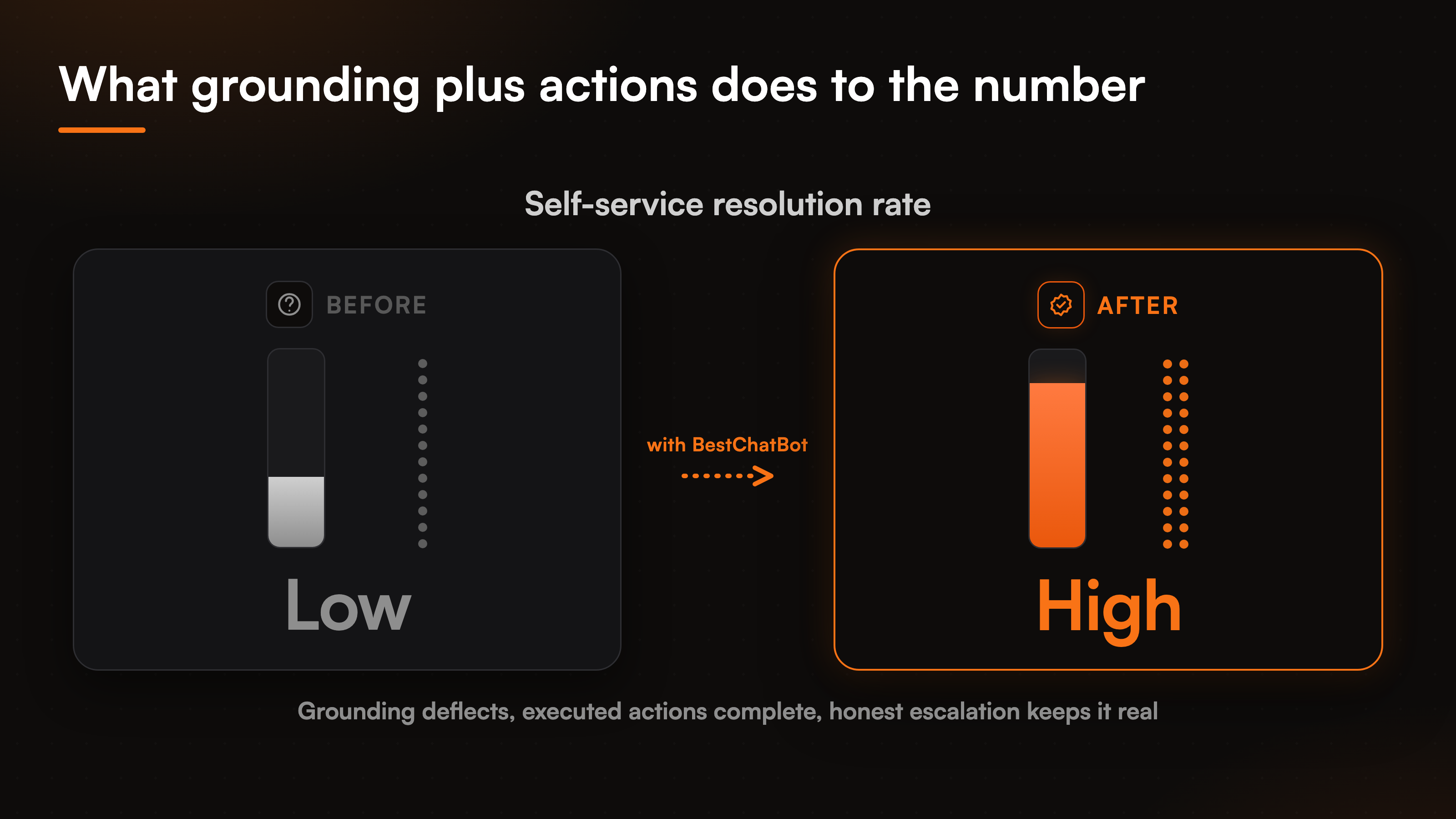
Three levers move resolution rate honestly, and all three are real mechanisms rather than dashboard tricks.
Grounded answering handles the repetitive, rule-bound questions that make up the bulk of a support queue. Because the widget answers from your content and declines when it is unsure, it resolves the questions it can and refuses to fake the ones it cannot. Action execution closes the gap the old answer-only bots left open: instead of telling a shopper where to look, an agent that takes real agentic actions checks the order and reports the status. Account-specific actions run only behind a verified visitor identity, with the email and name pinned from a signed token, so the agent acts for the right person or not at all. Honest escalation is the third lever, and it protects the number by keeping ticket handoffs out of the resolved count.
There is a plan reality worth stating plainly. Grounded answering is available from the Free tier up, while the agentic actions, the connectors and the 29 actions, come with Pro and Business. Automating the repetitive requests is what lifts a self-service resolution rate without gaming it, and it sits at the heart of any serious customer support automation effort. If you are still mapping out what belongs to the bot versus a person, our primer on AI customer service covers that split.
How to read your resolution rate honestly
A number is only as good as the habits around it. Measure over a fixed window, not since the beginning of time, because a lifetime average buries recent regressions. Pair the rate with a satisfaction score every single time. A climbing resolution rate next to a sinking satisfaction score is a warning, not a trophy, and it usually means the bot is closing conversations that were never really solved.
Segment the rate by question type before you celebrate it. Order-status questions resolve at a very different clip than billing disputes, and a blended 75% can hide a 95% on the easy intents and a 40% on the hard ones. Keep escalations in their own column so a busy handoff week cannot masquerade as a productivity win. Read this way, the metric earns its place in the weekly review. Read carelessly, it becomes a comfortable fiction.
FAQ
What is a good resolution rate for an AI support agent?
There is no universal number, because the rate depends entirely on your definition of resolved and the mix of questions you get. A store fielding order-status questions can sit far higher than a product with gnarly billing edge cases. Be suspicious of anyone quoting 90% or more without showing their satisfaction score and their definition alongside it.
How is resolution rate different from deflection rate?
Deflection rate counts the visitors who never opened a ticket, so it can climb just because people gave up. Resolution rate counts the conversations where the problem actually got solved. You can have high deflection and low resolution at the same time, which is exactly the signal a deflection-only view hides.
Does escalating to a ticket count toward resolution rate?
No. When the agent cannot resolve a request and files a ticket in Zendesk or Freshdesk, that is an honest handoff to your team, not a resolution by the agent. Counting escalations as resolved is the fastest way to inflate the number until it means nothing.
How can a chatbot actually improve resolution rate?
By resolving more requests on its own, not by guessing. Grounded answers close the repeatable questions and decline the ones outside their scope, while executed actions finish tasks the customer would otherwise wait on. Improvement comes from resolving and acting, never from a model bluffing its way to a bigger number.
Should abandoned chats count in resolution rate?
Treat an abandoned chat as unresolved. A visitor who left without an answer did not get helped, and folding those into the resolved bucket paints a rosier picture than your customers experienced. Track them separately so you can see whether the bot is losing people before it ever gets to act.
Resolution rate is worth tracking only when resolved means the same thing every week and the definition holds up to scrutiny. If you want to see which plan matches your conversation volume, and where grounded answering ends and paid actions begin, start with the AI support pricing guide, or work through the rest of our AI support agent resources.
See how these numbers relate to deflection versus containment.
Resolution rate is one of the support metrics that matter.