
RAG and Grounding Explained
RAG and grounding explained: how retrieval-augmented generation pulls answers from your own content, and why a grounded agent declines instead of guessing.
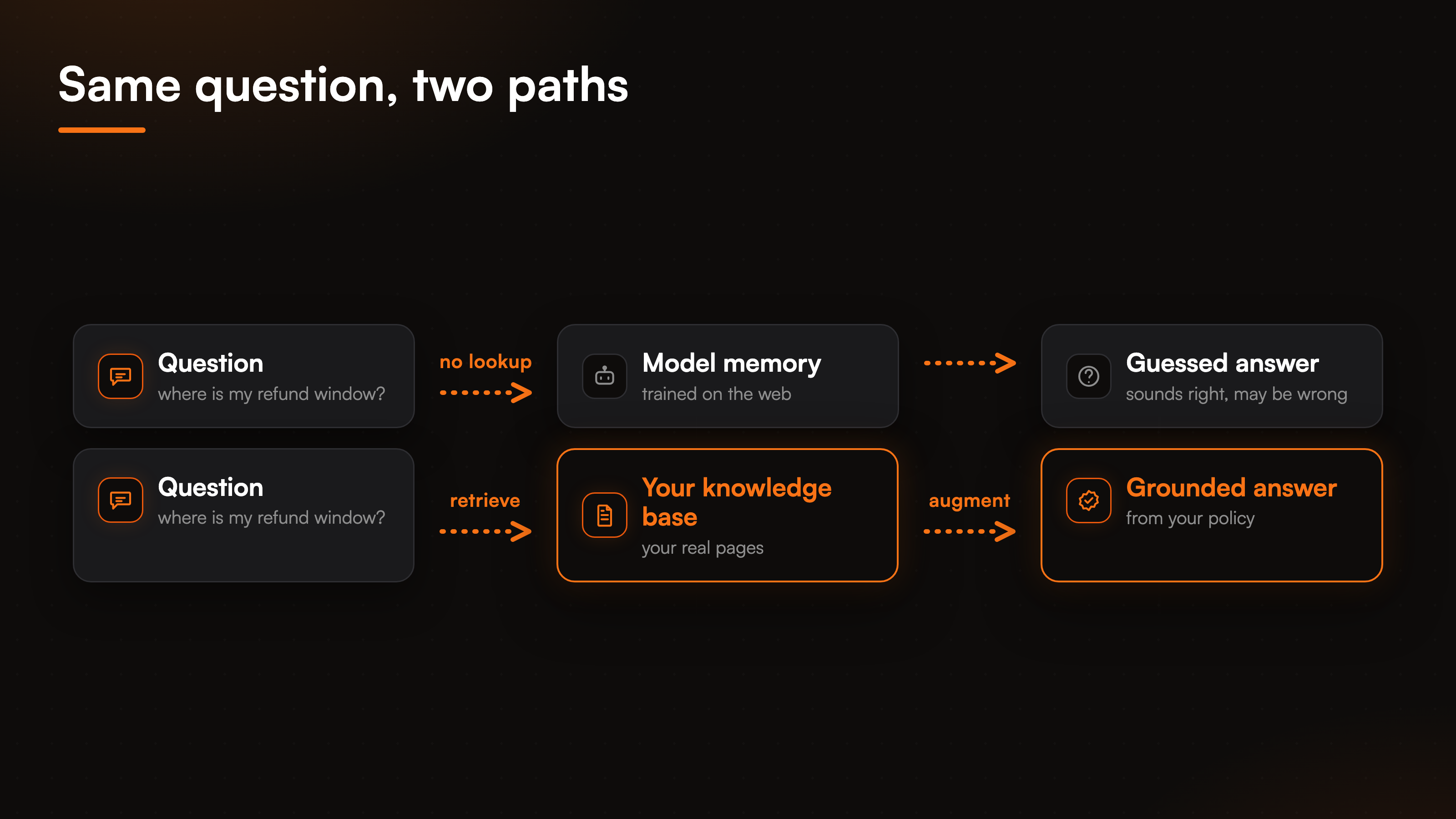
Ask a generic AI chatbot about your return window and watch what happens. It replies in a confident, well-formed sentence, and the sentence might be wrong. The model was trained on the public web, not on your policy page, so when it does not know your actual rule it fills the gap with something plausible. A shopper reads "you have 60 days to return this," plans around a number nobody at your company ever wrote down, and gets angry when reality disagrees.
Two ideas fix that failure, and people confuse them constantly. RAG, short for retrieval-augmented generation, is the mechanism that feeds the model your real content before it answers. Grounding is the discipline of answering only from that content and admitting when the answer is not there. This piece explains what is RAG in plain terms, how grounding sits on top of it, and what the pair looks like inside a support agent that has to be right in front of real customers.
What retrieval-augmented generation actually does
Start with the plumbing. A large language model on its own is a closed book. It knows what it saw during training and nothing about your business. RAG changes the order of operations. Before the model writes a single word, a retrieval step searches a knowledge base built from your own material, pulls the passages that match the question, and hands them to the model as context. The model then writes its reply from those passages instead of from memory.
So the shape is simple. A question comes in, the system retrieves the relevant chunks of your content, it augments the prompt with them, and only then does it generate the reply. That is the whole acronym. Retrieval, augmentation, generation. The clever part is not the writing, it is making sure the right three paragraphs of your documentation sit in front of the model at the moment it answers.
Here is why that matters more than it sounds. Without retrieval, a question about your refund policy gets answered from a blurry average of every refund policy the model ever read. With retrieval, the same question gets answered from your refund policy, the actual page, in front of it. One is a guess dressed as a fact. The other is a fact.
Grounding is the promise, RAG is how you keep it
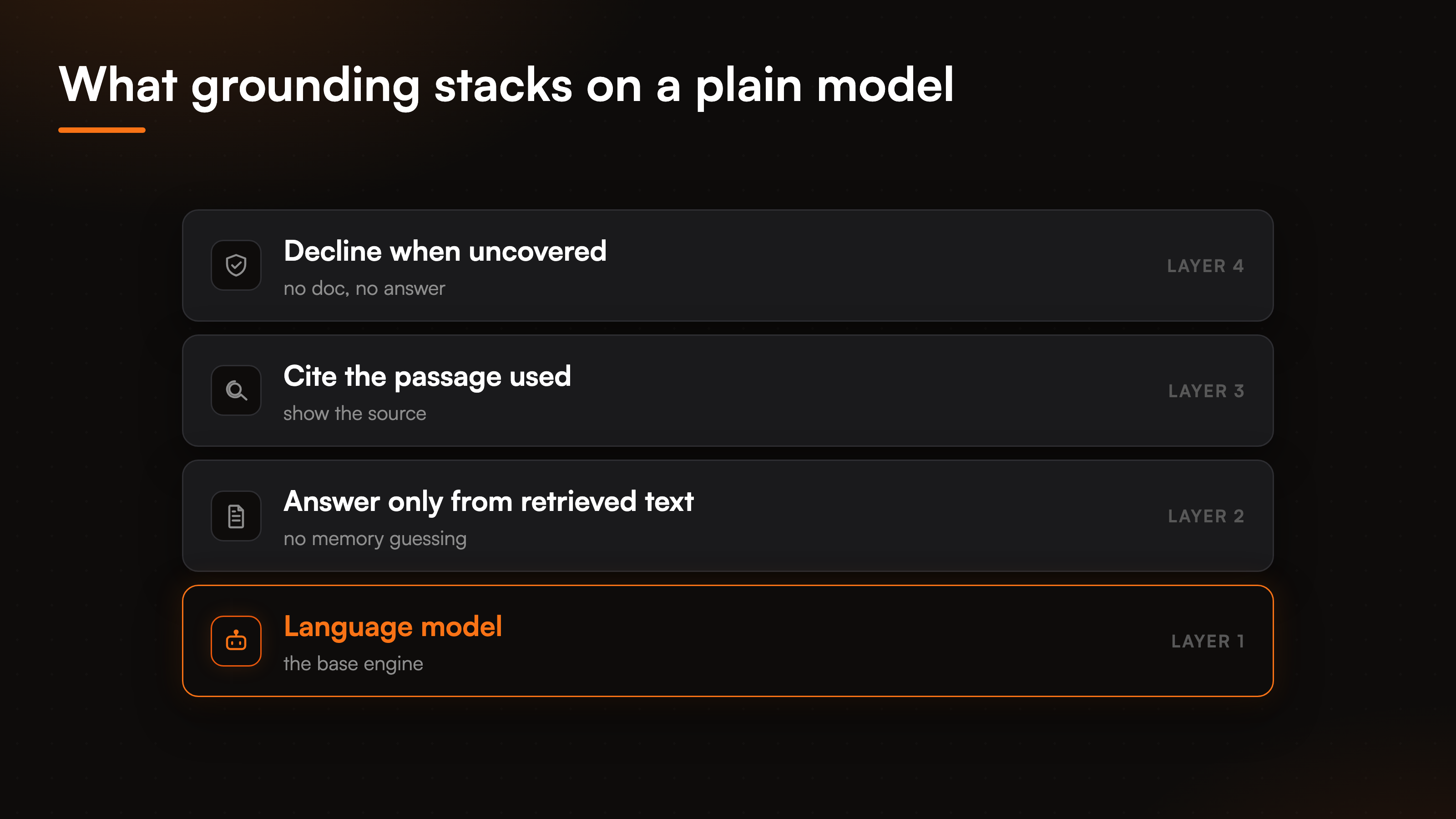
Retrieval gets the right content into the room. Grounding decides what the model is allowed to do with it. A grounded agent treats the retrieved passages as the only source of truth. If the answer lives in there, it answers and can point to the exact passage it used. If the answer is not in there, it says so instead of improvising.
That last behavior is the one people underrate. We built our own widget to decline rather than guess, because a support answer that is confidently wrong costs more than no answer at all. A wrong return window triggers a dispute. A made-up shipping date creates an angry email. An honest "I do not have that, let me route it to a person" is cheaper than a fluent lie every single time.
Grounding is really a stack of habits layered on top of a plain model. At the base sits the language engine that turns retrieved text into a readable reply. Above it, the rule that the reply may use retrieved content and nothing else. Above that, a citation so a reader can check the source. At the top, the refusal to answer when the content does not cover the question. Peel those layers away and you are back to a chatbot that sounds sure of itself and is right by luck. Our write-up on a no-hallucination support agent covers that refusal behavior in more detail.
RAG vs fine-tuning, and why grounding wins for support
There is a second way to make a model know your business: fine-tuning, where you retrain the model's weights on your data so the knowledge is baked in. It has a place, but for support it fights you. Fine-tuning bakes facts into a model that is slow to update, so the day your price changes you are stuck with a model that still quotes the old one until someone retrains it. RAG keeps the knowledge outside the model, in a knowledge base you can edit in minutes, so a price change is a document edit, not a training run.
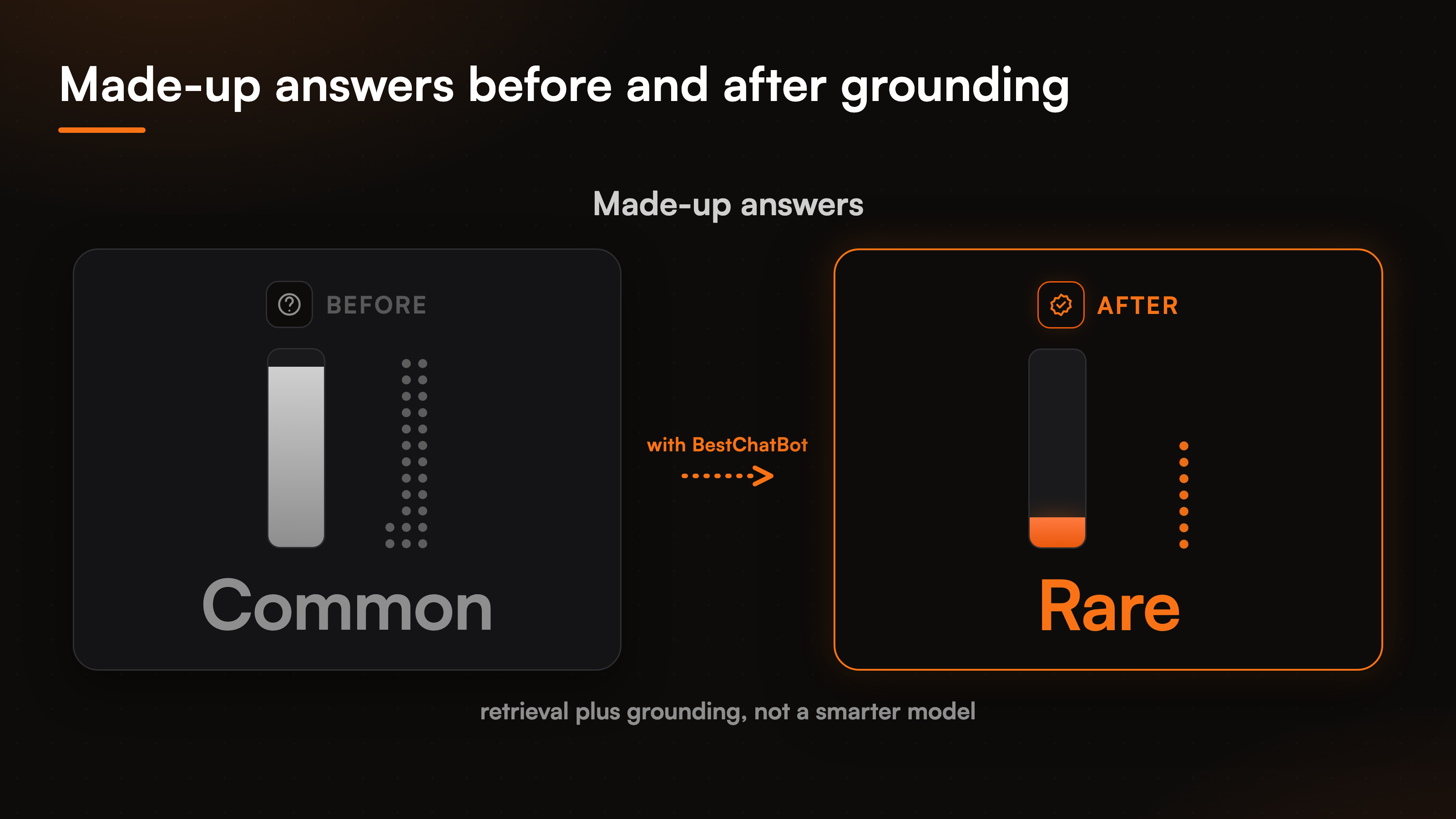
The comparison people should care about is not RAG vs fine-tuning on a benchmark. It is what each does to the rate of made-up answers. A plain or fine-tuned model with no retrieval answers everything, including the things it does not know, and a share of those replies are invented. Add retrieval and grounding and that share falls toward zero, because the model stops answering from memory and starts answering from your documents, then declines when the documents come up empty. That drop is exactly how retrieval and grounding reduce hallucinations in practice.
That trade, fewer answers overall but far fewer wrong ones, is the right one for anything customer-facing. A support team does not need a bot that answers 100 percent of questions at 80 percent accuracy. It needs one that answers the share it can ground and hands off the rest cleanly. When our agent cannot resolve something from your content, it does not stall. It files a ticket in Zendesk or Freshdesk and routes it to your team's inbox, so the customer lands with a human instead of a dead end.
What RAG and grounding look like in a support widget
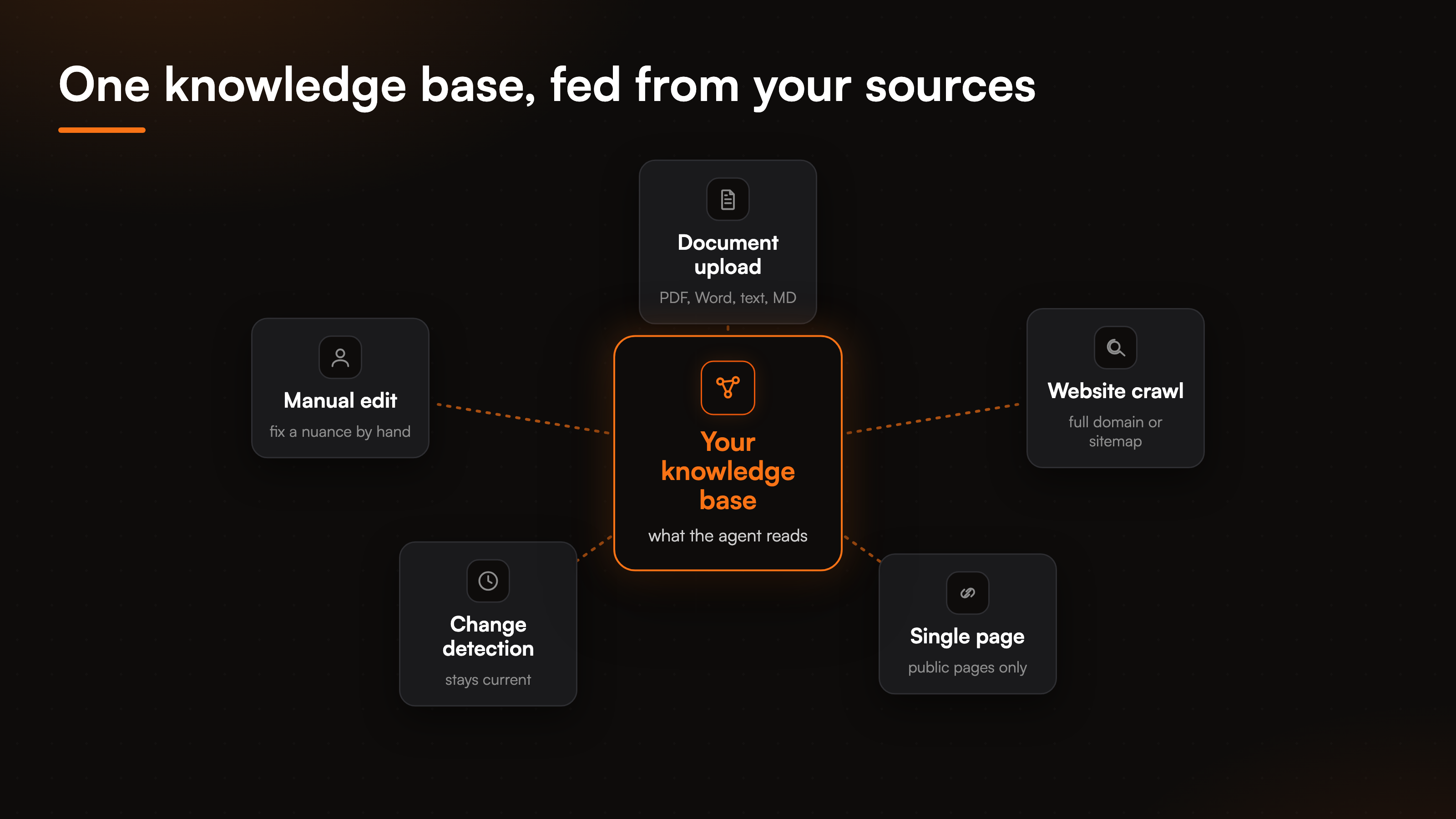
Definitions land better when you can watch them run. In our product the whole thing starts with the knowledge base, and that base is fed from sources you already have. You upload documents in PDF, Word, plain text, or Markdown. You point it at your website and it crawls the full domain, a sitemap, or a single page, pulling from public pages only and watching for changes so the content stays current. You can also edit an entry by hand when a crawl misses a nuance. The mechanics of turning a folder of files into answerable knowledge sit in our guide on a chatbot built from your docs. On top of the raw content sits a knowledge graph you can open in the dashboard, which is how the retrieval step finds the right passage instead of a bare keyword match.
Because the answer is grounded in that base, the agent can do the honest thing at both ends. When a question is covered, it answers and can cite the source, a toggle you control. When a question is not covered, it declines. And when the visitor asks for something tied to their account, the agent can move past answering into acting: it runs one of 29 prebuilt actions across 8 connectors, checking an order, booking a slot, starting a return, looking up a customer. Those actions are grounded too, in a different sense. A customer-specific action only runs once the visitor's identity is verified, with the email and name pinned from a signed token rather than from whatever they type.
Two honest limits keep this picture accurate. The agent does not teach itself. When an answer is wrong, a person reviews it in the dashboard and updates the knowledge, so it improves by decision, not by magic. And the action layer is a paid capability: grounded answers run from the free plan up, while the 29 actions and their connectors come with Pro and Business. If you want the reasoning behind an assistant that acts instead of only replying, our explainer on what agentic AI means walks through it, and the split from a plain bot is laid out in chatbot vs AI agent.
Where RAG and grounding fall short
RAG is not a cure for every failure. It only helps if the answer exists somewhere in your content, so a thin or outdated knowledge base produces a thin or outdated agent. Grounding makes the bot honest about the gap, and it still cannot invent the missing page for you. The fix is boring and human: keep the source material good, review the answers the agent gets wrong, and feed the corrections back in.
Retrieval also carries a failure mode of its own. If the search step pulls the wrong passage, the model will ground its answer in the wrong fact and sound just as confident doing it. That is why retrieval quality, the knowledge graph and how content gets chunked, matters as much as the model. A grounded agent is only as trustworthy as the base it reads from, which is the honest version of the pitch. This is a tool for answering from what you know, reliably, not a machine that knows everything. That boundary is the feature.
FAQ
What is RAG in simple terms?
RAG, or retrieval-augmented generation, is a method where an AI looks up relevant text from a knowledge base before it answers, then writes the reply from that text instead of from its training memory. The retrieval step puts your real content in front of the model, so the reply reflects your documents rather than a general guess.
What is the difference between RAG and grounding?
RAG is the mechanism that fetches your content. Grounding is the rule about how the answer uses it. A system can retrieve content and still ignore it. A grounded system answers only from what it retrieved, cites the source, and declines when the content does not cover the question. RAG supplies the facts, grounding enforces sticking to them.
Does RAG stop an AI from hallucinating?
It cuts hallucinations sharply and does not erase them. When the right passage is retrieved and the model is grounded to it, invented answers drop toward zero. Two things still bite: a retrieval step that pulls the wrong passage, and a knowledge base missing the answer entirely. Good source content and honest declining cover the rest.
RAG vs fine-tuning: which is better for a support chatbot?
For support, RAG usually wins. Fine-tuning bakes knowledge into the model, so every update means a retraining run and the model can still drift from your current facts. RAG keeps the knowledge in an editable knowledge base, so a policy change is a document edit that takes effect right away. Fine-tuning suits changing a model's style or format. RAG suits keeping it accurate on facts that move.
Can a grounded RAG agent take actions, not just answer?
Yes, when the product supports it. Grounded answering and action-taking are separate layers. In our case the agent answers from your knowledge base and, on the Pro and Business plans, runs 29 actions across 8 connectors like checking orders or booking appointments. Customer-specific actions require a verified identity before they run.
RAG and grounding are less a feature than a stance: answer from what you actually know, and say so when you do not. If you want to see which plan matches the volume of questions you would ground, start with the AI support pricing guide, or browse the rest of our AI support agent resources.