
What Is Agentic AI
What is agentic AI? A plain definition of the perceive, decide, act loop, how it differs from an assistant that only answers, and what it looks like in support.
For a few years the interesting question about AI was whether it could give you a good answer. Ask it something, get a paragraph back, judge the paragraph. That framing is starting to feel small. The newer question is whether the software can go and do the thing you asked for, not just describe how it would be done. That shift, from producing text to taking action, is what people mean when they say agentic AI.
The word gets thrown around loosely, so it is worth pinning down. Agentic AI is not a smarter chatbot or a longer answer. It is a system that can take a goal, decide the steps, and carry them out against real tools, then check whether the goal was actually met. This piece defines the term without the hype, shows how it differs from the assistant you are already used to, and grounds it in something concrete: what an agent that takes action looks like inside customer support, where the difference between talking and doing is easy to see.
What "agentic" actually means
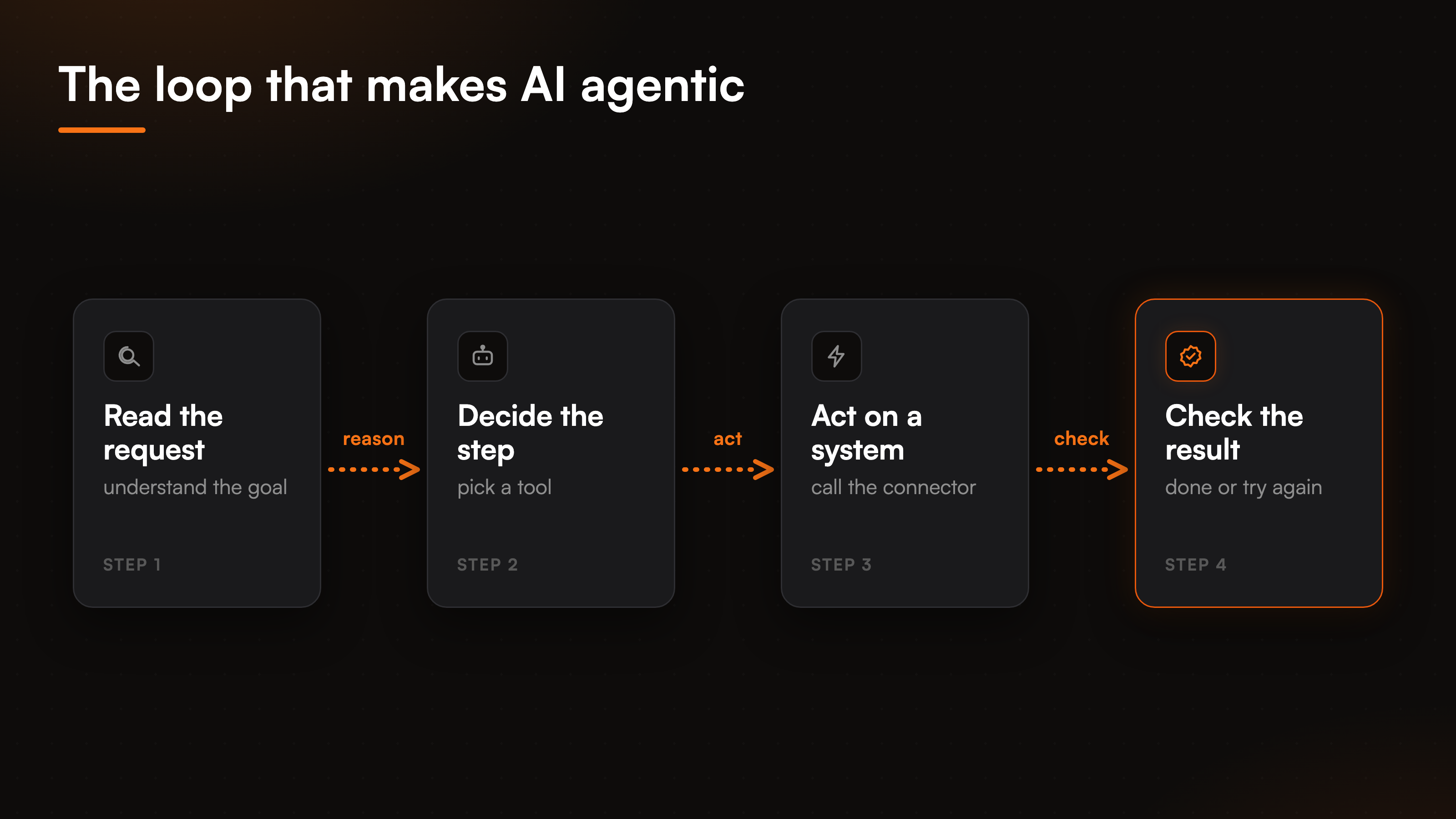
Strip away the marketing and agentic AI comes down to a loop. The system reads the situation, reasons about what to do, acts on a real system, and then looks at the result to decide if it is finished or needs another pass. A plain assistant stops at the first step and hands you words. An agent keeps going until the goal is met or it hits a wall it was told not to cross.
Here is the distinction that matters. A generative model predicts the next best token and produces language. An agentic system wraps that same model in a loop and gives it tools, so instead of writing "you can cancel your order in your account settings," it can actually call the store, find the order, and cancel it. The model is still the engine. Agency is the difference between an engine on a bench and an engine in a car that goes somewhere.
That loop is why agentic AI can fail in ways a chatbot cannot. A wrong answer is a wrong answer. A wrong action changes something in the world: a refund issued twice, an appointment booked for the wrong person, a subscription canceled by mistake. So the interesting engineering in an agent is rarely the reasoning. It is the part that decides when the agent is allowed to act at all.
Agentic AI vs an assistant that only answers
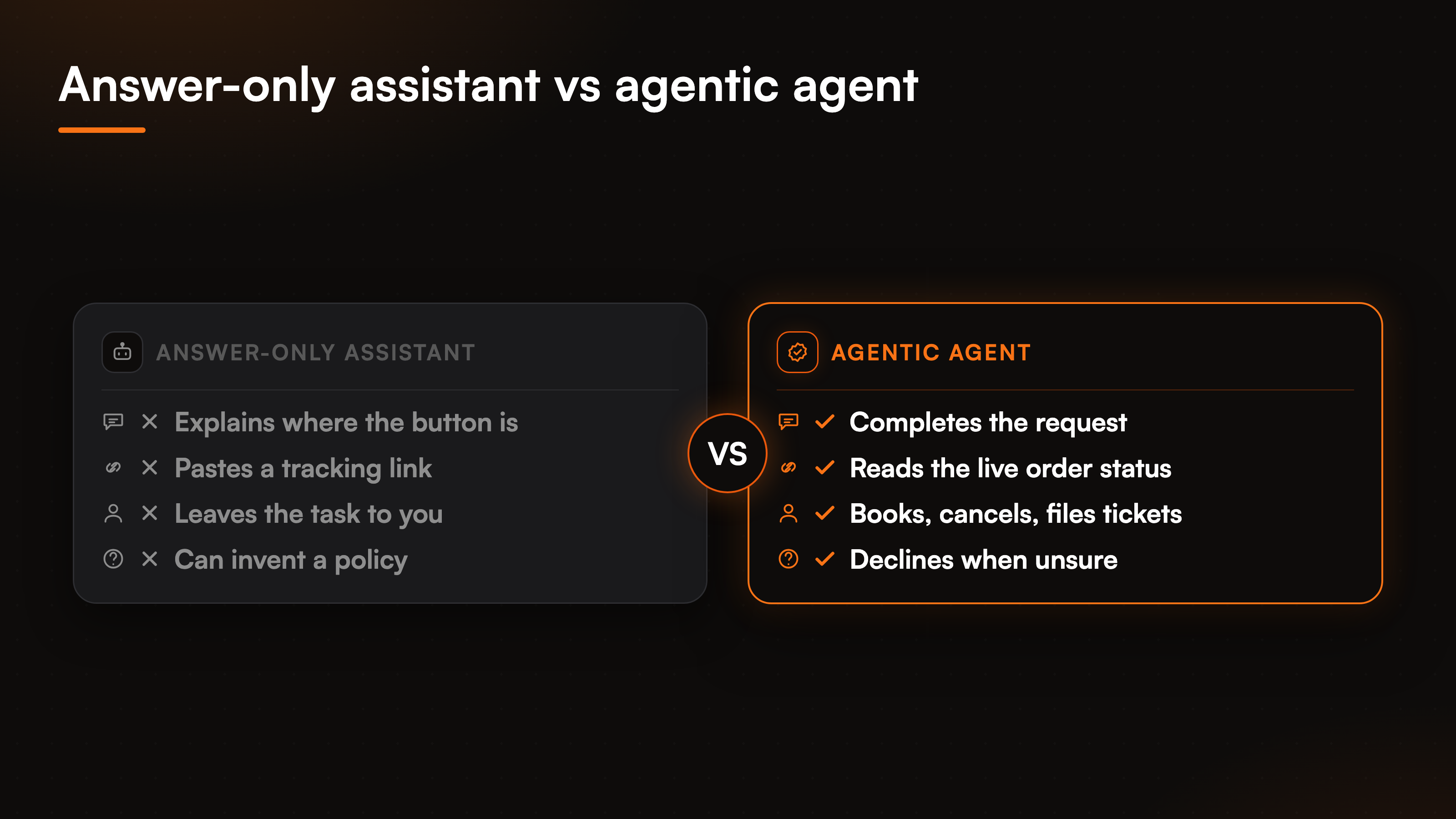
The clearest way to understand agentic AI is to put it next to the thing it replaces. Most people have used an AI assistant that answers questions. It reads your message, retrieves something relevant, and writes a reply. Helpful, but the work still lands on you. It tells you where the button is; you go press it.
An agentic system closes that last gap. When a shopper asks "where is my order," an answer-only bot pastes a tracking link or explains how to find one. An agent looks up the order against the store, reads the live status, and tells the shopper their package is out for delivery today. Same question, two very different outcomes. One describes the process, the other completes it.
We built our own product around exactly this line, because we think the value of AI in support is not cleverer phrasing, it is fewer half-answers that leave the customer with homework. An assistant that only answers is a search box with good manners. An agent is a colleague who handles the request.
The part that makes an agent safe: identity and guardrails
Giving software the power to act is the easy half. The hard half is making sure it acts only when it should, and only for the person who is allowed to ask. This is where a lot of "agentic" demos quietly skip the important work.
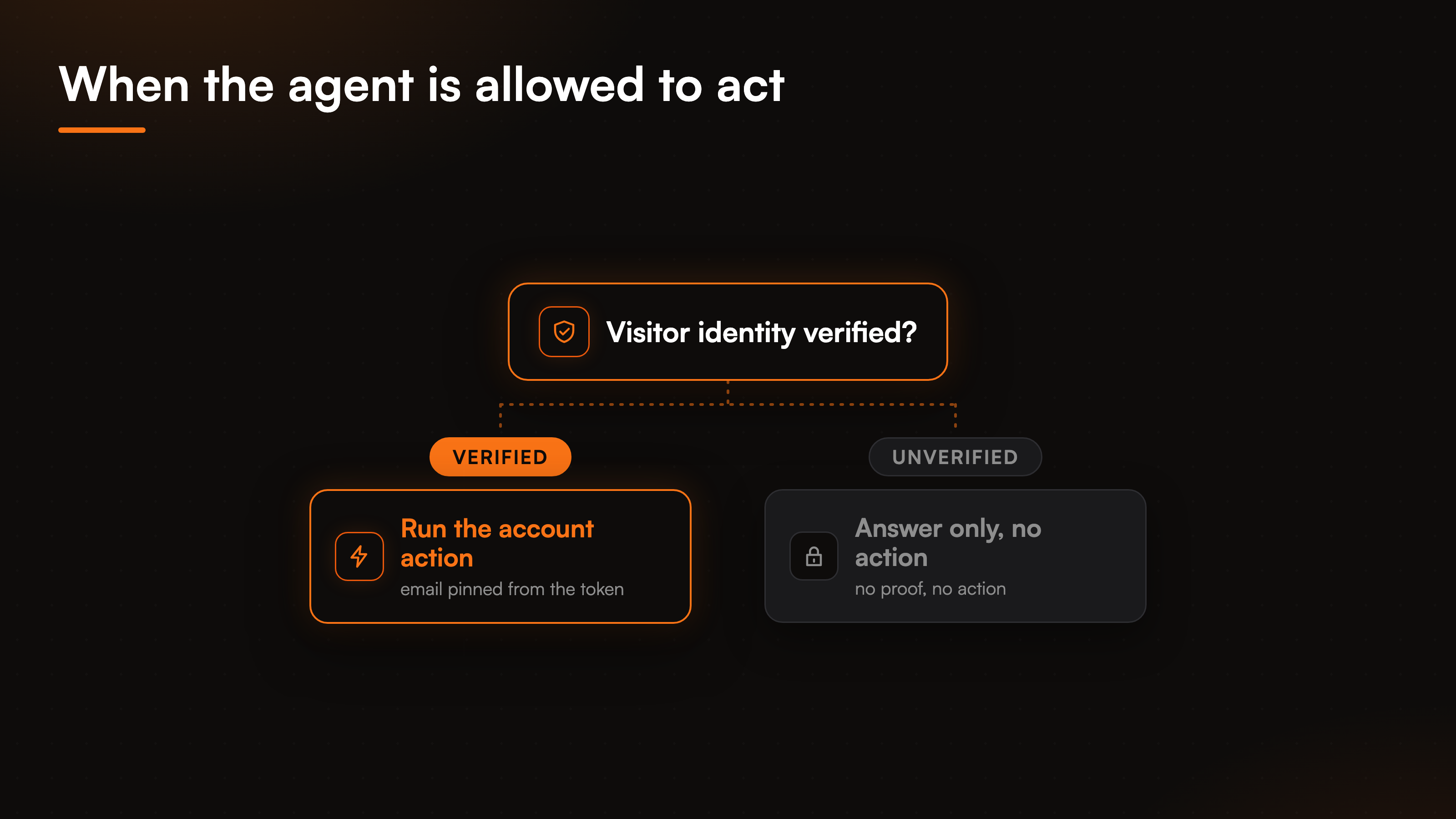
Consider the order cancellation again. Before an agent cancels anything, it has to know who is on the other end of the chat. Otherwise anyone could type "cancel order 4821" and the agent would obey. So a real agent gates customer-specific actions behind a verified identity. In our case the visitor's identity travels as a signed token, and the email and name the action uses are pinned from that token rather than from whatever the visitor types. No verified identity means the action does not run. The agent can still answer general questions, it just will not act on someone's account without proof of who they are.
Guardrails are the second layer. An agent is given a fixed set of things it is allowed to do and nothing more. It answers from the business's own knowledge and declines when a question falls outside it, instead of inventing a policy. When it genuinely cannot resolve something, it does not improvise. It files a ticket in Zendesk or Freshdesk and routes it to the team's inbox, so the request lands with a human instead of dead-ending. That combination, a verified visitor plus a bounded set of actions plus an honest handoff, is what separates an agent you can put in front of customers from a demo you can only show at a conference.
What agentic AI looks like in customer support
Definitions are easier to trust when you can see them working. Agentic AI in customer support shows up as an assistant embedded on a website that does not just talk about your systems, it reaches into them.
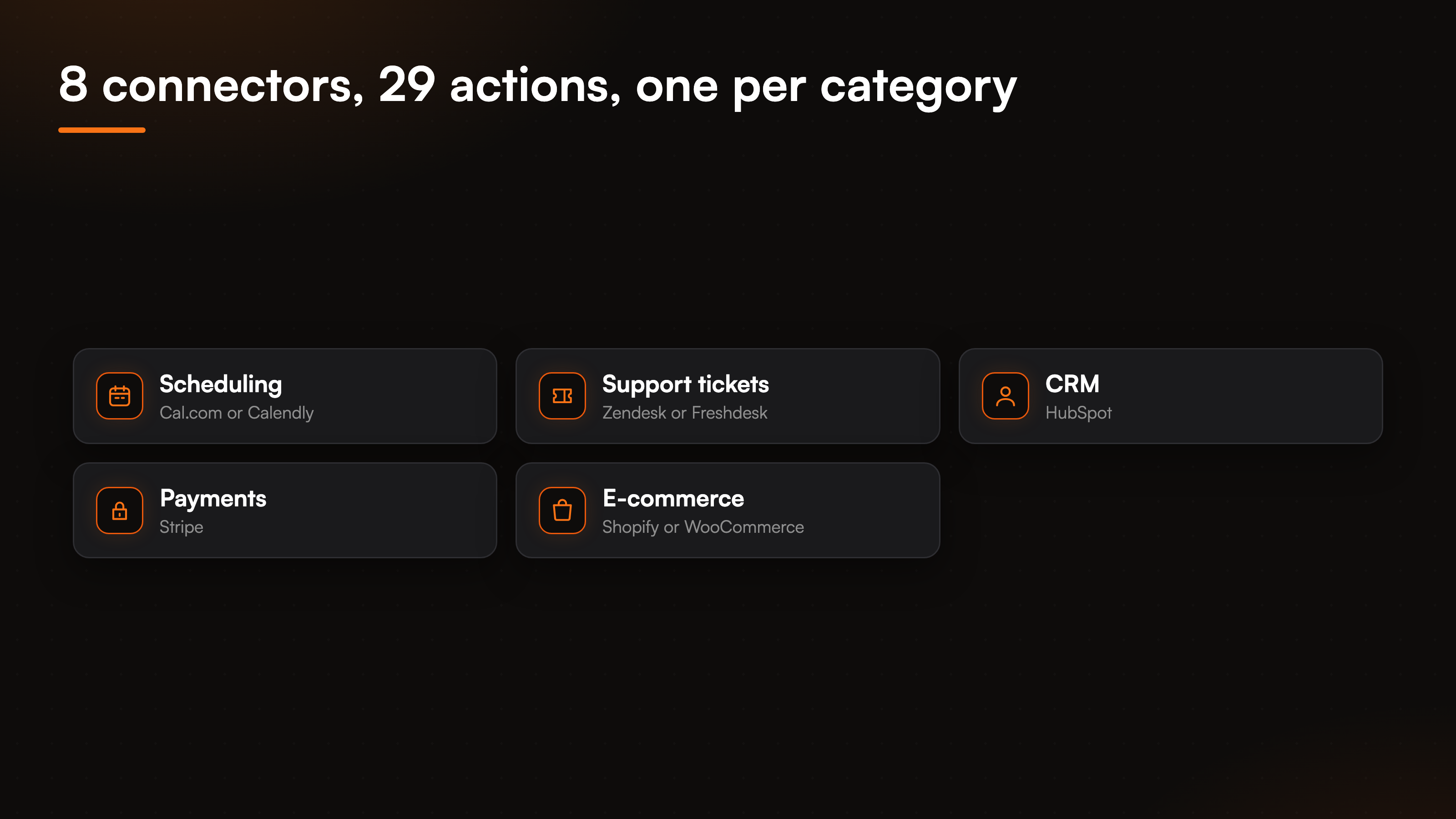
BestChatBot is an AI support agent you install as a web widget. It answers from the business's own content, declines when a question sits outside that content, and executes real actions through secure connections. There are 8 connectors and 29 prebuilt actions spread across scheduling, support, CRM, payments, and e-commerce, so the agent can check an order, book an appointment, start a return, look up a customer, or file a ticket without anyone wiring a connector by hand. The connectors are deliberately one per category: one calendar (Cal.com or Calendly), one help desk (Zendesk or Freshdesk), one store (Shopify or WooCommerce), rather than a vague promise of a hundred apps that half-work.
Two honest limits keep the picture accurate. The agent does not learn on its own; when an answer is wrong, a person reviews it and updates the knowledge, so improvement is a decision, not magic. And the action layer runs on the paid tiers. Grounded answering is available from the free plan up, while the agentic actions, the connectors and the 29 actions, come with Pro and Business. If you want the full catalog of what the agent can do, our overview of agentic actions for customer support lays them out, and the difference from an answer-only tool is covered in our piece on chatbot vs AI agent.
Where agentic AI helps, and where it does not
Agentic AI is a good fit for work that is repetitive, rule-bound, and tied to systems you already run. Checking an order, booking a slot, starting a return, answering the same policy question for the thousandth time: these are exactly the tasks where a bounded agent shines, because the steps are known and the risk of each action is small and reversible.
It is a poor fit for judgment calls, one-off exceptions, and anything where a wrong action is expensive and hard to undo. A grounded agent that declines and hands off is far more useful in those moments than one that guesses. The honest version of agentic AI is not "the AI does everything." It is "the AI does the bounded, verifiable work reliably, and knows exactly where its authority ends." That boundary is the feature, not a limitation, and it is why grounding matters as much as action. Our explainer on a no-hallucination support agent covers the answering side of that same discipline.
FAQ
What is agentic AI in simple terms?
Agentic AI is software that can take a goal, decide the steps, and carry them out against real tools, then check the result. A plain assistant reads your question and writes an answer. An agent goes further and completes the task, like actually checking an order status instead of explaining how you could check it yourself.
Agentic AI vs generative AI: what is the difference?
Generative AI produces content, usually text, by predicting what comes next. Agentic AI wraps a generative model in a loop and gives it tools, so it can act on systems rather than only describe them. The model is the same engine; agency is the ability to use it to get something done.
Is agentic AI safe for customer-facing work?
It can be, if it is bounded correctly. A safe agent verifies who the visitor is before running any action tied to their account, only performs a fixed set of allowed actions, answers from the business's own knowledge, and hands off to a human ticket when it cannot resolve a request. The safety comes from those limits, not from the model being clever.
What can an agentic AI support agent actually do?
In BestChatBot's case it answers from your content and runs 29 prebuilt actions across 8 connectors covering scheduling, support, CRM, payments, and e-commerce: checking orders, booking appointments, starting returns, looking up customers, and filing tickets. Customer-specific actions require a verified identity, and the action layer runs on the Pro and Business plans.
Does agentic AI replace human support agents?
No. It handles the repetitive, rule-bound requests reliably and files a ticket for the rest, which frees people for the judgment calls and exceptions where a wrong action would be costly. The point is division of labor, not replacement.
Agentic AI is less a breakthrough than a change in what you expect from the software: not a better answer, but a finished task. If you want to see where a grounded, action-taking agent fits your own support setup and which plan matches your volume, start with the AI support pricing guide, or browse the rest of our AI support agent resources.
Agentic AI builds on the conversational AI layer underneath.