
Chatbot vs AI Agent
The difference between a chatbot and an AI agent, explained as a spectrum: rule-based bots, NLP bots, grounded bots, and action-taking agents. Which one you actually need.
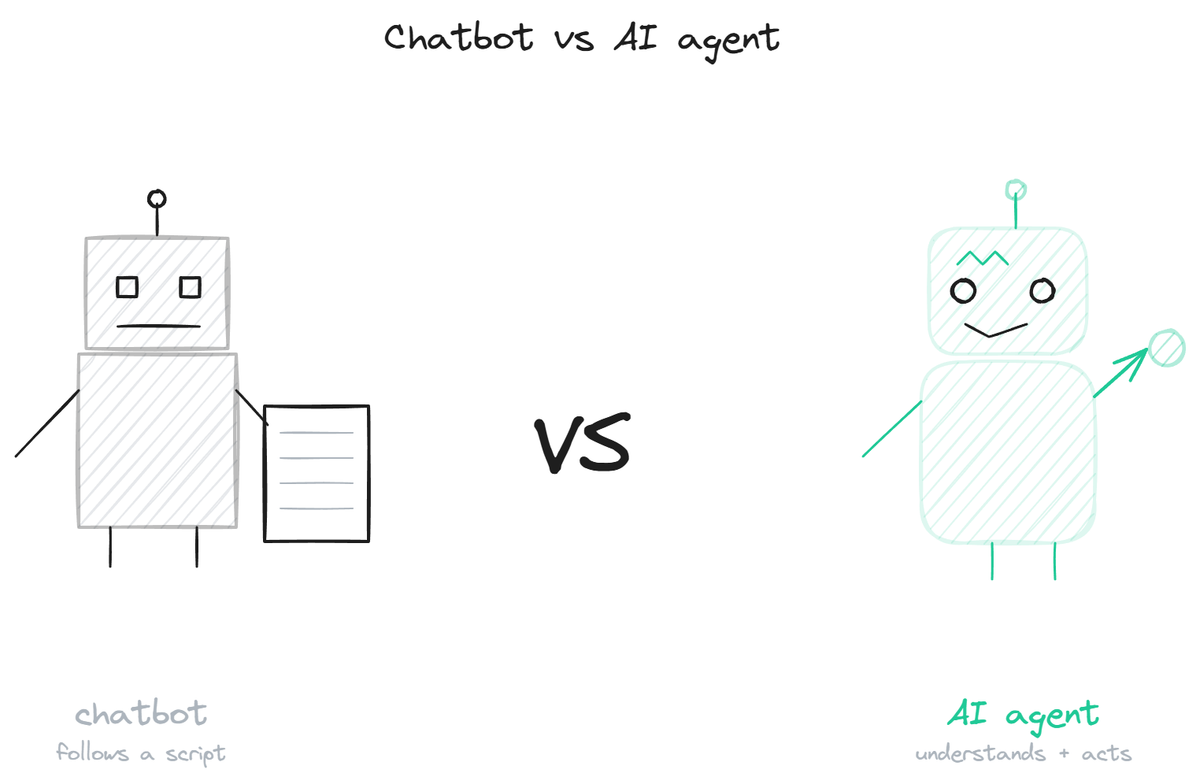
The terms chatbot and AI agent get used interchangeably, but they sit at opposite ends of a spectrum, and knowing where a tool falls on that spectrum tells you what it can actually do. At one end is the rule-based chatbot that matches keywords to scripted replies; at the other is the AI agent that understands language, answers from real knowledge, and takes actions. Between them are intermediate types that blur the line. This guide maps the full spectrum, explains what changes as you move along it, and helps you figure out which point on it matches what you actually need, so you are not paying for an agent when a chatbot would do or expecting agent behavior from a chatbot.
The spectrum from chatbot to agent
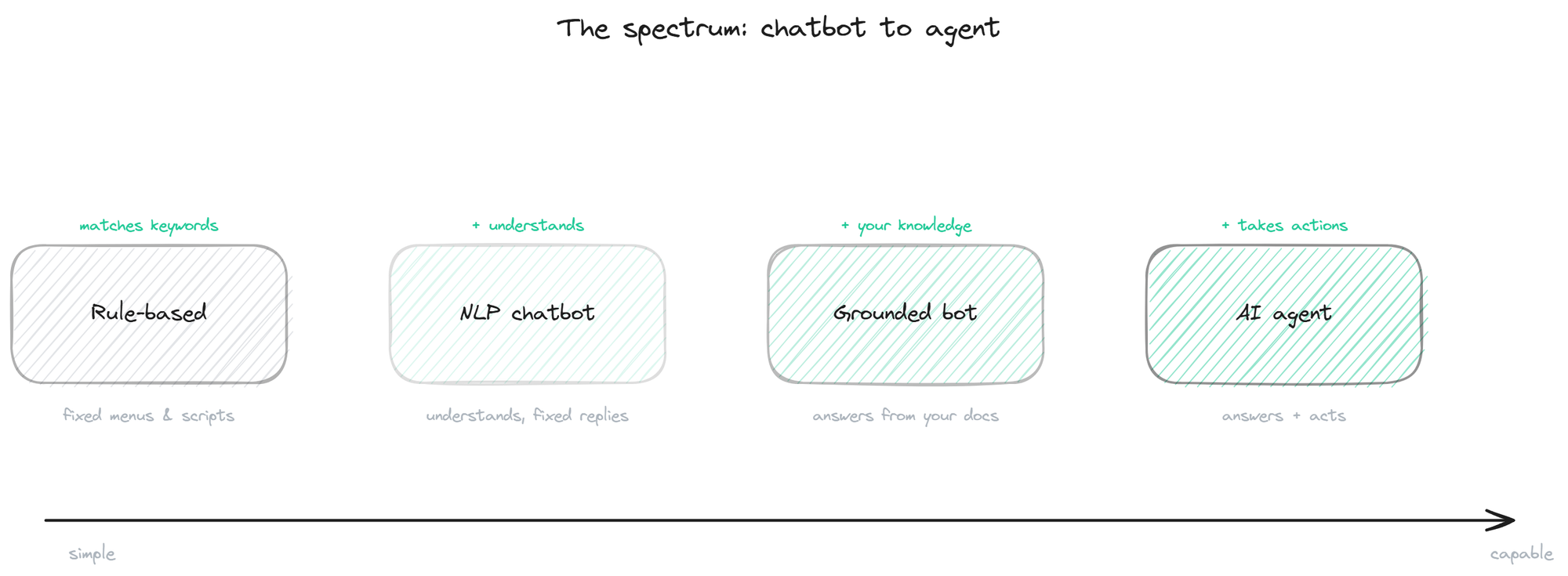
The spectrum has four rough stops, and each adds a capability the previous one lacked.
Rule-based chatbots are the simplest. They follow a decision tree or match keywords to canned responses, both written in advance. They do not understand language; they match patterns. They are predictable and cheap, and they break the instant a question falls outside their script. The frustrating "press 1 for billing" bots live here.
NLP chatbots add language understanding. They use natural-language processing to grasp what you are asking even when you phrase it unexpectedly, but they still return largely fixed responses from a predefined set. They understand better than rule-based bots but still mostly talk in pre-written answers.
Grounded bots add real knowledge. They retrieve answers from your actual documentation and generate responses from it, rather than returning canned lines, which means they can answer the long tail of questions about your specific business. This is where modern support bots that "answer from your docs" sit, and it is a large step up in usefulness.
AI agents add actions. On top of understanding language and answering from knowledge, they do things on your systems: look up an order, book a meeting, create a ticket. This is the capability that most justifies the word "agent," because the bot stops only describing and starts doing. The AI support agent guide covers this end of the spectrum in depth.
What changes as you move along it
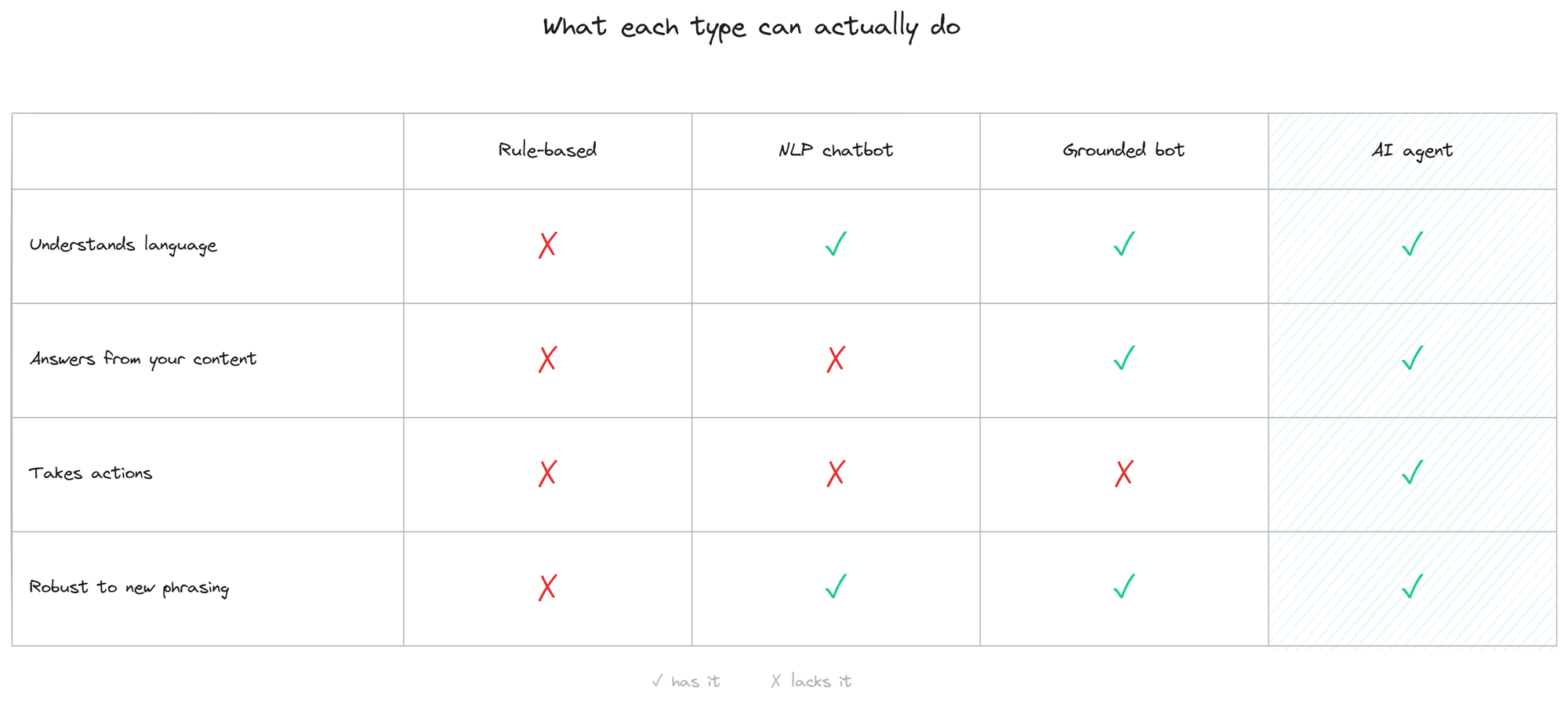
Three capabilities switch on as you move from chatbot toward agent, and they switch on in order.
Language understanding switches on at the NLP stage. Below it, the bot matches patterns and breaks on unexpected phrasing; at and above it, the bot grasps intent regardless of wording. This is the difference between a bot that feels like a keyword search and one that feels like it understood you.
Knowledge grounding switches on at the grounded-bot stage. Below it, answers come from a fixed set someone wrote; at and above it, answers come from your real content, so the bot can handle questions about your specific business that no one pre-scripted. This is the difference between a generic bot and one that knows your product.
Action-taking switches on at the agent stage. Below it, the bot can only give you information; at it, the bot can do the thing. This is the difference between "your order is in transit, here is how to change the address" and the bot actually changing the address for you.
Understanding the order matters because tools claim capabilities they do not have. A tool calling itself an "AI agent" while sitting at the NLP stage understands language but cannot act or answer from your content. The label is marketing; the capabilities are the reality, and the best AI support tools comparison evaluates tools on what they actually do rather than what they call themselves.
Which one you actually need
The right point on the spectrum depends on your job, and further along is not always better for your situation:
- If your support is a small set of fixed questions with fixed answers and nothing changes, a rule-based or NLP chatbot may be enough, and paying for an agent is overkill. These are rare cases, but they exist.
- If your support is mostly answering varied questions about your specific business, a grounded bot is the floor, because anything below it cannot answer the long tail accurately. Most support use cases need at least this, which is why "answers from your docs" has become the baseline expectation.
- If your support involves doing things, not just answering (checking orders, booking, creating tickets, processing returns), you need an agent, because a grounded bot will tell the customer how to do it themselves while an agent does it for them. For most modern support, especially in commerce and SaaS, this is where the real value is.
- The practical advice is to match the tool to the job, not to the label. Figure out whether you need to answer varied questions (grounded bot or above) and whether you need to take actions (agent), and choose the simplest point on the spectrum that covers your job. BestChatBot sits at the agent end, understanding language, answering from your content, and taking actions, for the common case where support means both answering and doing. To compare where different tools fall, see the best AI support tools page.
FAQ
- Is an AI agent always better than a chatbot? Not always; it depends on your job. If your support is a small fixed set of questions, a simpler bot may suffice. If you need to answer varied questions about your business, you need at least a grounded bot. If you need to take actions, you need an agent. Match the tool to the job, not to the label.
- What is the single biggest difference? Action-taking. A chatbot, at any stage, only talks: it gives you information. An AI agent does things on your systems. That shift from describing to doing is the line that most separates an agent from a chatbot.
- Why do so many tools call themselves agents? Because "agent" markets better than "chatbot." Many tools at the NLP or grounded stage call themselves agents despite not taking actions. The label is unreliable; test the actual capabilities (does it understand, answer from your content, and act?) rather than trusting the name.
- What is a "grounded" bot? One that answers from your real documentation rather than from a fixed set of pre-written responses. It retrieves the relevant content and generates an answer from it, which lets it handle questions about your specific business. It is the floor for most support use cases.
- How do I tell where a tool falls on the spectrum? Test three things: ask something phrased unusually (understanding), ask something specific to a business (grounding), and ask it to do something (action). The capabilities it has place it on the spectrum regardless of what it calls itself.
That jump from describing to doing is exactly the leap to agentic AI, which its own guide unpacks in full.
An agent knows when to hand off, escalating to a human agent.
Both are powered by the conversational AI behind both.