
Best AI Support Tools for Websites and Communities
The best AI support tools compared by grounding, action execution, and pricing. A tool-by-tool roundup for SMB and SaaS teams choosing in 2026.
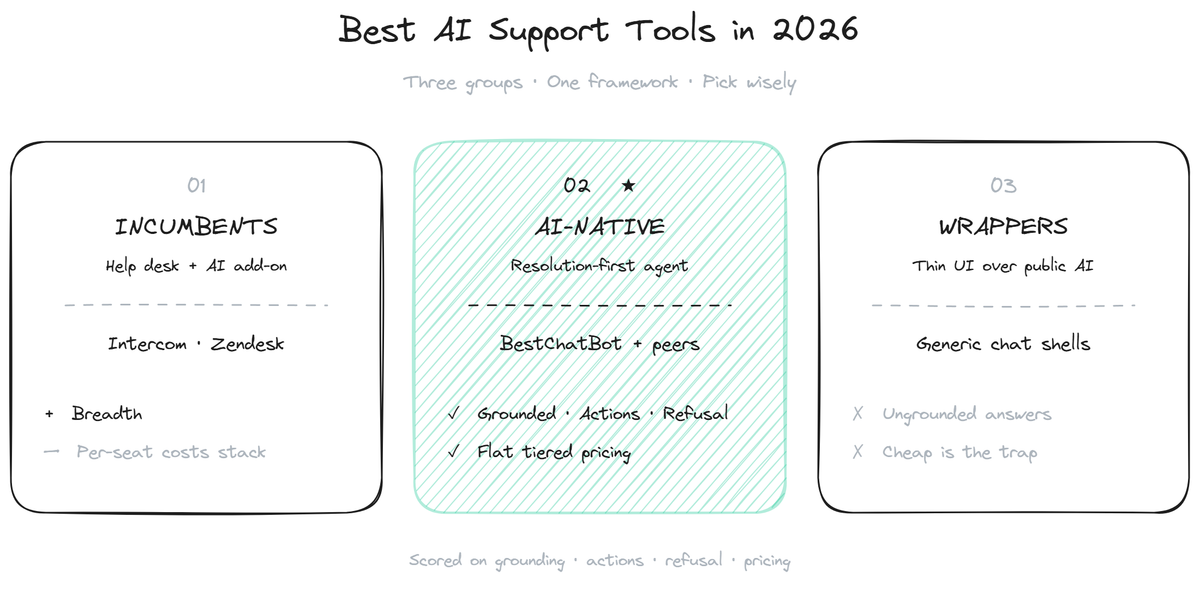
The best AI support tools in 2026 split into three groups, and knowing which group a tool belongs to tells you more than any feature list. The incumbents bolted AI onto existing help desk platforms. The AI-native tools built grounding and action execution from the start. The general-purpose wrappers put a thin layer over a public model with minimal grounding. This roundup goes group by group and tool by tool, scoring each on the four criteria that actually predict whether a tool works: grounding quality, action capability, honest refusal, and pricing transparency.
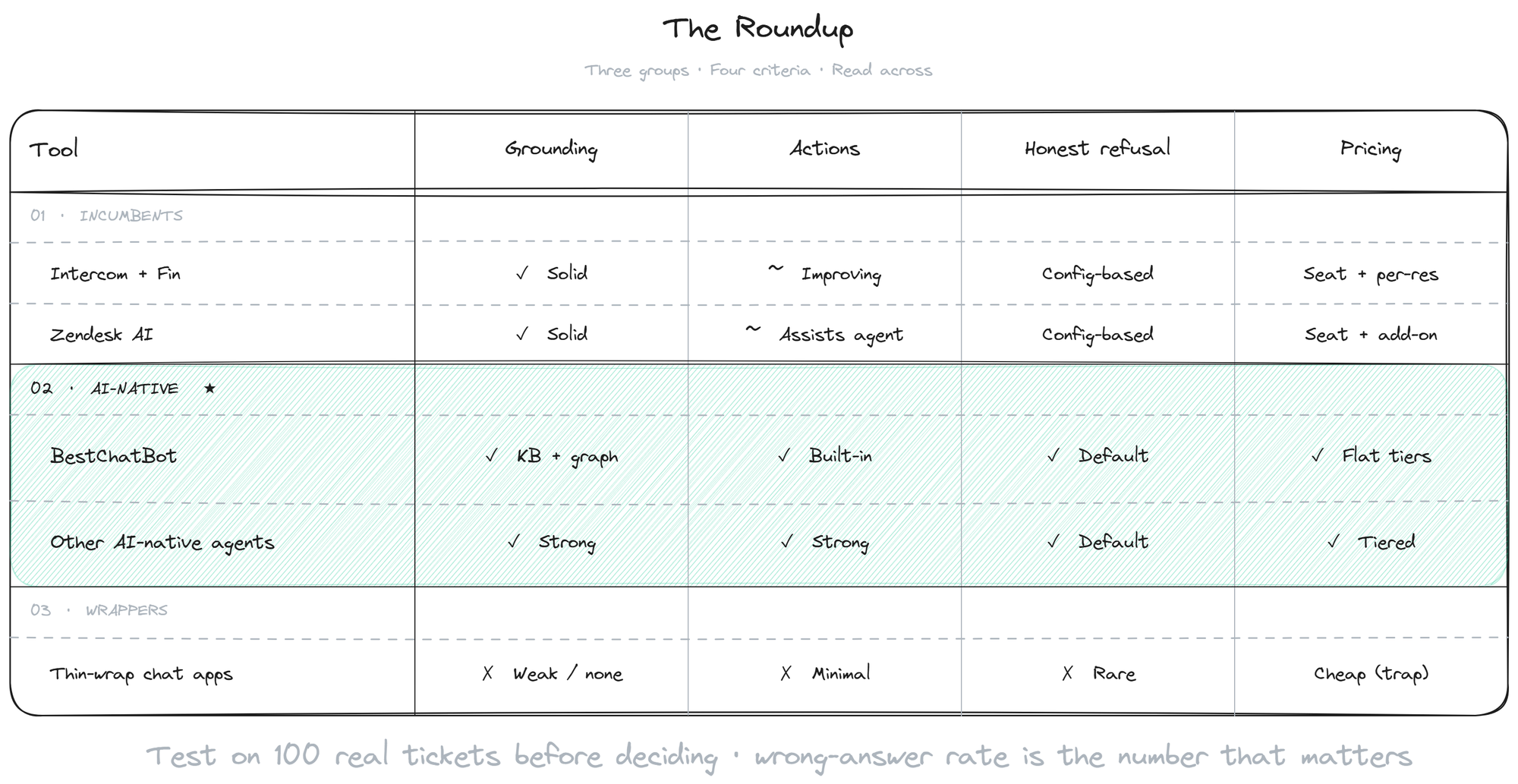
The four criteria, briefly
Before the tools, the scoring framework. Grounding quality: does the bot answer strictly from your content, and how good is its retrieval at surfacing the right passage. Action capability: can it only answer, or also do things (look up an order, book a meeting, fetch a billing date). Honest refusal: when it does not know, does it say so or guess. Pricing transparency: does the model scale predictably or surprise you at renewal. Every tool below is scored against these four.
Group 1: The incumbents
The incumbents are full help desk platforms with AI added on top. Intercom (with Fin AI) and Zendesk (with its AI agents) are the two most teams evaluate.
Their shared strength is breadth. These are complete platforms: ticketing, agent workspaces, multichannel support, reporting, large app marketplaces. The AI is one component of a much larger suite. For an organization that wants all of that in one place and has the budget, the breadth is real.
Their shared weakness for an AI-first buyer is that the AI sits on a ticket-first architecture, and the pricing reflects the whole platform. You pay for surface area you may not use, and the AI's per-resolution or add-on costs stack on top of platform and seat fees. The head-to-head detail lives on the Intercom alternative and Zendesk comparison pages. On the four criteria: grounding is solid, action capability is improving but answer-focused, honest refusal depends on configuration, pricing is the weakest dimension for a focused buyer.
Group 2: The AI-native tools
The AI-native tools were built around grounded answering and action execution from the start, with ticketing as a connection rather than the core. BestChatBot sits here, alongside other purpose-built support agents.
The enterprise-grade agentic vendors sit in this group too. See how BestChatBot compares as a Sierra alternative, as a lighter Forethought alternative, and as a Decagon alternative.
The shared strength is the AI itself. Grounding tends to be sharper because it is the whole product, not a feature. Action execution is more aggressive: these tools push hard on the bot doing things (order lookup, booking, billing queries) rather than just answering. Honest refusal is more often a default than an option. Pricing is usually flat and tiered by volume, which forecasts cleanly.
The shared weakness is the absence of a full help desk. No shared inbox with decades of workflow features, no deep SLA reporting, no marketing-and-tours suite. These tools connect to a help desk (Zendesk, Freshdesk) for ticket handoff rather than replacing it. On the four criteria: grounding strong, action capability strong, honest refusal strong, pricing transparent, breadth limited.
BestChatBot specifically grounds with a knowledge graph layer on top of vector search, executes actions across Shopify, Stripe, Calendly, HubSpot and others, refuses honestly by default, and improves through a supervised autolearning loop. The trade-off is the same as the rest of the group: a focused support agent, not a platform.
Group 3: The general-purpose wrappers
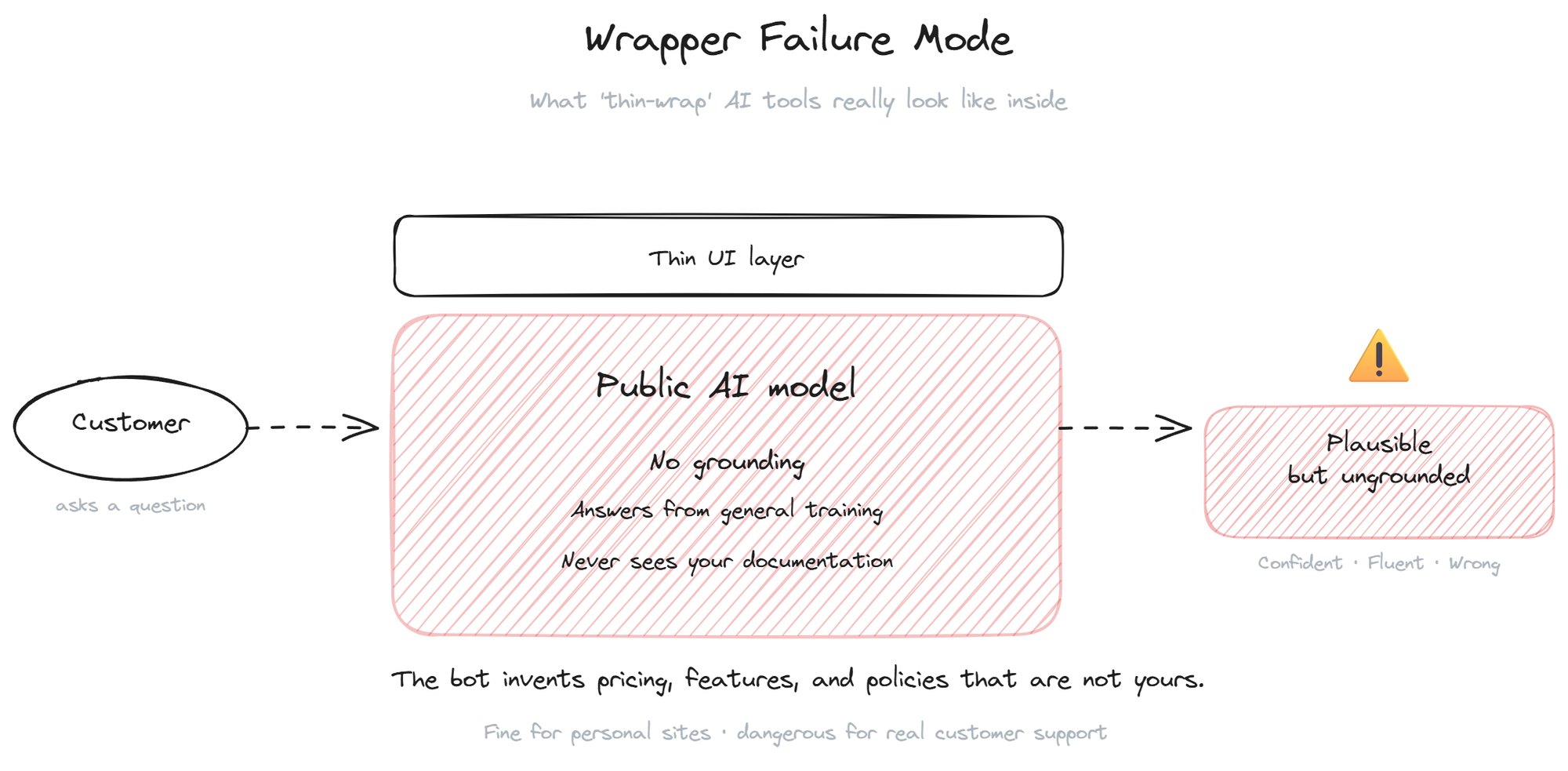
The third group is the one to avoid for most support contexts. These are thin interfaces over a public language model with little or no grounding in your content. They are cheap, fast to deploy, and dangerous for support, because they answer from the model's general training data rather than your documentation.
The failure mode is predictable: confident, fluent, wrong. The wrapper invents pricing, describes features you do not have, quotes policies that are not yours. For a low-stakes use case (a personal site, an internal experiment) the convenience can be worth it. For any support context where a wrong answer has a cost, the lack of grounding makes them unsuitable. On the four criteria: grounding weak or absent, action capability minimal, honest refusal rare, pricing cheap but the cheapness is the trap.
How to run your own evaluation
The roundup above is a starting filter, not a substitute for testing on your own content. The evaluation that produces a real answer takes about a day.
Pick two or three candidates, usually from the AI-native group plus whichever incumbent you already lean toward. Point each at your actual documentation. Run the same 100 historical support tickets through every candidate. Score each answer as correct, partial, wrong, or refused. The tool with the lowest wrong-answer rate on your own content has the best grounding for your use case, regardless of where it landed in any roundup. The reduce hallucinations page covers why the wrong-answer rate is the single most important number in the whole evaluation.
Then test action execution on your real systems if transactional support matters, and model total cost at your actual volume rather than comparing list prices. The combination of those three tests beats any listicle, including this one.
FAQ
- What is the single best AI support tool? There is no single best; it depends on whether you need a focused agent or a full platform, and on whether your support is resolution-first or ticket-first. The AI-native group wins on answer quality and action capability; the incumbents win on breadth. Test the top candidates on your own content to decide.
- Are the cheap general-purpose tools ever worth it? For low-stakes uses (personal sites, internal experiments) the convenience can justify the lack of grounding. For any customer-facing support where wrong answers have a cost, the grounding gap makes them a poor choice regardless of price.
- Do AI support tools replace my help desk? The AI-native ones connect to your help desk for escalations rather than replacing it. The incumbents are the help desk. Decide whether you want to add an AI layer to your existing stack or consolidate everything in one platform.
- How important is action execution really? It depends on your question mix. If your support is mostly informational, answer-only tools cover it. If it is heavily transactional (order status, billing, booking), action execution resolves questions that answer-only bots can only deflect, which often makes it the deciding factor.
- How do I compare pricing across such different models? Model your actual monthly volume rather than comparing list prices. Per-resolution, per-seat, per-conversation, and flat-tier models produce very different bills at different volumes. Build a realistic estimate for each candidate at your numbers. For BestChatBot's tiers, see pricing.
For pricing details, see plans.
Want the head-to-head on one of these builders? Read a closer look at Chatbase alternatives.
For the small-business side of the market, see how the Tidio alternatives stack up.
If Intercom is your current baseline, see the best Intercom alternatives ranked.
For a focused breakdown, read the dedicated Ada alternative.
If Drift is on your shortlist, see a Drift alternative built to act.
See the Crisp alternative comparison.
Best Gorgias alternative for ecommerce: an AI support agent that resolves order-status, returns, and product questions grounded in your store data.
Prefer one-on-one comparisons? See how BestChatBot stacks up against Chatbase or BestChatBot versus Tidio.
Weighing tools on whether they can actually do things? Compare support AI that executes real actions against answer-only bots.