
Best Tidio Alternative for AI Support
The best Tidio alternatives for AI support, ranked. Agents that resolve the ticket and decline instead of guessing, not just live chat with a bot bolted on.
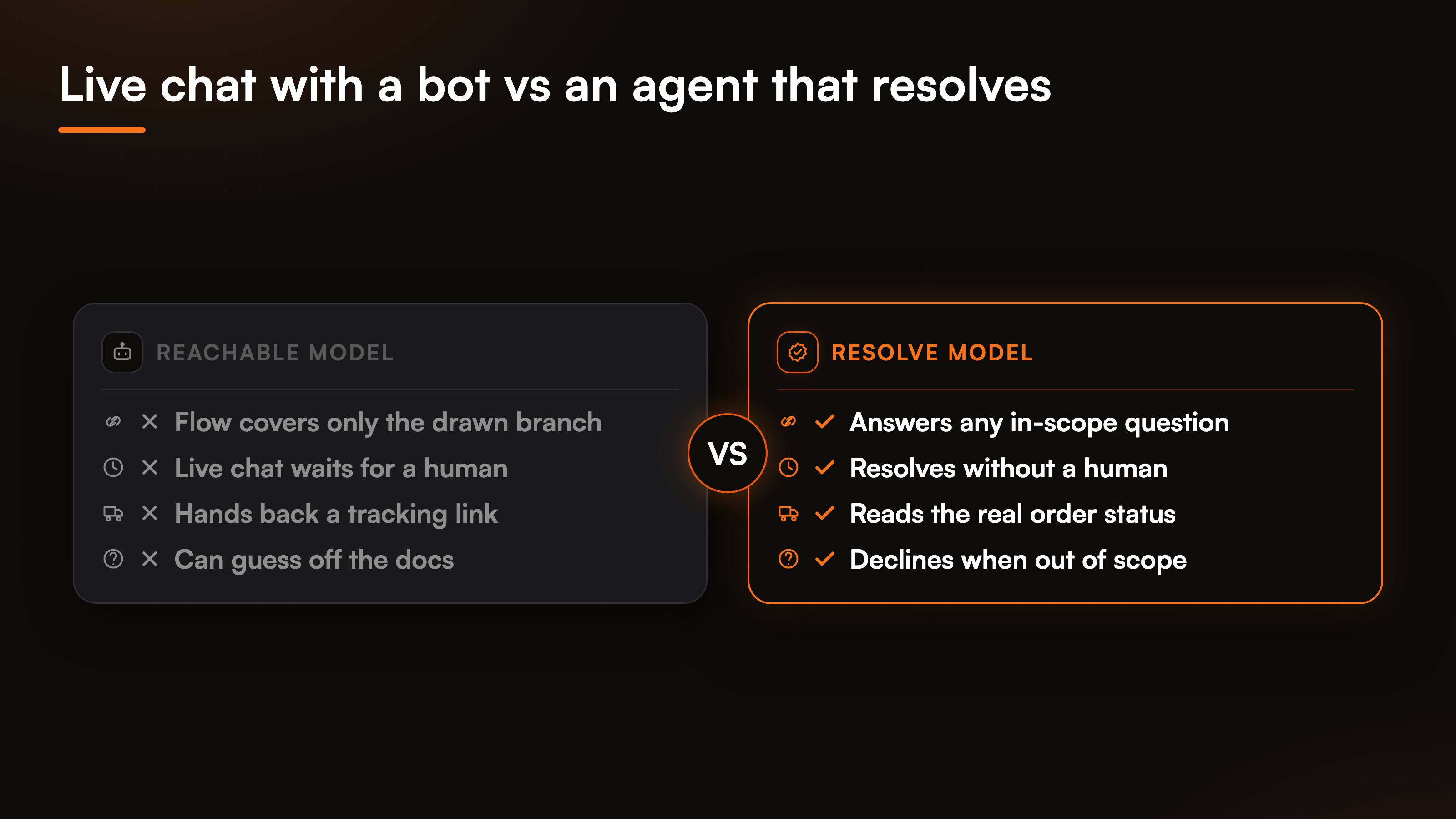
Tidio puts a friendly chat bubble on your store with live chat, a few rule-based flows, and an AI assistant called Lyro, all in one box. For a small shop that mostly needs a human to be reachable, that works. The trouble starts as volume climbs. Every repeat question about shipping windows, return windows, and "where is my order" still funnels back to a person, because a flow built from if-this-then-that branches only handles the path you drew, and live chat is only as fast as whoever is online. The cost of answering the same five questions forty times a day sends teams looking for a Tidio alternative.
The question underneath that search is not "who has a nicer widget." It is "what resolves the ticket on its own without making something up." A bot that hands back a tracking link instead of the actual order status has not resolved anything, it delayed the email that follows. An assistant that invents a confident refund policy that was never in your help center creates a worse problem than no answer at all.
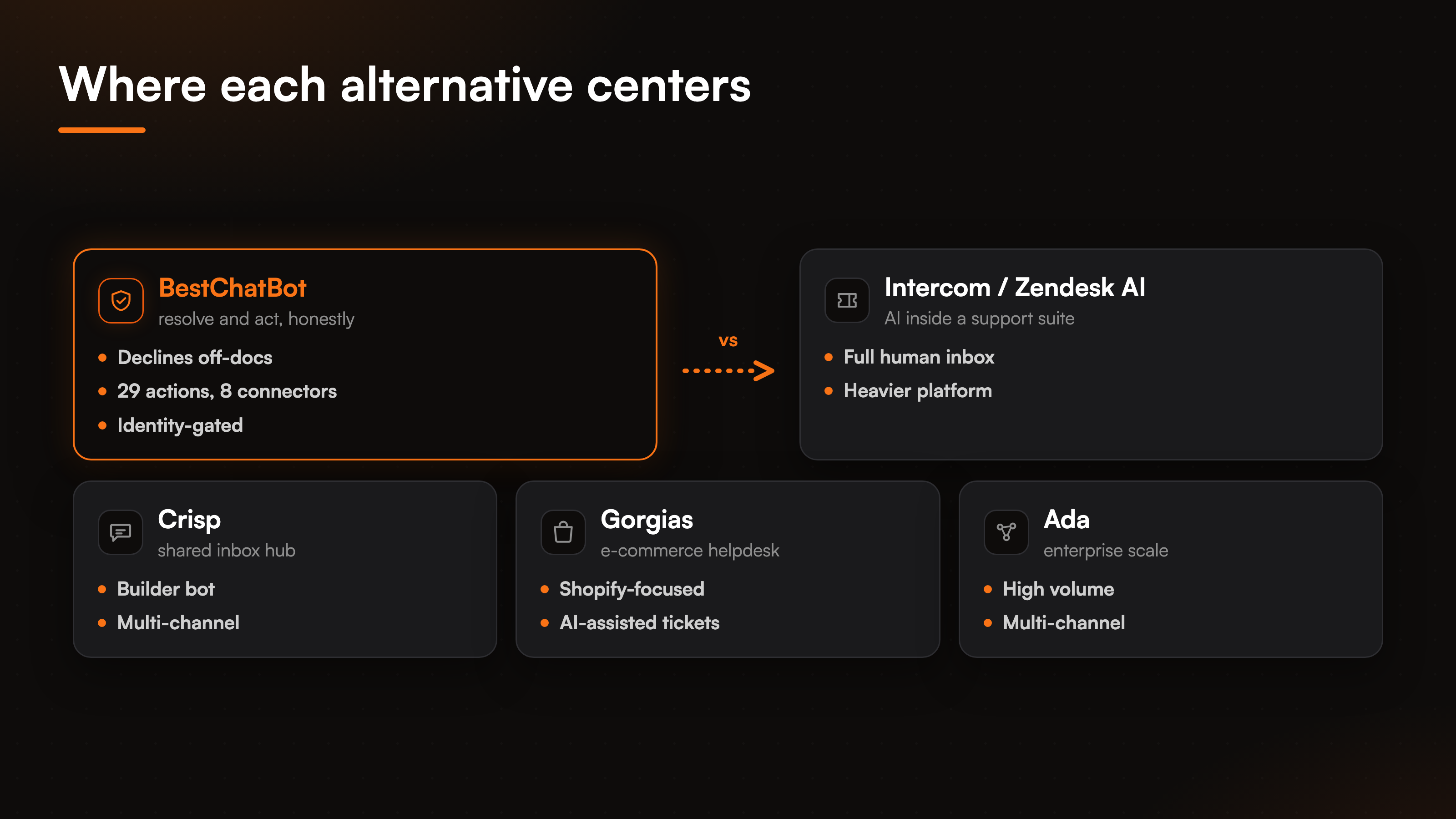
This post ranks the best Tidio alternatives worth a look, what each is built around, and who it fits. BestChatBot sits first because it targets the resolve-it-honestly job rather than the be-reachable job, and we are specific about how. For the others we stay general and fair, describing what each tool centers on, not invented prices or limits we cannot stand behind. Tidio is the starting point, so it is not listed against itself.
1. BestChatBot, built to resolve, not just chat
BestChatBot is an AI Support Agent for Business Websites. Like Tidio it trains on your own content and embeds as a website widget, but the design goal differs from the ground up. Tidio centers on a human being reachable, with a bot helping out. BestChatBot centers on the agent closing the loop itself, and handing off only when it genuinely should.
Two mechanisms carry that. The first is grounding. A model trained on your docs still generates text, so the moment a question lands outside what you uploaded, the easy failure is a fluent, wrong answer. BestChatBot answers only from your indexed knowledge, and when a question falls outside it, the agent says so instead of improvising. Ask "do you ship to Canada" and it pulls the real line from your shipping page, or replies "I do not have that detail, let me route it to the team." It will not hand back a guessed yes. The agent can cite the source it used, a toggle you control, so a reader can verify the claim. We hold that bounding answers to retrieved content beats clever prompting, because no prompt reliably stops a model from confabulating once a question pushes past what it knows. The full mechanism lives in the no-hallucination AI support agent write-up.
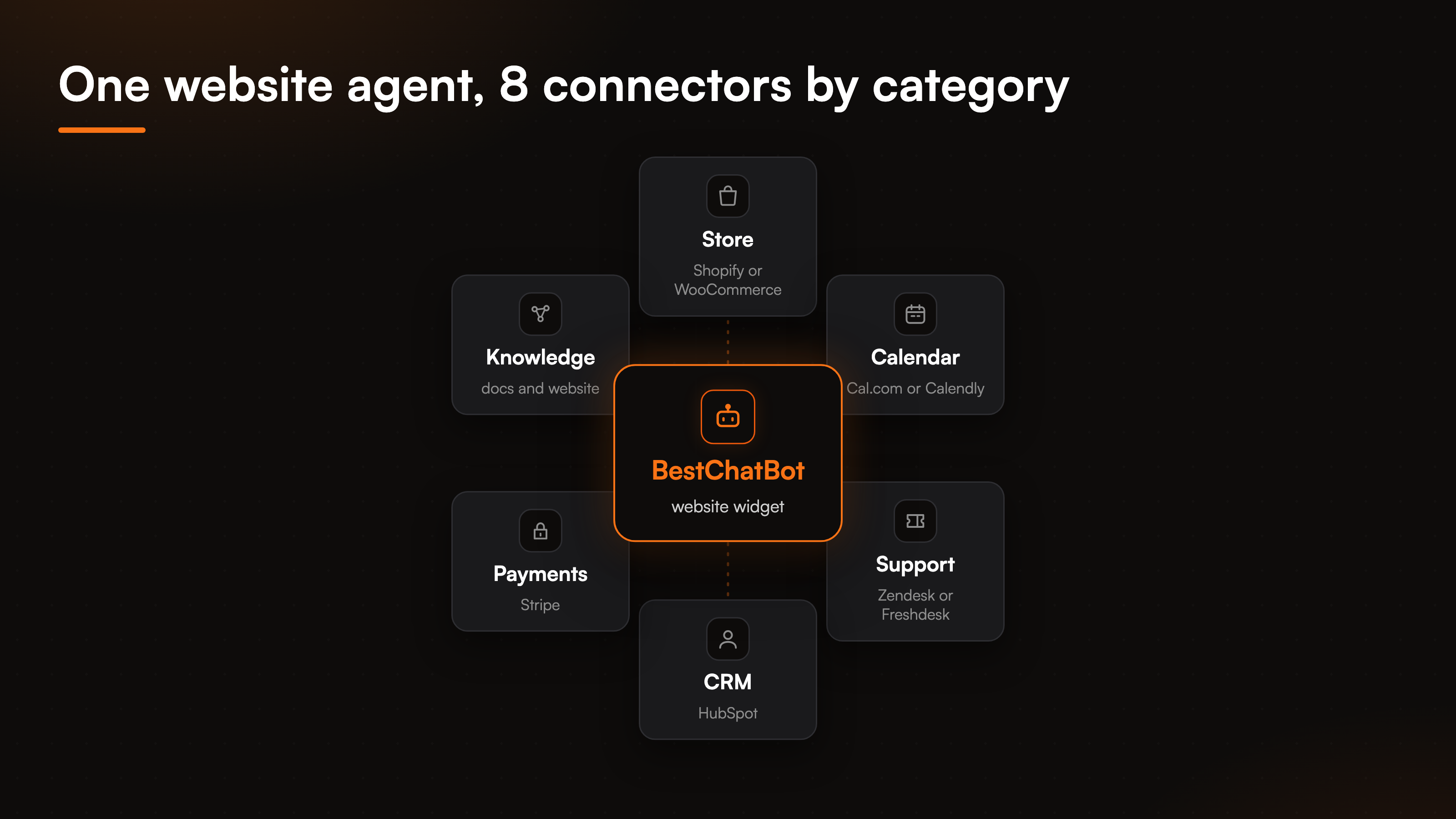
The second is action. Where Lyro and a flow builder talk about your systems, this agentic chatbot runs the task inside them. It ships 8 connectors and 29 actions across scheduling, support, CRM, payments, and e-commerce. A buyer asks "where is my package" and the agent reads the live status from your store, not a generic link. A customer wants to reschedule and the agent checks the connected calendar and books the slot. The connector set is deliberate, one per category: one calendar (Cal.com or Calendly), one support tool (Freshdesk or Zendesk), one store (Shopify or WooCommerce), plus HubSpot and Stripe. They are mutually exclusive by category, so you wire the calendar you actually run on rather than a menu of five you ignore.
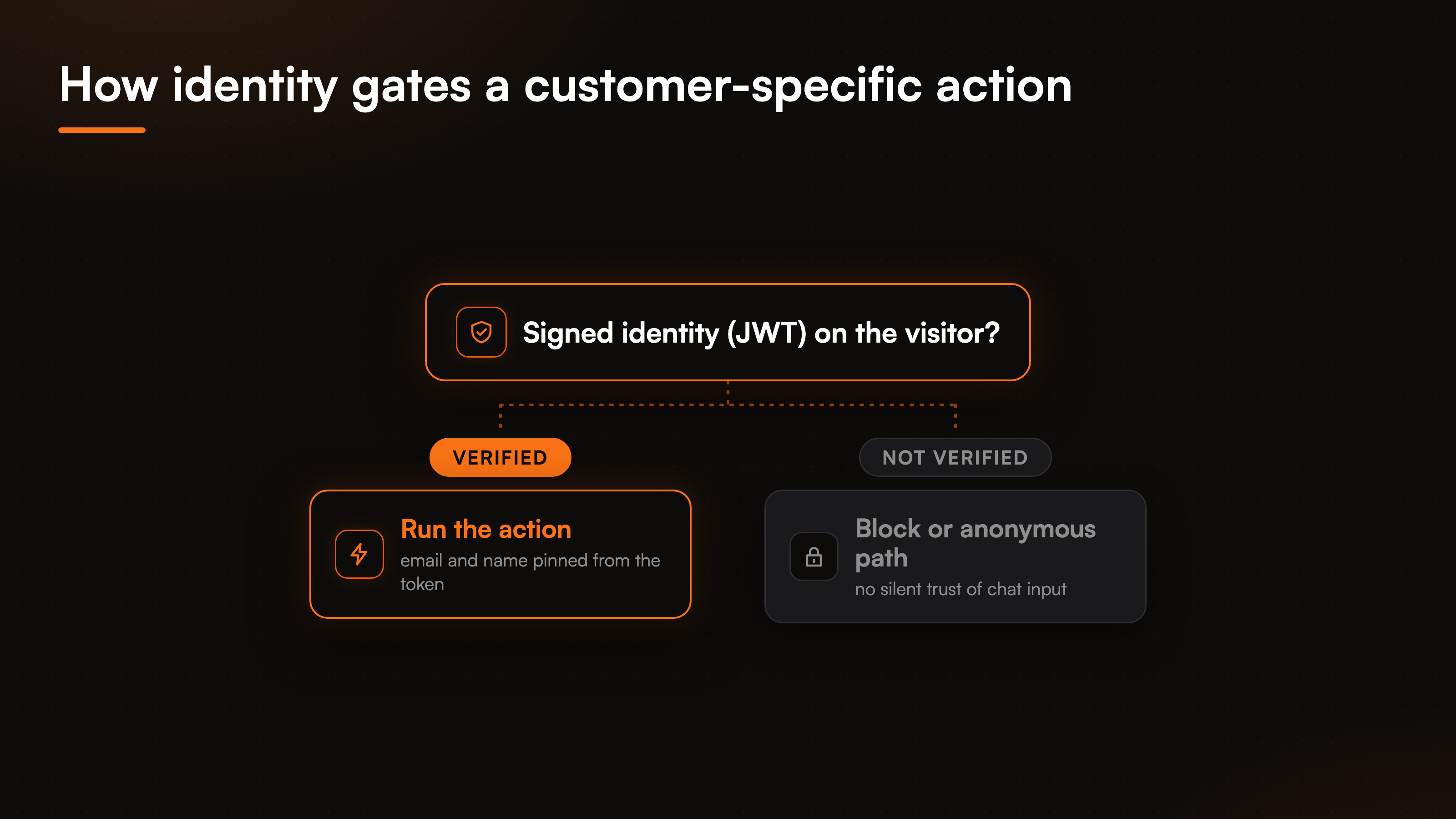
What keeps those actions safe is identity. Anything tied to a specific customer sits behind a verified identity. When your site passes a signed token (JWT) for a logged-in visitor, the agent pins the email and name from that token, never from what the visitor types. So "cancel my subscription" runs against the verified account, not a stranger guessing an email. No verified identity, and the action is blocked or sent down an anonymous path, with no quiet fallback to trusting chat input. BestChatBot never stores your customers' credentials either; a specialized provider keeps connection secrets encrypted and refreshes tokens over OAuth or API key.
Now the honest trade-offs, because they are real. BestChatBot does not pass the chat to a live human in real time the way Tidio's live chat does. Escalation creates a tracked ticket in Zendesk or Freshdesk, routed to your team's inbox with the conversation attached, so nothing drops, but a customer who wants a person typing back this second gets a ticket. And it runs on the website only. No WhatsApp, no SMS, no voice. If your support starts on your own site, that single channel done well is the point, not a missing feature.
Strengths: grounded answers that decline rather than guess, plus real action execution across 8 connectors and 29 actions, all gated by verified identity. Trade-off: no real-time human handoff (escalation becomes a ticket) and website only, no omnichannel inbox. Who it's for: website-first teams that want the agent to resolve and act honestly, not just keep a human reachable. Action execution is a Pro or Business feature; plans run Free, Starter, Pro, Business.
2. Intercom
Intercom is a full customer messaging platform with an AI layer (Fin) on top of an inbox, a help center, and a routing engine. It is built for support orgs that already work inside a ticketing product and want AI to clear the easy questions before a human takes the rest.
Strengths: breadth. A complete human-agent inbox, a polished omnichannel surface, and AI threaded through all of it. Trade-off: it is a platform commitment, far heavier than a store owner leaving Tidio for a smarter widget usually wants. We weigh that in the Intercom alternative comparison. Who it's for: established support teams that want AI inside a full messaging suite.
3. Zendesk AI
Zendesk layered its AI onto a long-standing ticketing and help-center product. The AI is built to resolve and route tickets inside a workflow that thousands of teams already run.
Strengths: continuity for an existing Zendesk shop. The AI sits where agents work, alongside your macros, help center, and reporting. Trade-off: it is suite-first. For a team whose entire footprint is a website widget and a knowledge base, adopting Zendesk to get its AI is a big move, and its grounding is framed around its own help-center content. The Zendesk alternative piece covers where a lighter agent fits. Who it's for: teams already committed to the Zendesk ecosystem.
4. Crisp
Crisp bundles a shared inbox, a chat widget, and a chatbot builder into one multi-channel hub. Startups like it for keeping several channels in a single tidy place.
Strengths: a clean, low-cost hub that pulls channels into one inbox, with a friendly setup close to what Tidio offers. Trade-off: the bot is a builder attached to a messaging suite, not an agent designed around grounded refusal and identity-gated actions. If your goal is "answer honestly and do the task," that is not the center of gravity. Who it's for: startups wanting an affordable shared inbox with a basic bot attached.
5. Gorgias
Gorgias is a helpdesk built for e-commerce, with deep Shopify ties and automations aimed at order-related tickets. It overlaps Tidio's small-store crowd but leans harder into the support-desk side.
Strengths: e-commerce focus. Ticket workflows and macros shaped around online stores, with strong storefront connection. Trade-off: it is a helpdesk first, so the AI assists ticket handling rather than acting as a grounded, decline-first agent that runs actions itself behind verified identity. A team wanting an autonomous resolver, not a faster human queue, is reaching for a different shape of tool. Who it's for: online stores that want an e-commerce helpdesk with AI-assisted ticketing.
6. Ada
Ada is an automation-first AI support platform aimed at larger enterprises with high ticket volume. It is built to resolve conversations at scale and slot into an existing support stack.
Strengths: enterprise scale and channel breadth, designed for big brands routing large volumes. Trade-off: the enterprise framing means it is rarely the quick, self-serve choice a Tidio user expects. Training a bot on your docs this afternoon and adding a couple of real actions is not the path it optimizes for. Who it's for: large support organizations resolving high conversation volume across channels.
Matching the alternative to your real reason for leaving
The right pick follows the actual pain, not the longest feature list. Pin down which sentence sounds like you.
"My bot answers but still creates work." You want grounding that resolves and declines cleanly, so the answer is final, not a placeholder before the email. "It chats but never does the thing." You want real action execution gated by identity, not more channels to watch. "I have a human inbox and live agents already." A suite like Intercom or Zendesk AI may fit even though it is heavier than a widget. "I am a Shopify store drowning in order tickets." Gorgias or a store-connected agent both deserve a look, and the difference is whether you want a faster human queue or an agent that closes the ticket itself.
For a website-first team that wants honest answers and real actions without committing to a full platform, BestChatBot is the closest replacement for what Tidio's AI tries to do, plus the resolve-and-act layer it was never built for. The content you would feed it is the same kind Tidio uses, so the move is less "rebuild" and more "re-point and add what was missing." If you are weighing the heavier incumbents too, the comparison hub lists the rest, and the tier-by-tier breakdown sits on the pricing guide.
FAQ
What is the best Tidio alternative?
It depends on why you are leaving Tidio. For grounded answers that decline instead of guessing plus real action execution on a website widget, BestChatBot is the closest fit, since it resolves and acts rather than keeping a human reachable. For a full human-agent inbox at scale, an Intercom or Zendesk-class suite fits better, and a Shopify-heavy store may want Gorgias.
Why do people look for a Tidio alternative?
Volume is the usual trigger. Tidio blends live chat, rule-based flows, and its AI, which suits a small store, but flows only cover the branch you drew and live chat depends on someone being online. As repeat tickets pile up, teams want an agent that resolves the question on its own and stays honest when the answer is not in the docs.
Is BestChatBot a drop-in Tidio replacement?
For the answering and resolving part, it is close. It trains on the same kind of content and embeds as a website widget. The behavior differs: it declines on out-of-scope questions instead of guessing, and on Pro or Business it runs real actions through connected tools rather than only talking about them. The one thing it does not replicate is Tidio's real-time live human chat; escalation becomes a tracked ticket instead.
Can these tools actually resolve a ticket, or just route it?
That is the dividing line. Many chat tools, including a flow builder, talk about your systems or hand off to a person. BestChatBot runs the task: with a store connected it reads the real order status, with a calendar connected it books the slot, every customer-specific action gated by a verified identity. Those are part of its 29 actions on Pro and Business.
Does BestChatBot work outside the website?
No, and that is deliberate. It is a website widget, one surface done well, with no WhatsApp, SMS, or omnichannel inbox. If your support starts on your own site, the single-channel focus is a strength rather than a gap.
If you need something more agentic than Drift, see the best Drift alternative.
Or, for the Crisp alternative.
And if you run a Shopify store, compare a Gorgias alternative that grounds every answer in your catalog and order data.
Want the numbers side by side? Read the direct Tidio vs BestChatBot comparison.