
Best Chatbase Alternative for AI Support
The best Chatbase alternatives for AI support, ranked. Tools that decline instead of guessing and run real actions, not just chat over your docs.
You trained a Chatbase bot on your docs, dropped the script on your site, and it answered questions on day one. That part is genuinely good. Then a customer asked about an order that shipped late, and the bot wrote a confident, friendly paragraph that was completely made up. Another asked to reschedule a call, and the bot replied with a link and a polite "you can do that here." It chatted. It did not act, and once in a while it invented.
That gap is why people start shopping for a Chatbase alternative. Chatbase is a quick way to build a bot that talks about your content, and for a plain FAQ that is enough. The questions that send teams looking elsewhere are sharper: does the bot stay honest when the answer is not in my docs, and can it actually do the thing the customer asked for? This post ranks the best Chatbase alternatives for AI support, what each one is built for, where it shines, and where it stops. We put BestChatBot first because it answers both of those questions head on, then we cover five more credible options so you can match a tool to your stack.
A quick note on fairness. We know our own product cold, so the BestChatBot section is specific about mechanisms. For the others we stay honest and general, describing what each tool is built around rather than inventing numbers or limits we cannot stand behind. A good comparison earns trust; a rigged one does not.
1. BestChatBot, the most complete alternative
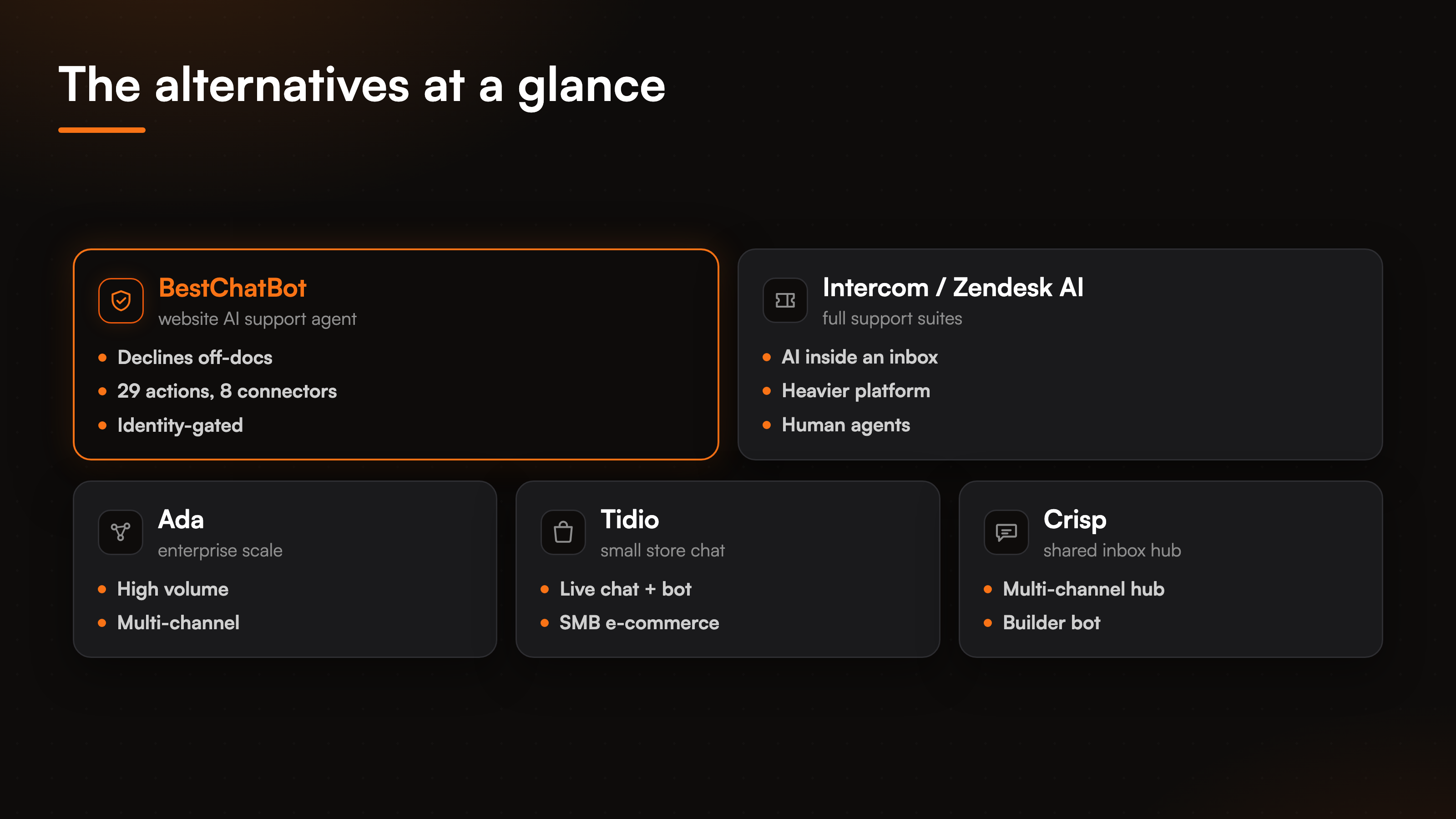
BestChatBot is an AI Support Agent for Business Websites. It trains on your own knowledge and embeds as a website widget, like Chatbase, but it is built around the two things a doc chatbot cannot do. It declines instead of inventing, and as an agentic chatbot it runs real actions on your connected tools.
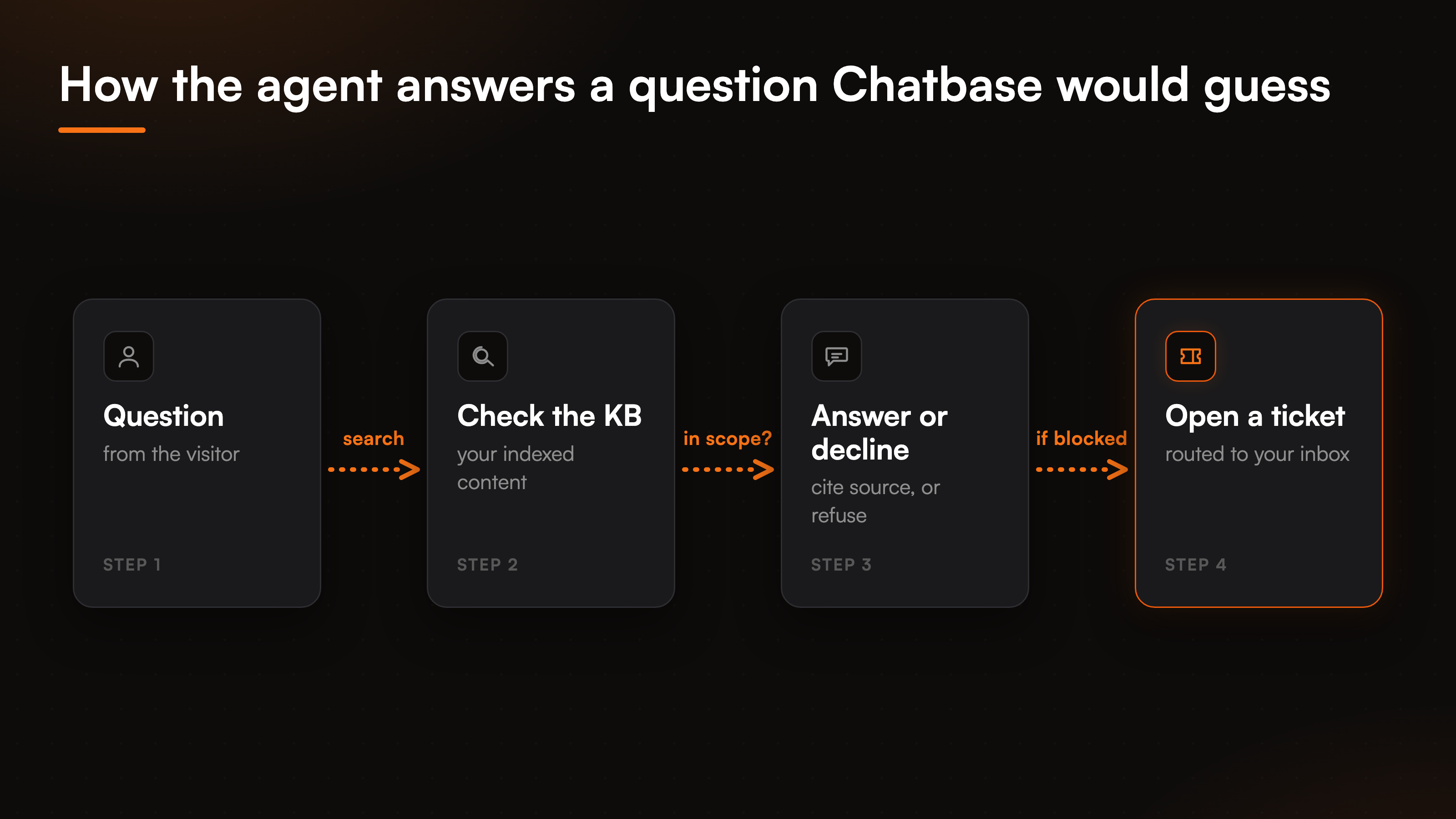
Start with grounding. A model trained on your docs still generates language, so when a question lands outside what you uploaded, it tends to fill the gap with something plausible. BestChatBot answers only from your indexed knowledge and, when the question falls outside it, says so rather than improvising. A customer asking "do you ship to Norway" gets the real answer pulled from your shipping page, or an honest "I do not have that detail, let me get it to the right person." It never gets a guessed yes. The agent can also cite the source it used, a toggle you control, so a reader can check the claim. We think bounding answers to retrieved content beats clever prompting, because no prompt fully stops a model from confabulating once you push past its knowledge. The mechanics are covered in our no-hallucination AI support agent write-up.
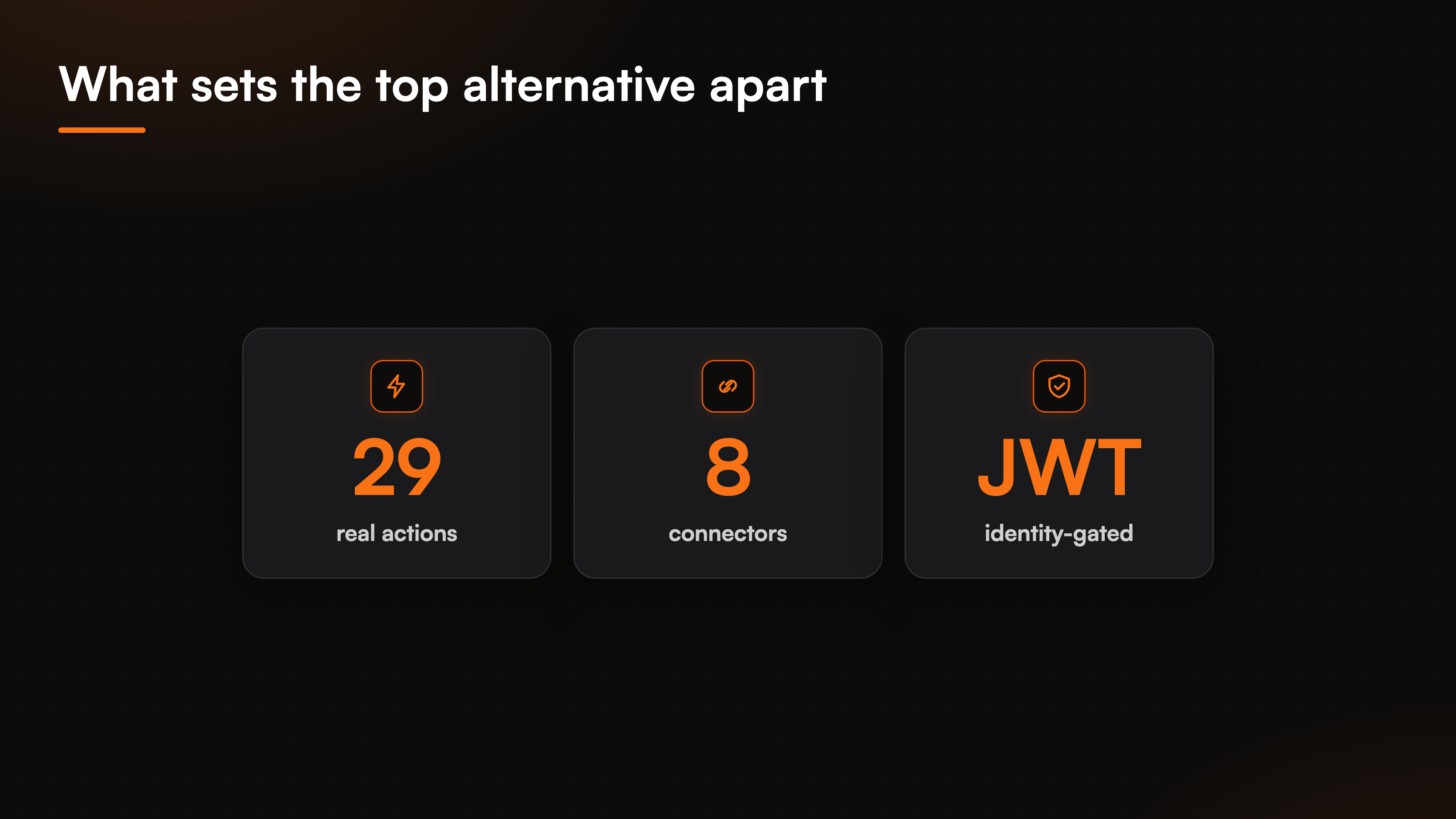
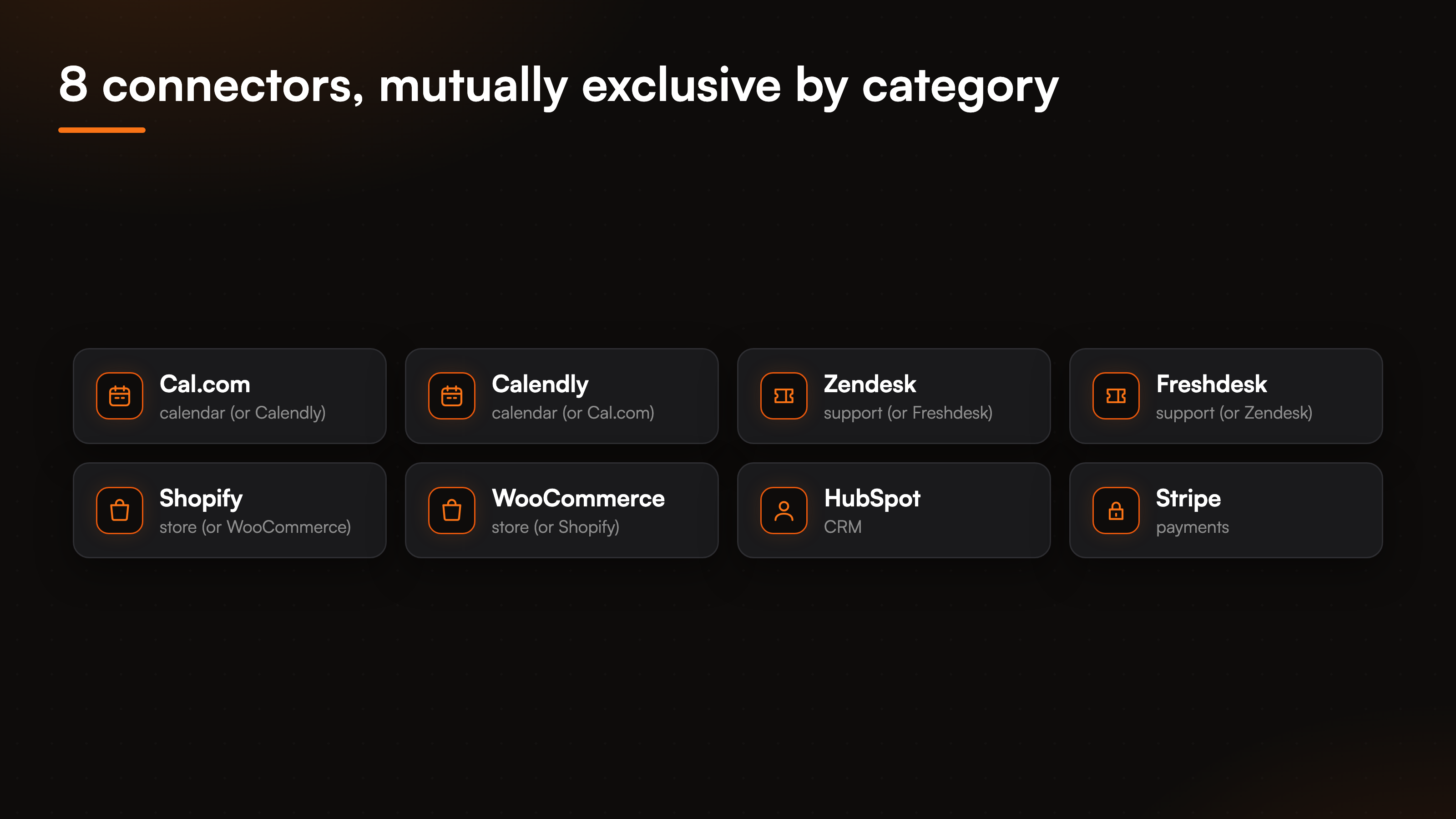
Then actions. BestChatBot ships 8 connectors and 29 actions across scheduling, support, CRM, payments, and e-commerce. The set is deliberate, not a "100 apps" line: one calendar (Cal.com or Calendly), one support tool (Freshdesk or Zendesk), one store (Shopify or WooCommerce), plus HubSpot and Stripe. They are mutually exclusive by category, so you wire up the calendar you actually use rather than five you do not. A buyer asks "where is my order" and the agent looks up the live status in your store. A customer wants a demo and the agent checks the calendar and books the slot. A question it cannot resolve becomes a ticket in Zendesk or Freshdesk, routed to your team's inbox with the conversation attached.
Two honest constraints, framed as choices. BestChatBot does not hand the chat to a live human in real time; escalation creates a tracked ticket so nothing slips. And it lives on the website only. There is no WhatsApp, no SMS, no voice, no omnichannel layer. If your support starts on your site, that single-channel focus is a feature.
The part that makes actions safe is identity. Customer-specific actions sit behind a verified identity. When your site passes a signed token (JWT) for a logged-in visitor, the agent pins the email and name from that token, not from whatever the visitor types. So "cancel my subscription" runs against the verified person's account, never a stranger's. No verified identity means the action is blocked or routed down an anonymous path, with no silent fallback to trusting chat input. The agent never holds your customers' credentials either; a specialized provider stores connection secrets encrypted and refreshes tokens over OAuth or API key. The identity verification page walks the JWT flow end to end.
Best for: teams that want grounded answers plus real action execution on a website, and are fine with one channel done well. Action execution is a Pro or Business feature; plans run Free, Starter, Pro, Business.
2. Intercom
Intercom is a mature customer messaging platform with an AI layer (Fin) layered on top of a full inbox, help center, and routing engine. It is built for support orgs that already live inside a ticketing and conversations product and want AI to deflect the easy questions before a human picks up the rest.
Where it shines: the breadth. If you need a human agent inbox and a polished omnichannel surface, Intercom is a complete suite, and the AI plugs into all of it.
Where it stops for a Chatbase refugee: it is a platform commitment, not a lightweight doc bot. The pricing and surface area suit larger support teams more than a founder who just wants a smarter widget. If your reason for leaving Chatbase is "I want real actions on a simple site widget," Intercom is a heavier answer than the question. We dig into that trade-off in the Intercom alternative comparison.
Best for: established support teams that want AI inside a full messaging and inbox suite.
3. Zendesk AI
Zendesk built its AI features around its long-standing ticketing and help-center product. The AI focus is resolving and routing tickets inside a workflow that thousands of support teams already run on.
Where it shines: if you are already a Zendesk shop, the AI sits where your agents work, with your macros, your help center, and your reporting intact. That continuity is real value.
Where it stops: like Intercom, it is suite-first. For someone whose whole footprint is a website widget and a knowledge base, adopting Zendesk to get its AI is a large move. The grounding and refusal behavior is also framed around its own help-center content rather than the decline-first stance some teams want. The Zendesk alternative piece covers where a lighter agent fits better.
Best for: teams committed to the Zendesk ecosystem who want AI inside it.
4. Ada
Ada is an automation-first AI support platform aimed at larger enterprises with high ticket volume. It is built around resolving conversations at scale across channels and integrating into existing support stacks.
Where it shines: enterprise scale and channel breadth. For a big brand routing huge volumes, Ada is designed for that load.
Where it stops: the enterprise framing means it is rarely the quick, self-serve choice a Chatbase user is used to. Setup weight and cost lean toward larger organizations. If you want to train a bot on your docs this afternoon and add a few real actions, that gap is the honest catch.
Best for: larger support organizations resolving high conversation volume across channels.
5. Tidio
Tidio is a website chat and helpdesk tool popular with small and mid-size online stores, blending live chat, simple automations, and an AI assistant. It leans toward the e-commerce small-business crowd.
Where it shines: approachable for a small store. Live chat plus lightweight bots in one tool, at a price point that suits smaller teams.
Where it stops: the AI is one feature inside a broader chat product rather than a grounded, action-running agent. For deep, secure action execution gated by verified identity, it is built around a different goal. We compare the angles in the upcoming Tidio alternative piece.
Best for: small online stores wanting live chat plus light automation in one place.
6. Crisp
Crisp is a multi-channel business messaging tool that bundles a shared inbox, chat widget, and a chatbot builder, popular with startups that want one tidy hub for conversations.
Where it shines: a clean, affordable hub that pulls several channels into one inbox, with a friendly setup.
Where it stops: the chatbot is a builder bolted to a messaging suite, not an agent designed around grounded refusal and identity-gated actions. If your priority is "answer honestly and actually do the task," that is not where Crisp concentrates.
Best for: startups wanting a low-cost shared inbox with a basic bot attached.
How to pick the right Chatbase alternative
Match the tool to the actual reason you are leaving. If the pain is "my bot invents answers," you want grounding that declines, not a bigger suite. If the pain is "it talks but does not do anything," you want real action execution with identity gating, not more channels. If you are a large org with a human inbox already, an Intercom or Zendesk-class suite may fit even though it is heavier.
For a website-first team that wants honest answers and real actions without adopting a whole platform, BestChatBot is the closest replacement for what Chatbase does, plus the two things it cannot. The answering quality you already built carries over: it trains on the same source types (uploaded docs, your website, manual edits), so migrating is less "start over" and more "re-point and add what was missing." If you are weighing the bigger incumbents too, the full comparison hub lists the rest, and tier-by-tier pricing is on the pricing guide.
Building for a SaaS product? See the AI agent built for SaaS support.
FAQ
What is the best Chatbase alternative?
It depends on why you are leaving. For grounded answers that decline instead of guessing plus real action execution on a website widget, BestChatBot is the closest match to what Chatbase does well, minus the two things it cannot do. For a full human-agent inbox at scale, an Intercom or Zendesk-class suite fits better.
Why do people look for a Chatbase alternative?
Two reasons come up most. The bot sometimes invents a confident answer when a question falls outside the uploaded docs, and it can only talk about your systems, not act inside them. Teams want a tool that stays honest and can actually book a meeting or look up an order.
Is BestChatBot a drop-in Chatbase replacement?
For the answering part, yes. It trains on the same source types and embeds as a website widget. The difference is behavior: it declines on out-of-scope questions instead of guessing, and on Pro or Business it runs real actions through connected tools rather than only chatting about them.
Can these tools actually run actions, or just chat?
That is the dividing line. Most doc chatbots, Chatbase included, talk about your systems. BestChatBot runs the task: with a store connected it looks up the real order, with a calendar connected it books the slot, all gated by a verified identity. Those are part of its 29 actions on Pro and Business.
Does BestChatBot work outside the website?
No, and that is on purpose. It is a website widget, one surface done well, with no WhatsApp, SMS, or omnichannel layer. If your support starts on your site, the single-channel focus is a feature, not a gap.
For a side-by-side scorecard, see the full Chatbase vs BestChatBot breakdown.