
Best Zendesk Alternative for AI Support
Looking for a Zendesk alternative? How AI-first support compares against Zendesk's legacy ticketing stack on accuracy, setup speed, and complexity.
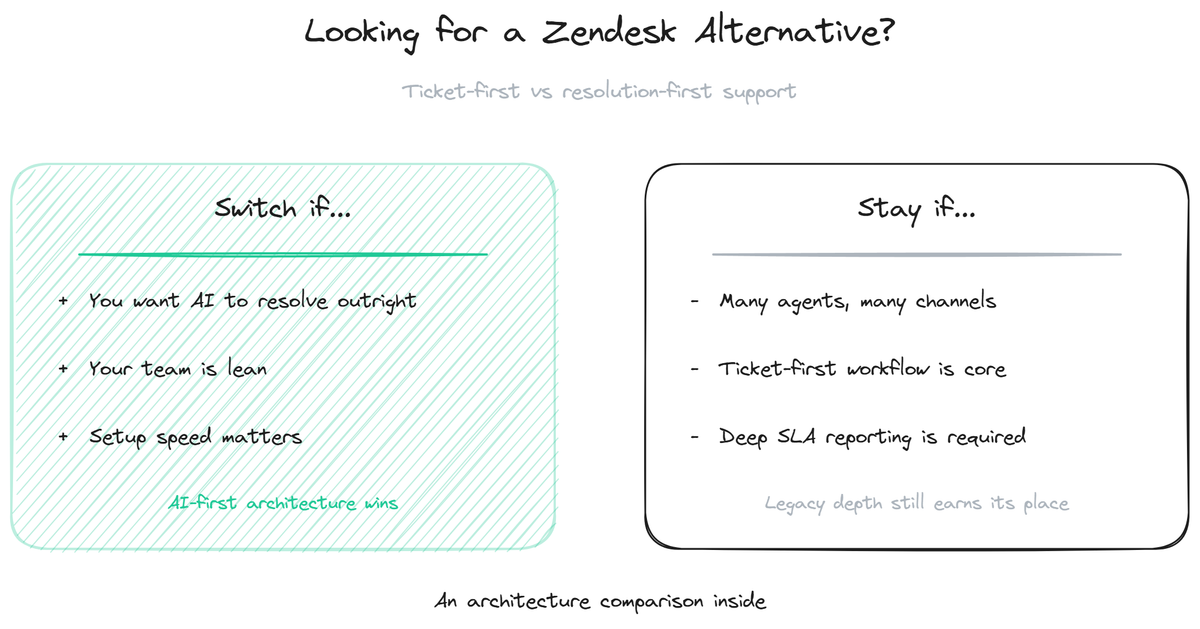
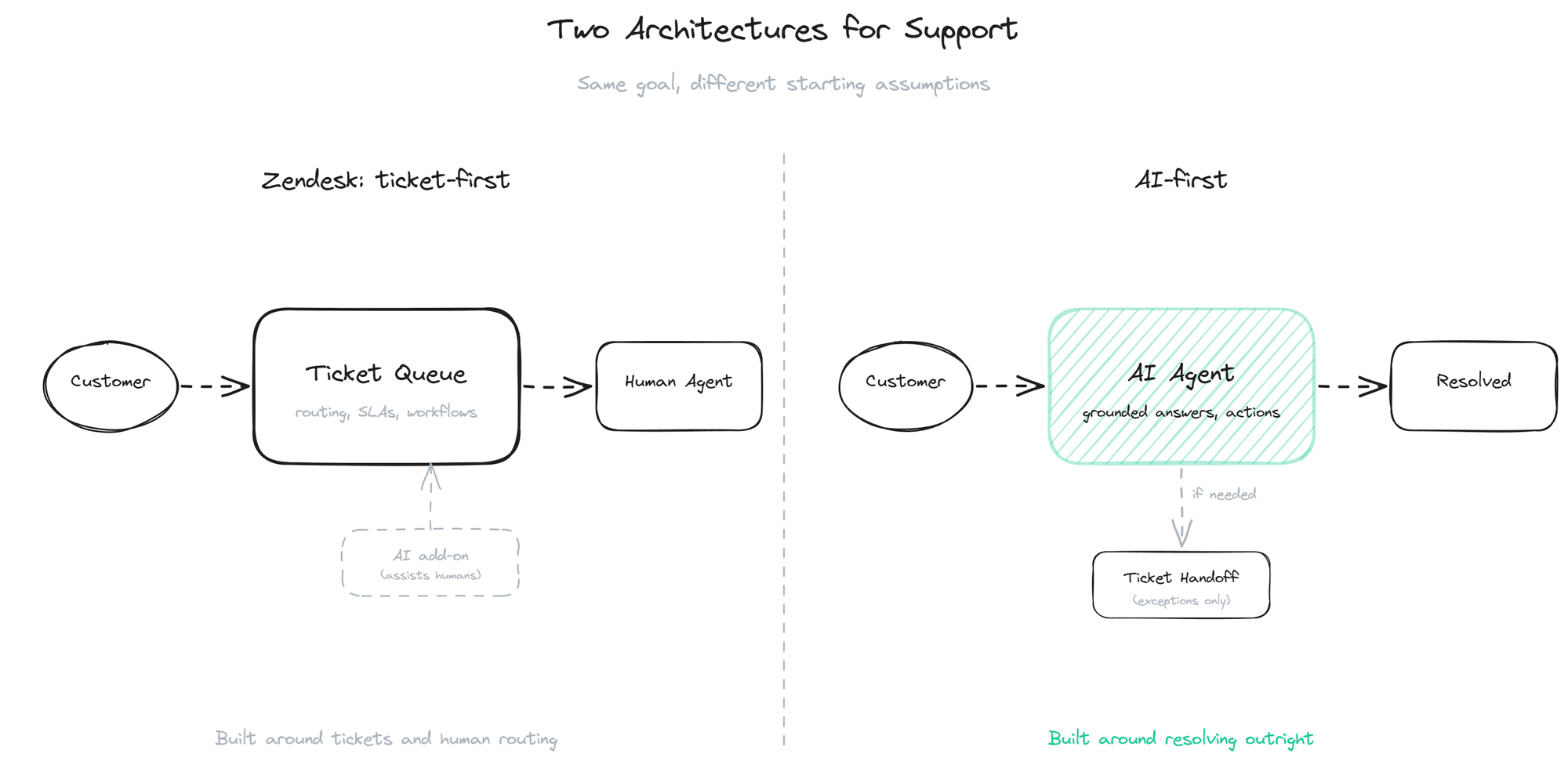
Teams looking for a Zendesk alternative are usually weighing a legacy support stack against an AI-first one. Zendesk is the incumbent: a mature, comprehensive ticketing and help desk platform that has added AI agents on top of an architecture built for human-handled tickets. The AI-native alternatives took the opposite path, building grounded AI answering and action execution from the ground up and connecting to ticketing only for the cases that need a human. The choice between them is less about features and more about which architecture matches how you want support to work. This page covers Zendesk's strengths, where the AI-first alternatives win, and how to decide.
Where Zendesk is genuinely strong
Zendesk earns its incumbency. As a comparison this only works if it is honest about what the platform does well.
Zendesk is a complete help desk: multichannel ticketing (email, chat, phone, social), a powerful agent workspace, reporting and analytics, SLA management, and a large app marketplace. For a support organization with many agents handling complex, multi-touch cases across channels, that depth is hard to replace. The workflow automation, routing rules, and reporting are built for scale and for teams whose work is fundamentally ticket-based.
Zendesk's AI agents and Copilot features are real and improving. For an organization already invested in Zendesk, with agents trained on it and workflows built around it, adding AI on top is the natural move and avoids a migration.
The case for staying on Zendesk is strongest for larger support organizations with many human agents, complex multichannel workflows, and a genuine need for the full ticketing-and-reporting depth. If that describes you, an AI-first alternative may be too narrow.
Where the AI-first alternatives win
The case for a Zendesk alternative strengthens when the support model is shifting from ticket-first to resolution-first.
Setup speed and complexity is the most immediate difference. Zendesk is powerful partly because it is configurable, which means it takes real work to set up and maintain. An AI-first tool that grounds on your docs and installs as a widget can be live in days, not weeks, with far less ongoing administration. For a lean team, the lower complexity is itself the value.
Answer accuracy on the first contact is the second. A ticket-first architecture assumes a human will eventually handle the case; the AI is an assistant to that process. An AI-first architecture assumes the AI resolves the case outright and only escalates the exceptions. If your goal is resolving questions without a human touching them, the AI-first design is built for that and the ticket-first design is built around it. The reliable support AI page covers why grounded accuracy is the foundation of first-contact resolution.
Lower total complexity is the third. Zendesk's breadth means surface area: features to configure, agents to license, workflows to maintain. A team that does not need all of it pays for it anyway in both money and administrative overhead. An AI-first tool focused on grounded answering and action execution skips that surface area. The connection options for the AI-first stack are simpler too; the deployment options page covers what an AI-first setup actually connects to.
How to evaluate the switch
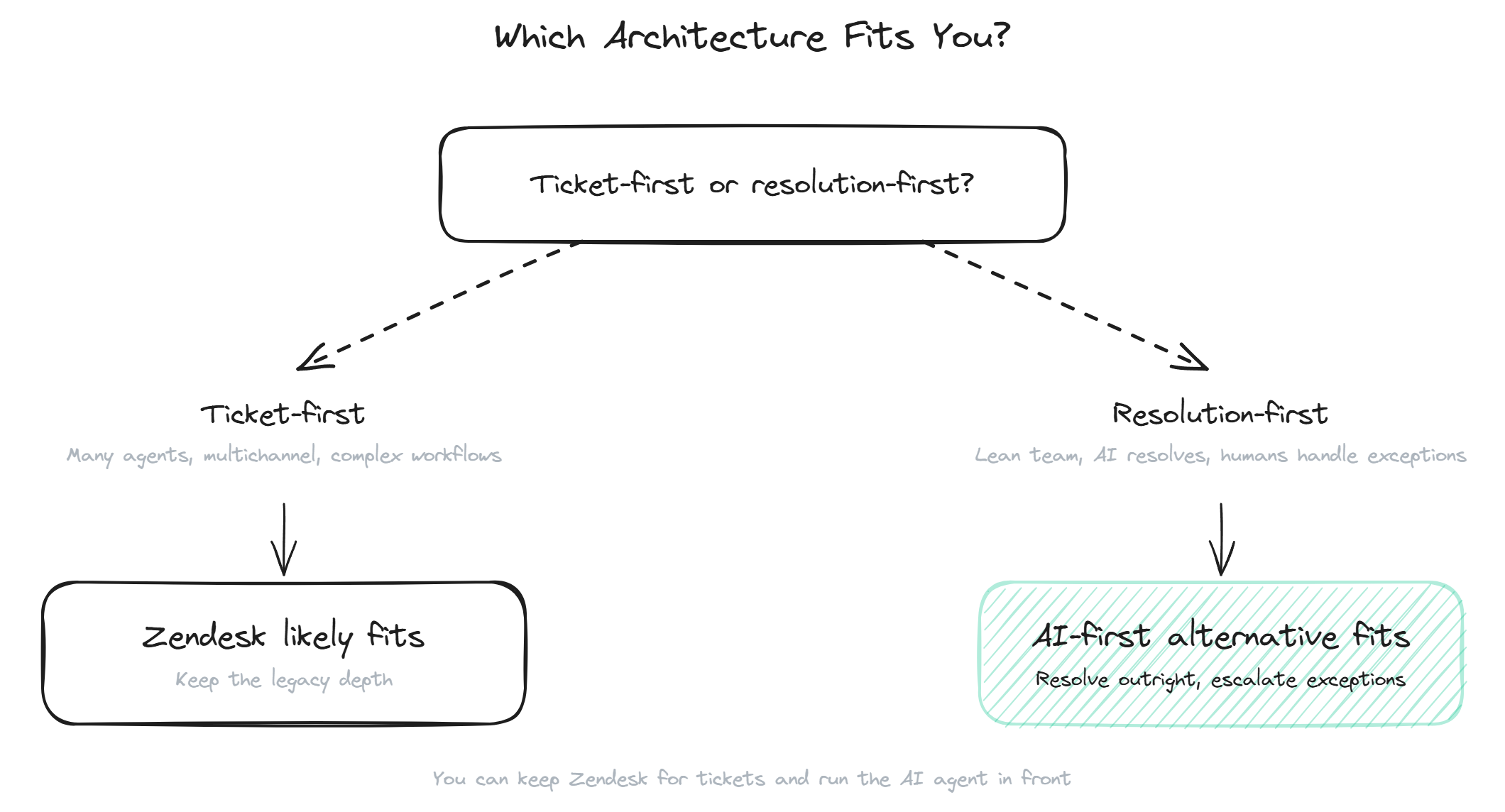
The deciding question is whether your support is fundamentally ticket-first or resolution-first. Ticket-first means most cases need a human eventually and the system exists to route and track that human work; Zendesk is built for this. Resolution-first means most cases should be resolved by AI outright with humans handling only exceptions; the AI-first tools are built for this.
If you are resolution-first, evaluate the alternatives the same way as any AI tool: run 100 real historical tickets through the candidate against your own documentation, score the answers, and compare the wrong-answer rate. Then model the total cost at your real volume, accounting for the seats and features you would drop by leaving Zendesk versus the simpler pricing of a focused tool.
Confirm the escalation path works for the cases the AI cannot resolve. An AI-first tool that connects to Zendesk or Freshdesk for ticket handoff lets you keep a lightweight ticketing layer for exceptions without running the full Zendesk platform for everything.
Where BestChatBot fits
BestChatBot is an AI-first Zendesk alternative for teams whose support is resolution-first. It grounds answers in your documentation, executes actions through connections to Shopify, Stripe, Calendly and others, refuses honestly outside its knowledge, and improves through supervised autolearning. For the cases it cannot resolve, it creates a ticket in your connected Zendesk or Freshdesk with the full conversation transcript attached, so you can keep a thin ticketing layer for exceptions without running the full legacy stack.
The honest framing: this is not a replacement for Zendesk's full help desk. It is a replacement for the assumption that every support question needs a ticket and a human. If your support is genuinely ticket-first across many agents and channels, Zendesk fits. If you want AI to resolve most questions and humans to handle only the exceptions, the AI-first architecture is the better match.
FAQ
- Can I keep Zendesk for ticketing and add an AI-first agent on top? Yes, and many teams do exactly this. Run the AI-first agent as the first layer on your website, connect it to Zendesk for ticket handoff, and let it resolve what it can while Zendesk handles the escalations. You do not have to fully migrate to get the AI-first answering benefits.
- Is an AI-first tool cheaper than Zendesk? Usually, for resolution-first teams, because you drop per-agent seat costs for the questions the AI resolves and pay a flat tier based on query volume instead. For large ticket-first organizations the comparison is closer because you still need the ticketing depth Zendesk provides.
- How long does migration take? The AI answering side is fast: point the tool at the same help center content Zendesk used and it is grounded on the same material in days. Migrating ticketing workflows, agent training, and reporting is the slower part, and whether you migrate those at all depends on whether you are leaving Zendesk entirely or running the AI agent alongside it.
- Will answer quality match Zendesk's AI agents? Answer quality depends on grounding and retrieval, which you can test directly. Run the head-to-head on your own content. AI-native tools are often built more aggressively around grounding and action execution than AI features bolted onto a ticketing platform, but the only reliable answer comes from testing on your docs.
- What about reporting and analytics? This is where Zendesk's depth shows. A focused AI agent provides resolution metrics, gap logs, and conversation analytics, but not the full SLA-and-agent-performance reporting suite Zendesk offers. If deep support analytics across a large agent team is a core requirement, weigh that gap. For pricing details, see pricing.
For pricing details, see plans.
For teams weighing a lighter doc-bot first, we also ranked grounded Chatbase alternatives.
Shopping below the enterprise tier as well? See what to use instead of Tidio.
Enterprise teams comparing Ada should also see the Ada alternative.
For a lighter-weight option, see the Crisp alternative.
And for ecommerce helpdesks, see the Gorgias alternative that answers order-status and returns questions without per-ticket pricing.
If Intercom is also on your shortlist, see the main Intercom competitors.