
What Is an AI Support Agent
An AI support agent answers customer questions from your real content and can take actions like booking or order lookups. What it is, what it does, and how it differs from a chatbot.
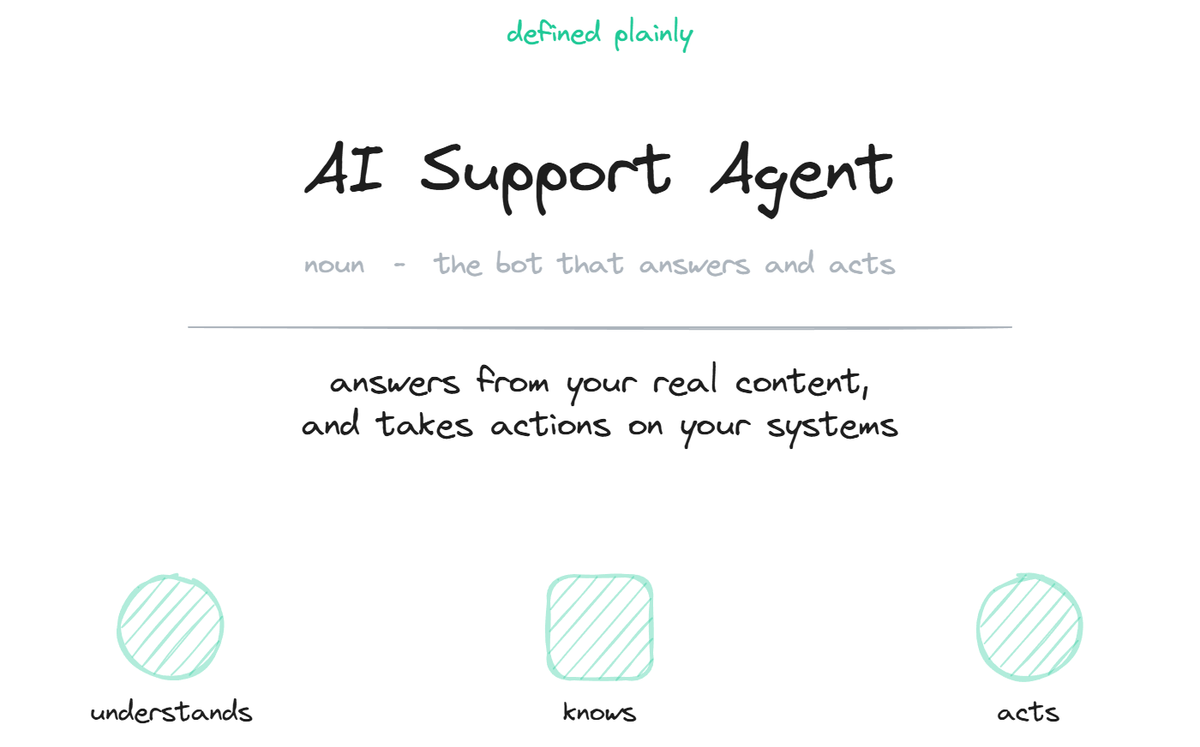
An AI support agent is software that answers customer questions in natural language, drawing on your business's real information, and that can take actions on your systems rather than only talking. That is the short definition, and the two halves of it (answers from your real content, and takes actions) are what separate an AI support agent from the scripted chatbots that came before. This guide unpacks the definition: what makes something an agent rather than a basic chatbot, what an AI support agent actually does, and how it differs from the chatbots you have probably already used and been frustrated by.
What makes it an "agent"
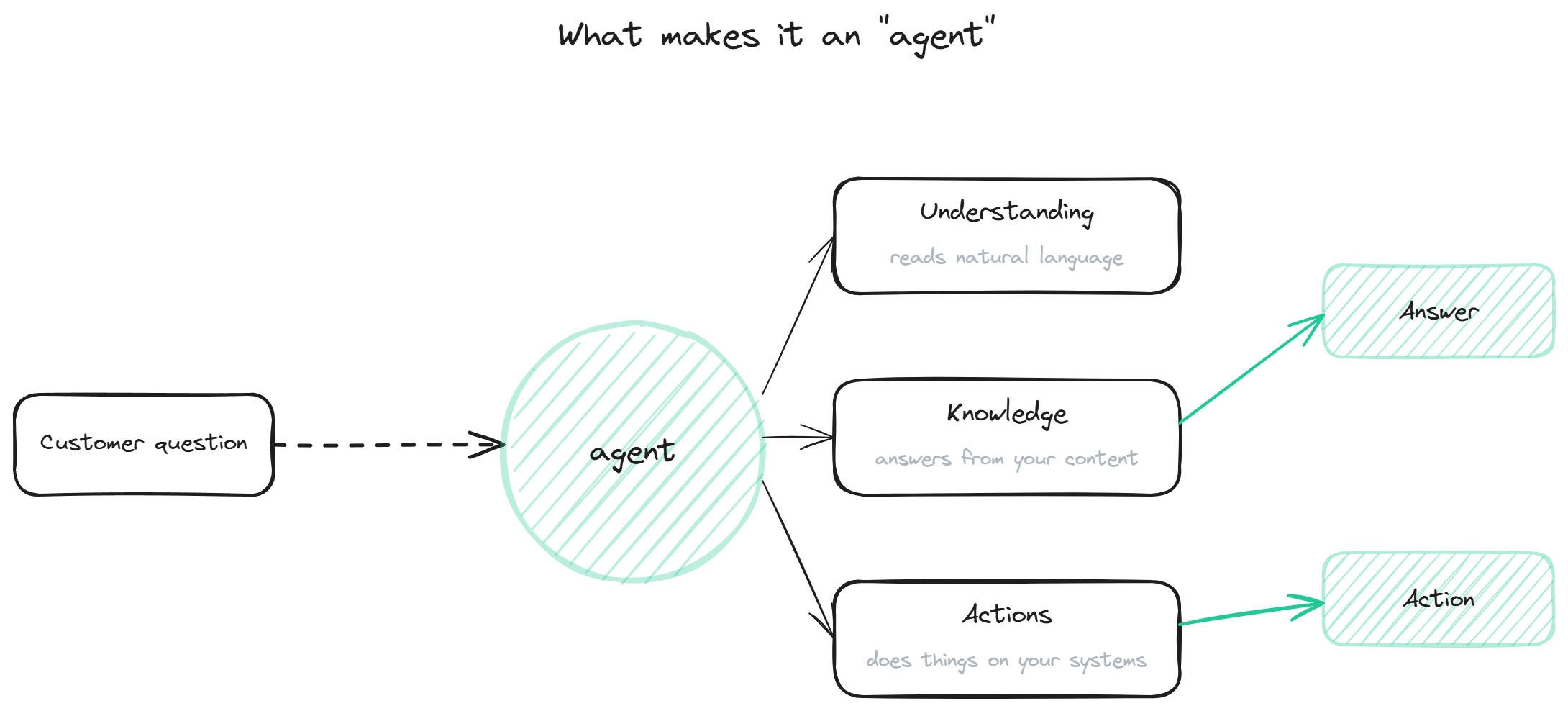
The word "agent" is doing real work in the term, and it points to a capability older chatbots lacked: an agent can act, not just respond.
A basic chatbot follows a script. It matches your question to a pre-written rule and returns a canned answer, or walks you down a decision tree someone built in advance. It does not understand what you said; it pattern-matches against what it was programmed to expect, which is why it falls apart the moment you phrase something it did not anticipate.
An AI support agent has three capabilities that a scripted bot does not. It understands natural language, so it grasps what you are asking even when you phrase it in a way no one scripted. It answers from your actual knowledge, retrieving the relevant information from your documentation rather than returning a canned line. And it takes actions, doing things on your systems (looking up an order, booking a meeting, creating a support ticket) rather than only handing you information and leaving the doing to you.
The third capability is what most justifies the word "agent." A bot that can tell you your order status is useful; an agent that can look up your specific order, tell you where it is, and start a return if you need one is doing the work, not just describing it. That shift from talking to acting is the line between a chatbot and an agent.
What an AI support agent does
In practice, an AI support agent does a combination of answering and acting across a support conversation.
On the answering side, it handles the questions customers ask: how something works, what a policy is, whether a feature exists, how to do a task. It pulls these answers from your real content (your help docs, FAQs, product information), which means the answers reflect your actual business rather than generic knowledge. A well-built agent also refuses honestly when it does not know, rather than inventing an answer, which is the difference between a trustworthy agent and a liability.
On the acting side, it does the things that resolve a request fully. Depending on what it is connected to, that can mean checking an order and its tracking, booking an appointment on a real calendar, capturing a lead, creating a support ticket for the human team, or looking up a subscription. These actions turn the agent from an information desk into something that actually completes tasks.
The combination is what makes it valuable. A customer asking "where is my order and can I change the delivery address?" gets both the lookup and, if possible, the action, in one conversation, instead of an answer plus instructions to do the rest themselves. The chatbot vs AI agent guide goes deeper on why this combination matters.
How it differs from the chatbots you have used
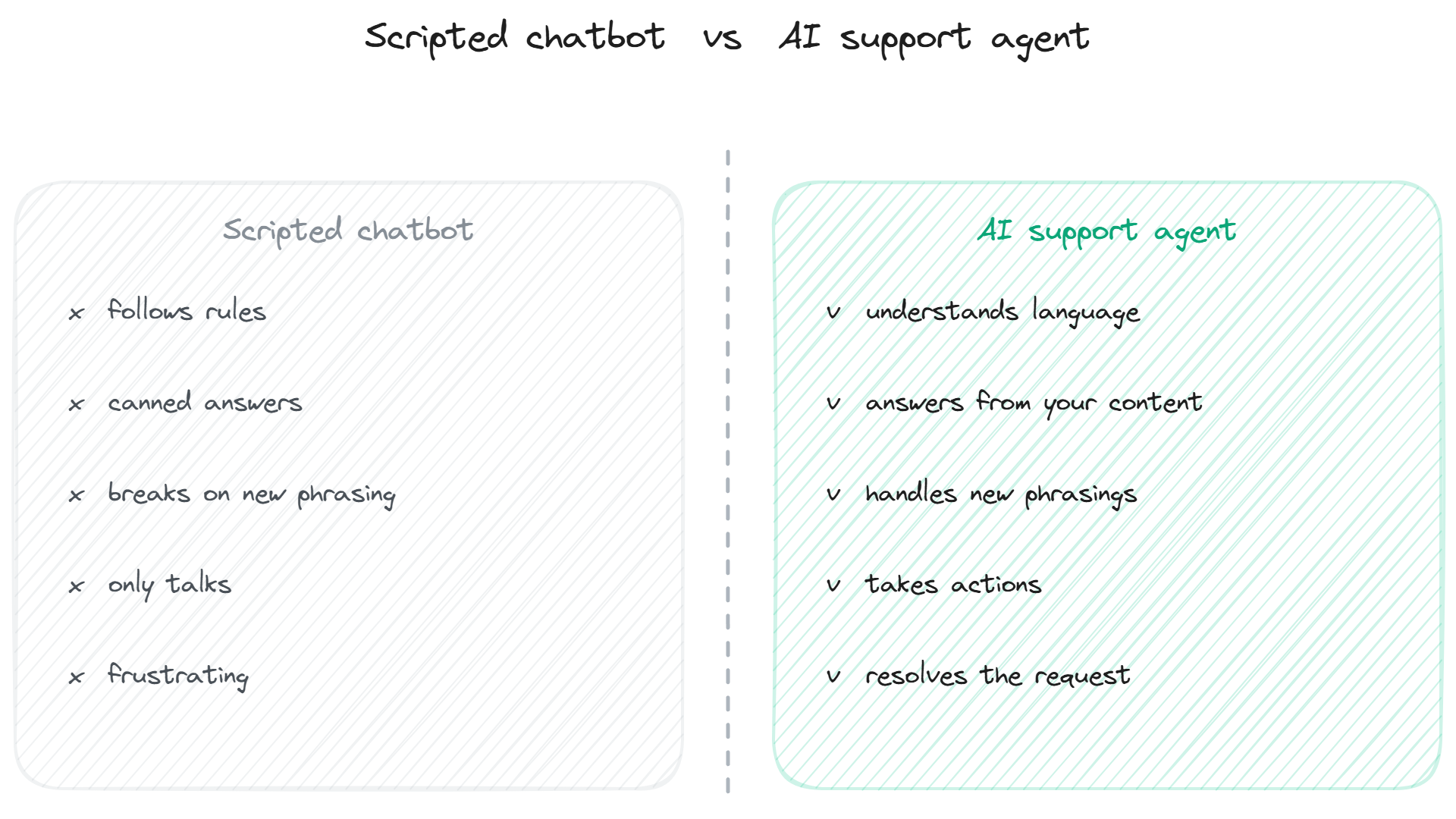
Most people's experience of chatbots is the frustrating kind: the bot on a website that could not understand a slightly unusual question, looped you through menus, and eventually told you to call a number. That experience is what an AI support agent is built to be different from.
The scripted chatbot follows rules and returns canned answers, so it breaks the moment your question does not fit its script, and it can only talk, never act. The frustration comes from that rigidity: you can feel that it is matching keywords rather than understanding you, and it cannot actually do the thing you need.
An AI support agent understands the question even when it is phrased in a new way, answers from your real content so the answer is accurate to your business, and can take the action that resolves the request rather than just describing it. The experience is closer to talking to a knowledgeable person who can also press the buttons, which is a different thing from the keyword-matching bots that gave chatbots their bad reputation.
The distinction matters when you are evaluating tools, because plenty of products call themselves AI agents while behaving like scripted chatbots underneath. The test is the three capabilities: does it genuinely understand language, does it answer from your content, and can it take actions. A tool that does all three is an agent; one that does not is a chatbot with better marketing.
BestChatBot is an AI support agent in this full sense: it understands natural language, answers grounded in your business's real content and refuses rather than inventing, and executes actions across commerce, scheduling, payments, and support tools. To see the product, visit the BestChatBot.io homepage.
FAQ
- Is an AI support agent just a chatbot with a better name? No, if it has the three capabilities: understanding natural language, answering from your real content, and taking actions. Many tools market themselves as agents while behaving like scripted chatbots underneath, so the capabilities are the test, not the label.
- What does "takes actions" actually mean? It means the agent does things on your connected systems, not just talks. Depending on what it is connected to, that can be checking an order, booking a meeting, creating a ticket, capturing a lead, or looking up a subscription. The action resolves the request rather than describing what the customer should do.
- How does it answer from "my real content"? It retrieves the relevant information from your documentation, help articles, and product content, and generates its answer from that, rather than from generic knowledge. This is what makes the answers accurate to your business, and a good agent refuses when the answer is not in its knowledge rather than guessing.
- Is an AI support agent the same as AI customer service? An AI support agent is a specific tool; AI customer service is the broader category it belongs to. The AI customer service guide covers the wider picture; this guide covers the specific tool.
- How do I tell a real agent from a scripted chatbot? Test the three capabilities. Ask something phrased unusually (does it understand, or break?), ask something specific to the business (does it answer accurately, or give a canned line?), and ask it to do something (can it act, or only talk?). A real agent handles all three.
An agent that acts on your connected systems is one application of agentic AI in practice, a concept the dedicated guide explains from the ground up.