
Custom Support Bot Cost Guide
What it really costs to build your own support bot: development, maintenance, the actions layer, and time to value, compared against buying a ready-made one.
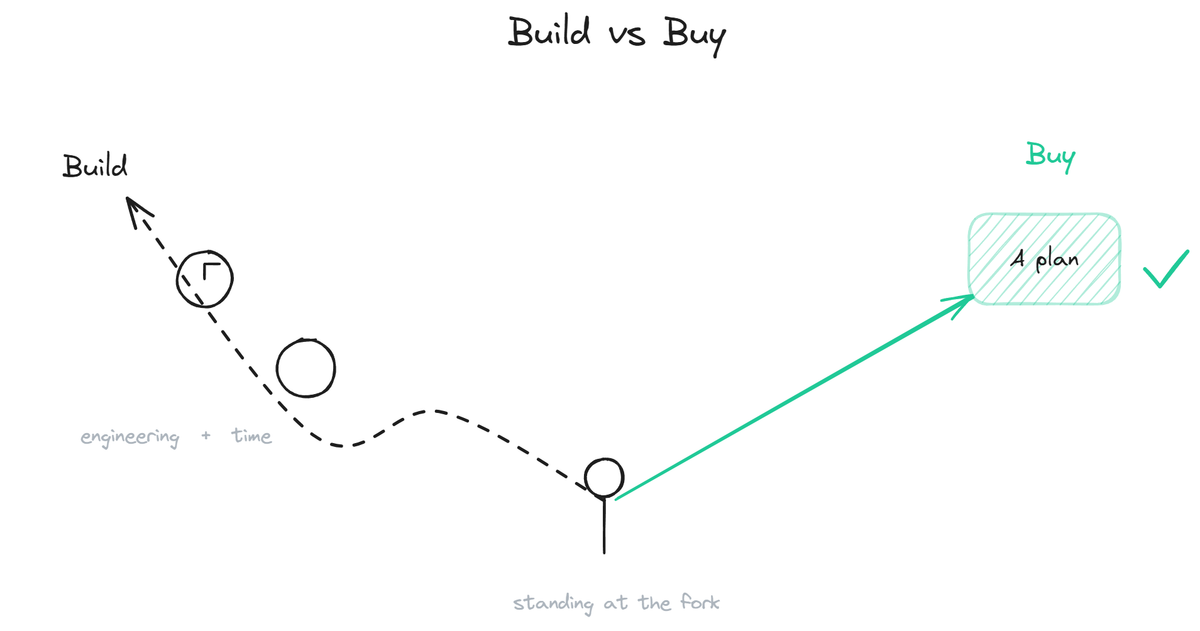
The build-versus-buy question for a support bot usually starts with a tempting thought: the language models are available through an API, so how hard can it be to wire one up to our docs and skip the subscription? The answer is that the model is the easy part, and the parts around it (the retrieval, the actions layer, the maintenance, the time before it works) are where the real cost lives. This page lays out what building your own support bot actually includes, the ongoing cost that surprises people most, why the actions layer is where custom gets expensive, and the cases where building genuinely does make sense.
This page zooms in on the build side of that math; for the full decision, our guide on how to build vs buy an AI support agent weighs the running cost of a custom stack against a subscription end to end.
What "building your own" actually includes
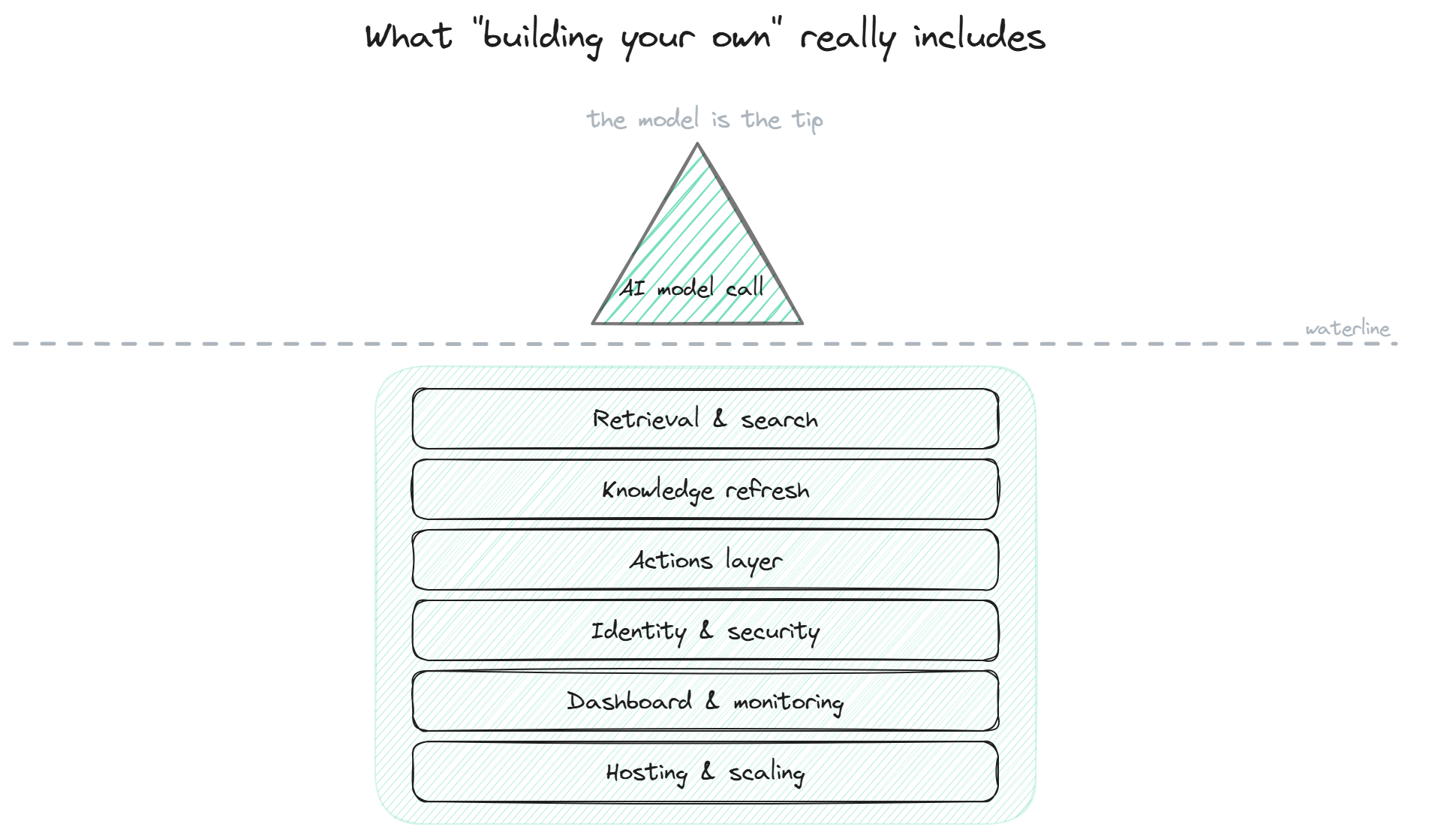
The model call is one line of code. Everything that makes it a usable support bot is not.
Retrieval is the first hidden layer. A support bot has to find the right piece of your documentation to answer from, which means ingesting your content, chunking it, embedding it, storing it in a vector database, and querying that store on every question. This is a real system to build and run, not a single API call, and getting the retrieval quality right (so the bot finds the relevant content and not the wrong content) is where a lot of the engineering time goes.
Knowledge ingestion and refresh is the next layer. Your content changes, so the bot's knowledge has to update: re-crawling your site, re-processing changed documents, detecting what changed so you do not reprocess everything. Building this pipeline, and keeping it running, is ongoing work.
Then there is the surrounding system: a way to monitor what the bot is answering, a dashboard to manage knowledge, identity and security handling, and the hosting to run all of it reliably. None of this is exotic, but all of it is work, and it adds up to a real engineering project rather than a weekend script.
The honest accounting of "build" is the cost of building and running that whole stack, not the cost of the model calls. The model calls are often the smallest line in the budget.
The cost that surprises people: maintenance
The build-versus-buy math goes wrong most often because people compare a one-time build cost against a recurring subscription, when the build is not one-time. A support bot is a living system that needs continuous maintenance, and that recurring cost is the one that surprises teams after they have committed.
The maintenance is constant because the inputs keep changing. Your product changes, so the knowledge needs updating. The models you built on get deprecated or replaced, so the integration needs updating. The retrieval quality drifts as content grows, so it needs tuning. Edge cases surface in production, so the handling needs fixing. A bot that was working six months ago and got no maintenance is a bot giving stale, increasingly wrong answers today.
This means the real comparison is not "build cost versus subscription cost" but "build cost plus ongoing engineering time versus subscription cost." The ongoing engineering time is the expensive part, because it is a recurring claim on your most expensive and scarcest resource: developer hours. A subscription converts that unpredictable, recurring engineering cost into a predictable line item, which is much of what you are paying for.
The actions layer is where build gets expensive
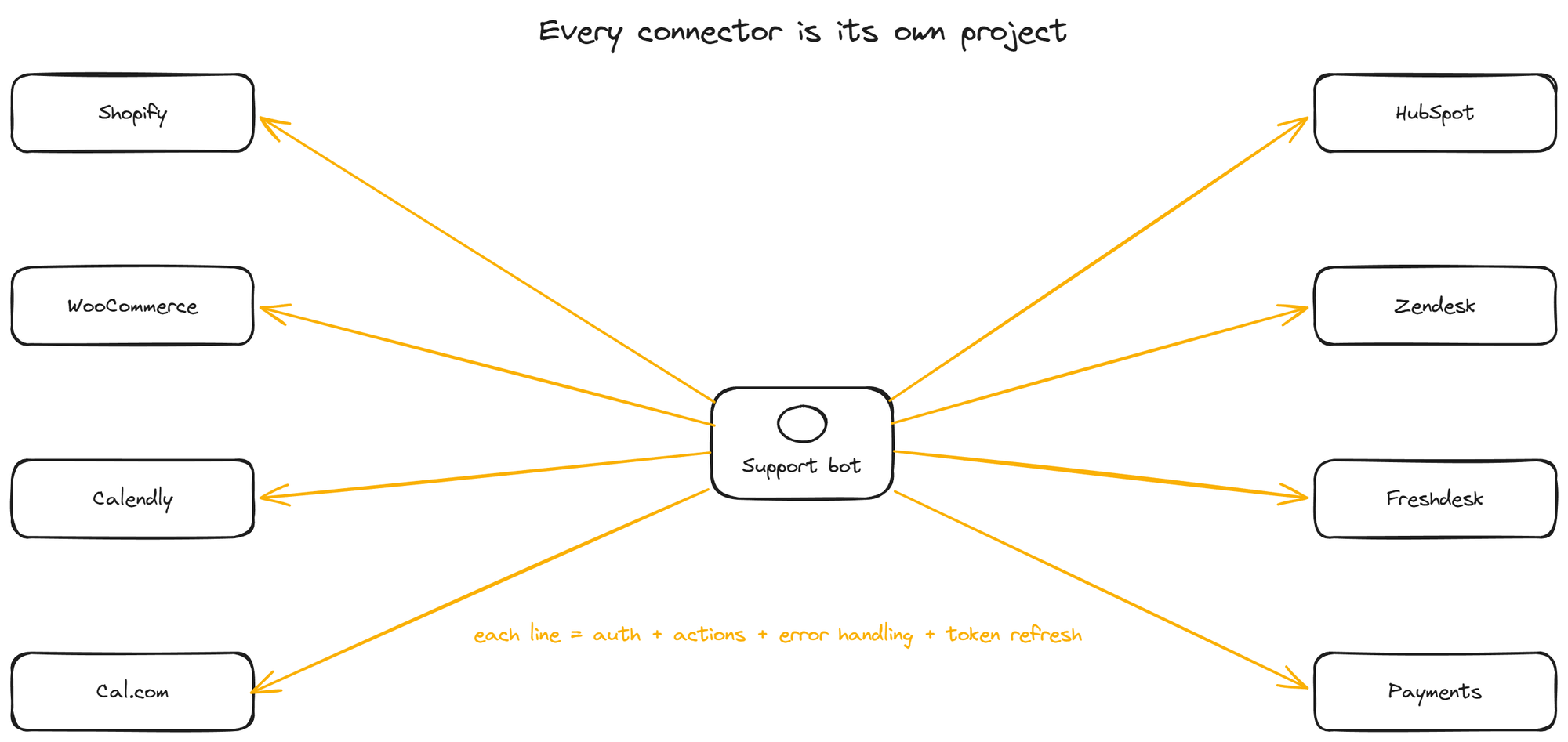
If your support bot only answers questions, building it is expensive but bounded. The moment it needs to do things (look up an order, book a meeting, create a ticket, check a subscription), the cost climbs steeply, because each action is a connection to a third-party system with its own complexity.
Every connector is its own small project. Connecting to a store platform means handling its authentication, mapping its data model, building the specific actions (search products, check order status, process a return), and handling its failure modes gracefully. Then you do it again for the calendar tool, again for the payment system, again for the support desk. Each connection needs auth handling, credential storage and refresh, per-action logic, and error handling for when the third-party service is down or rate-limited.
This is the layer where buying pulls decisively ahead, because a mature product has already built and maintained these connectors across many customers, absorbing the cost of every API change and edge case. Building the same action layer yourself means carrying all of that engineering and maintenance alone. The developer integration page covers how the action layer works on the buy side, where the connectors are maintained for you.
The credential security alone is a serious undertaking: storing third-party credentials encrypted, refreshing tokens, isolating one customer's connections from another. Getting this wrong is a security incident, so it is not a corner you can safely cut, which means it is real cost whether you build or buy.
When building your own makes sense
Building is not always the wrong call, and an honest guide says so. There are cases where custom is the right answer.
If your support needs are genuinely unusual, in a way no product addresses, building gives you control that buying cannot. If you have specific, hard requirements around data residency or architecture that no vendor meets, building may be the only path. If you are at a scale where the subscription cost at your volume exceeds the cost of a dedicated engineering team to build and maintain a bot, the math can flip. And if the support bot is itself your product (you are building support AI to sell), then building is not a build-versus-buy decision at all; it is your core engineering.
For most teams, though, none of these apply. The support bot is a tool to run support, the requirements are common, the volume does not justify a dedicated team, and the time to value matters. In that common case, buying wins on every axis that matters: faster to launch, cheaper over time once maintenance is counted, and a maintained action layer you do not have to build. The ready-made plans cover what buying costs.
BestChatBot is the buy side of this comparison: grounded answers, a maintained set of action connectors across commerce, scheduling, payments, and support tools, encrypted credential handling through a specialized provider, and a flat subscription that converts the recurring engineering cost of a custom build into a predictable line item. For the actual plans and prices, see plans.
FAQ
- Isn't building cheaper because the model API is cheap? The model API is cheap, but it is the smallest part of the cost. Retrieval, knowledge refresh, the actions layer, monitoring, security, and hosting are the real costs, and the ongoing maintenance of all of it is the part that surprises teams. The model call is the tip of the iceberg.
- What is the single biggest hidden cost of building? Ongoing maintenance, because it is a recurring claim on developer time, your scarcest resource. A bot is not a one-time build; it needs continuous updates as your product, the models, and your content change. Comparing a one-time build cost to a subscription misses this entirely.
- Why is the actions layer so expensive to build? Because each connector to a third-party system (store, calendar, payments, support desk) is its own project with its own auth, data model, actions, and failure handling, and all of it needs ongoing maintenance as those APIs change. A product amortizes this across many customers; building it yourself means carrying it alone.
- When does building actually make sense? When your needs are genuinely unusual, you have hard requirements no vendor meets, your volume is large enough that the subscription exceeds a dedicated team's cost, or the support bot is itself your product. For most teams running support as a function, none of these apply.
- How do I compare the two honestly? Put the full build cost (development plus ongoing engineering maintenance plus the actions layer) against the subscription at your volume, not just the build against the subscription. Count the recurring developer time, because that is the expensive part. For the actual plans, see plans.
For the actual plans and prices, see plans.