
AI Support Metrics That Matter
AI support metrics that matter: which numbers show real outcomes, which flatter your dashboard, and where to read deflection, containment, and executed actions.
A support dashboard rarely runs short on numbers. It runs short on numbers you can trust. Open most AI support tools and you meet a wall of counters, total chats, messages sent, average handle time, one big green deflection percentage, and almost none of them tell you whether a customer walked away with the problem solved. A team can watch every one of those tick upward for a month and still lose the customers it meant to help.
So the split worth drawing is between the AI support metrics that describe a real outcome and the ones that only describe activity. This piece walks through the customer support metrics worth putting in a weekly review, what each one actually measures, and how to read it without fooling yourself. The reference throughout is a grounded, action-taking assistant installed as a website widget, where a resolved chat should mean the customer's need got met, not just answered at.
The support metrics worth tracking
Start with a short list, not a long one. Six numbers cover almost everything a support lead needs to know about an AI agent, and each maps to something a customer would recognize as help.
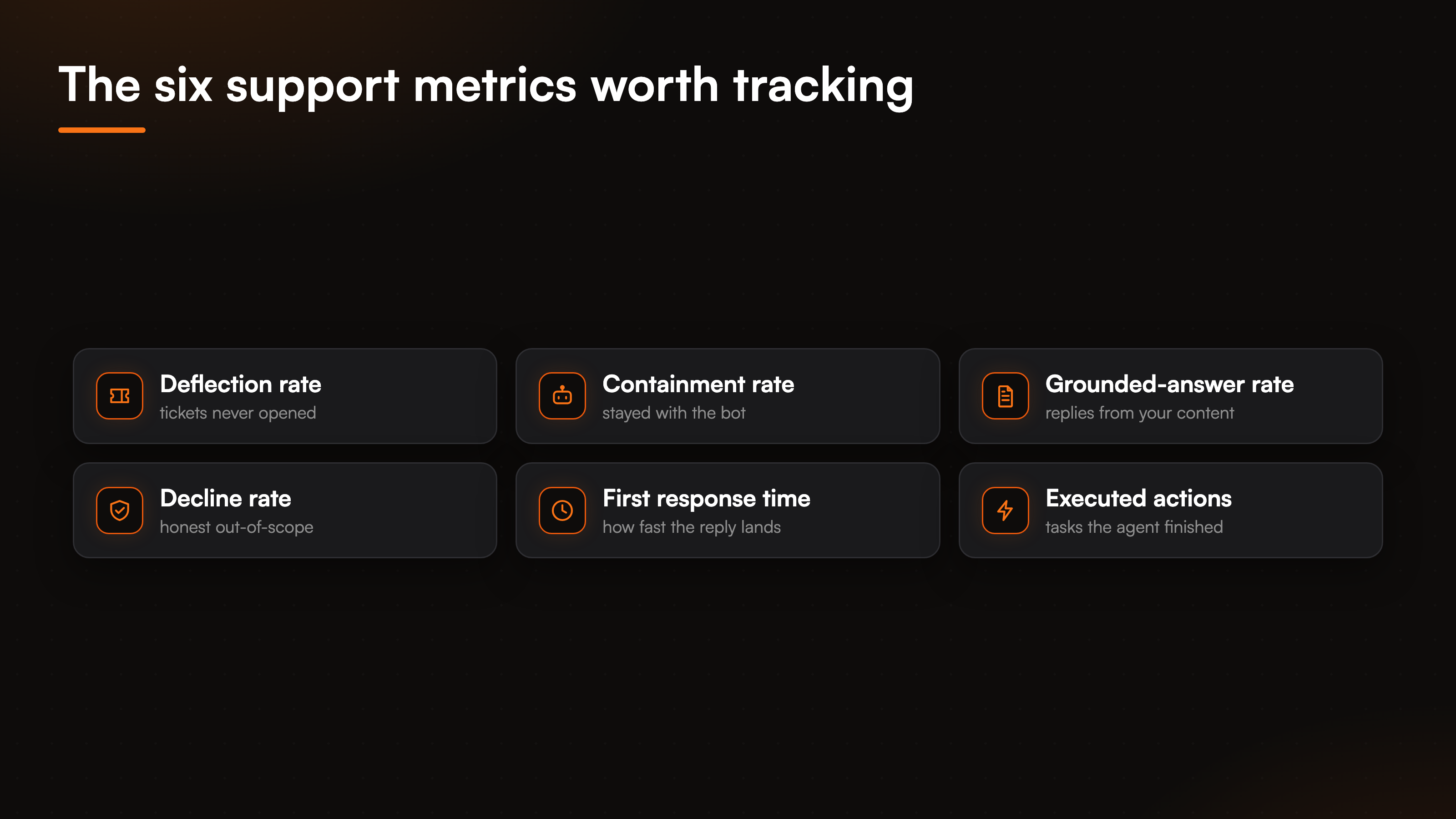
Deflection rate counts the visitors who got what they needed and never opened a ticket. Containment rate counts the conversations that stayed inside the bot and never routed to a person. Grounded-answer rate counts the replies the widget pulled straight from your own content. Decline rate counts the honest "I do not have that" when a question falls outside what the business ever wrote down. Time to first response counts how fast the opening reply lands. Executed actions counts the tasks the agent finished on the customer's behalf, a checked order, a booked slot, a started return.
Notice what the list leaves out. Raw chat volume, messages sent, session length. Those are chatbot metrics that grow no matter what happens to the customer, which is why they make poor headlines. We built the widget to be judged on the six above, because every one traces back to a person who left better off, which is the real aim of any customer support automation worth running.
Deflection and containment: activity, not the whole story
Deflection rate and containment rate get quoted the most and understood the least. They are useful, and they are also the easiest pair to misread.
Deflection rate rewards a visitor never filing a ticket, so it climbs just as happily when someone gives up and closes the tab as when the bot solved the issue. A store can post a 95% deflection figure while a good chunk of that 95% is quiet abandonment. Containment rate has the same soft spot: a customer stuck in a loop with a bot that refuses to admit defeat counts as contained and failed at the same moment.
Here is how I read them without getting fooled. Treat deflection rate and containment rate as guardrails, never as the trophy on the wall, and pair each one with an outcome number. A soaring deflection rate next to a sinking satisfaction score is not a win. It is a warning that people are bouncing off the bot rather than getting helped by it.
Grounded-answer rate and declines: the quality pair
The two numbers most support teams never think to track are the two that say the most about answer quality. Grounded-answer rate and decline rate move together, and reading them as a pair is the honest way to judge whether an agent is helping or bluffing.
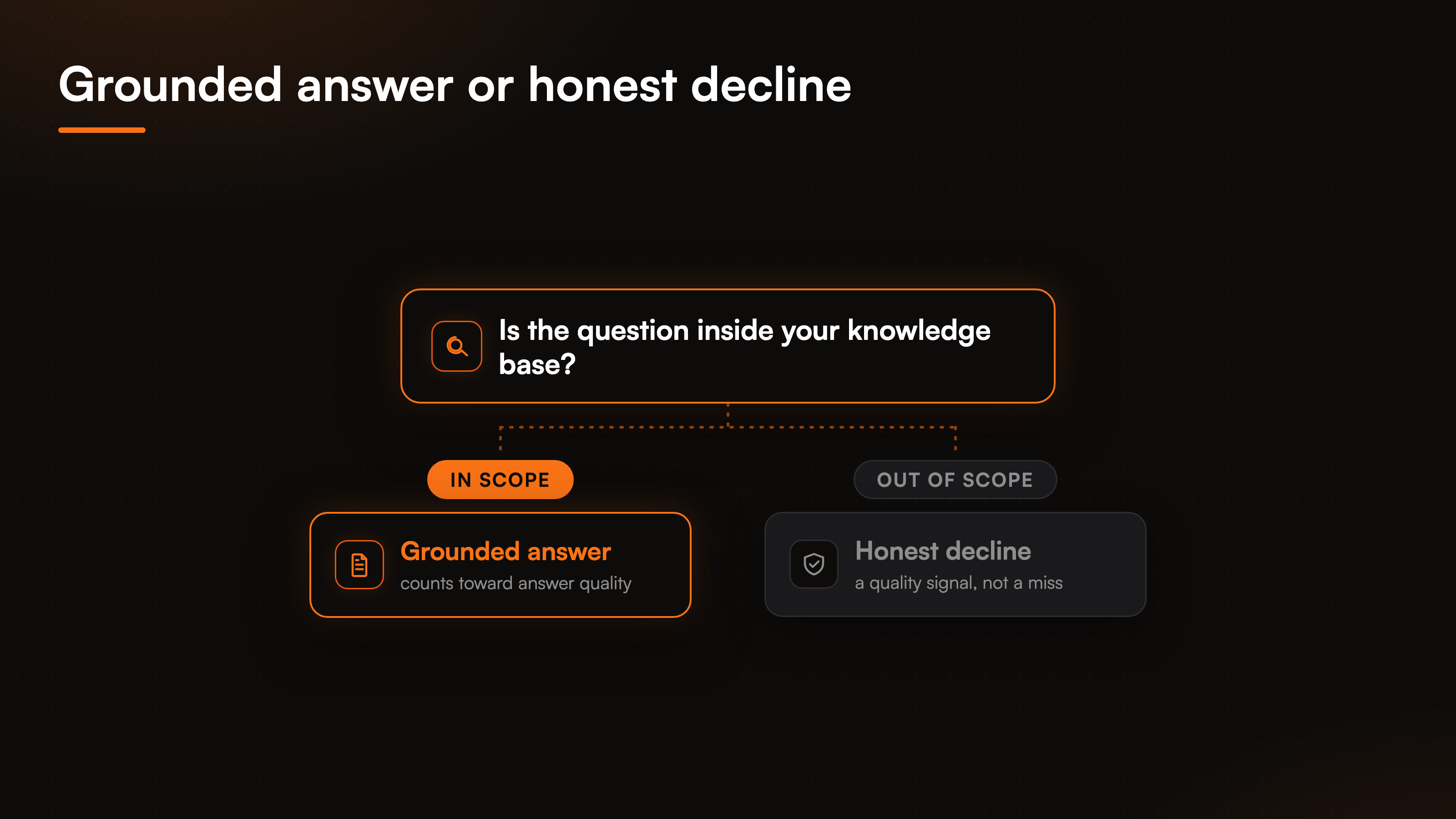
A grounded answer is a reply the widget built from the business's own uploaded content, a doc, a help article, a policy page, rather than from a model guessing at a plausible-sounding sentence. That discipline is the whole point of a no-hallucination support agent, and a healthy grounded-answer rate is the sign it is working. The decline rate is its twin: when a question sits outside the knowledge base, the agent says so and can hand off, instead of inventing a refund window or a shipping date that was never real.
Plenty of teams see a decline and flinch, as if the bot failed. My take is the opposite. A decline is a quality signal, not a miss. Every honest "I cannot answer that from your content" is a wrong answer that never reached a customer, and a wrong answer in support costs far more than a polite gap. Watch the two together: a high grounded-answer rate with a sane decline rate means the agent is resolving what it can and refusing to fake the rest.
Time to first response and executed actions
Two metrics measure the parts customers feel most directly, speed and completion.
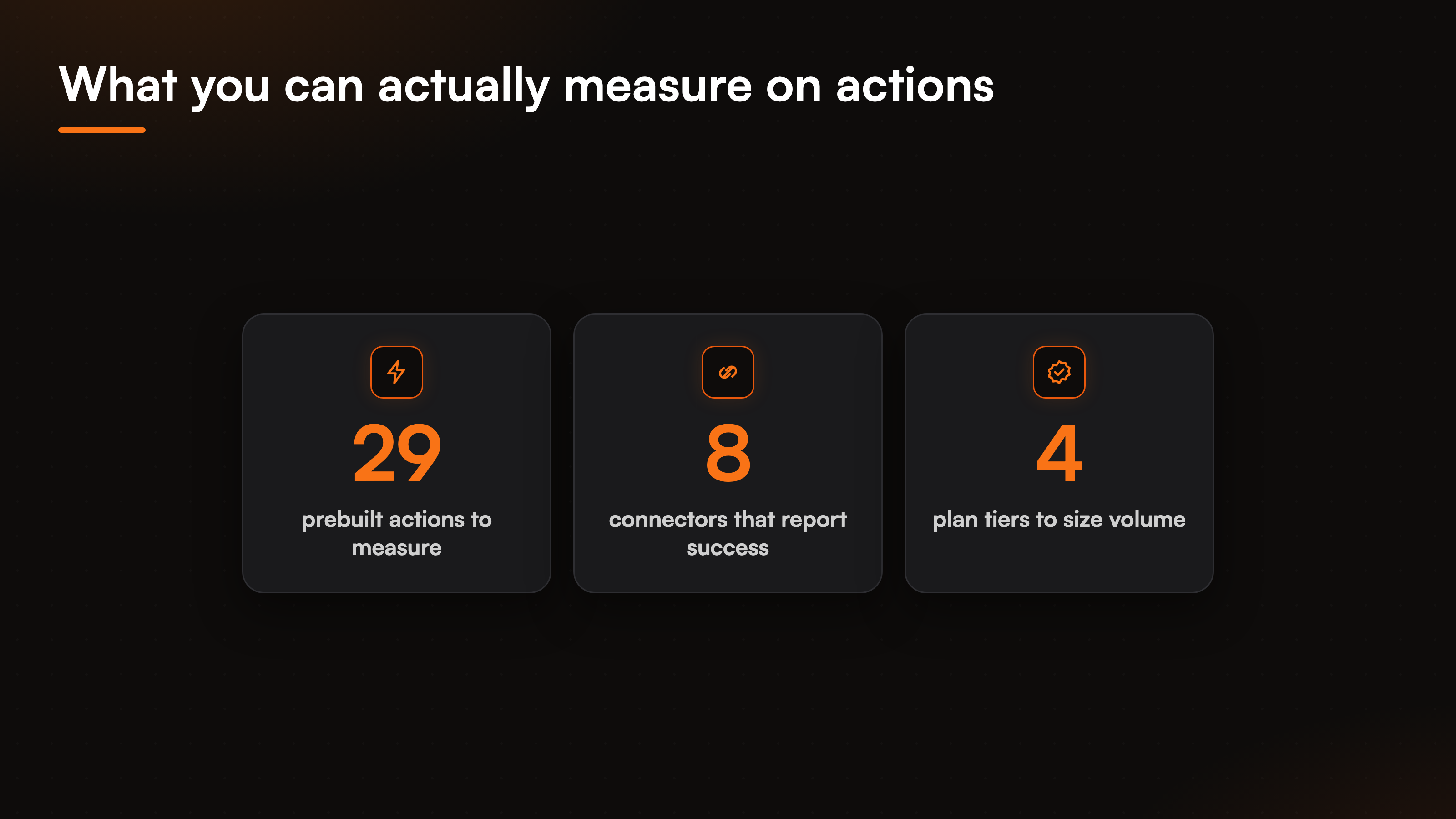
Time to first response stays honest, because a bot answers in the same second whether it is busy or quiet. There is no queue to hide behind, so a slipping number here points at a real problem in the pipeline. Executed actions is the metric that separates an answer-only chatbot from an agent that does the work. Instead of telling a shopper where to look, the widget runs one of 29 prebuilt actions across 8 connectors, checks the live order, books the slot, starts the return, then confirms the result back in the chat. Every completed run is a task the customer did not have to wait on a human for.
One plan reality belongs here, stated plainly. Grounded answering is available from the Free tier up, so the answer-quality numbers apply to everyone. The executed-action metrics only exist once you are on Pro or Business, where the connectors and the 29 actions switch on. Account-specific actions run only behind a verified visitor identity, with the email and name pinned from a signed token, so a completed action is always taken for the right person. That is why executed actions is a metric you can defend rather than pad: a completed run proves the agent finished a real task, not that it sent a longer message.
The vanity metrics that mislead
Some numbers look like progress and measure almost nothing. These are the vanity metrics, and they crowd the top of most dashboards because they only ever go up.
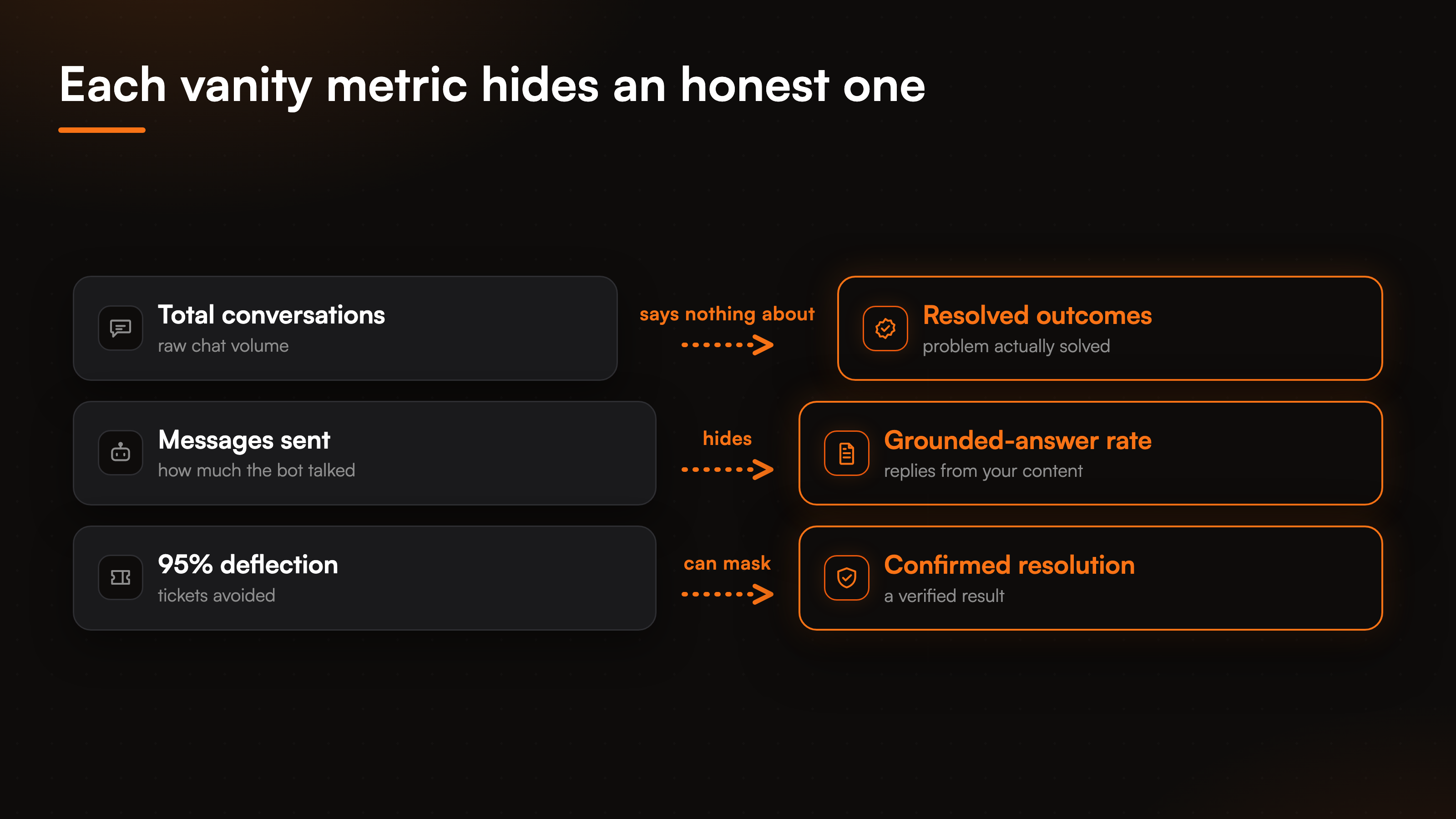
Total conversations tells you how much traffic hit the widget, and nothing about how any of it went. Messages sent rewards a chatty bot, which is often a bot that could not get to the point. A raw deflection percentage with no outcome beside it can mask a wave of people quietly giving up. None of these are lies, they just answer a question nobody asked, and a team that manages to them ends up with a busier bot, not a better one.
The fix is not to delete them, it is to demote them. Keep total conversations as a denominator, the thing you divide the good outcomes by, and stop treating it as a scoreboard. The moment a number cannot be traced to a customer who left helped, it drops out of the weekly review and into the footnotes.
Where these numbers actually live
None of this matters if the metrics sit in a slide nobody reads. Inside the product, the honest ones surface in the Response Monitor, the review surface where a human reads back what the bot said, spots a weak answer, and updates the knowledge behind it. The bot does not quietly retrain itself. A person reviews, then re-uploads a doc, re-scrapes a page with change detection, or edits an entry by hand, and the next answer reflects the fix.
Three habits keep the numbers useful. Measure over a fixed window, a week or a month, never a lifetime average that buries a recent regression. Segment by question type before you celebrate, because order-status questions resolve at a very different clip than billing edge cases, and a blended 80% can hide a 95% on the easy intents and a 40% on the hard ones. Keep escalations in their own column, since a chat that files a ticket in Zendesk or Freshdesk is an honest handoff to your team, not a resolution by the agent. Read this way, a handful of AI support metrics earns its place. Read carelessly, the dashboard becomes a comfortable fiction.
FAQ
Which AI support metrics matter most?
The ones that trace to a real outcome: resolution and deflection paired with a satisfaction score, grounded-answer rate against decline rate, time to first response, and executed actions. Skip the counters that only measure activity, like total conversations and messages sent, because they climb no matter what the customer experienced.
Is a high decline rate bad for a support bot?
No, it is usually a good sign. A decline means the agent refused to invent an answer for a question outside your content and either said so or handed off. Every honest decline is a wrong answer a customer never received, which is far cheaper than a confident mistake about a refund or a shipping date.
What is the difference between deflection rate and containment rate?
Deflection rate counts visitors who never opened a ticket. Containment rate counts conversations that stayed inside the bot and never routed to a person. Both can rise while customers quietly give up, so read each one next to an outcome number rather than on its own.
Which support metrics are vanity metrics?
Total conversations, messages sent, and a raw deflection percentage with no outcome beside it. They grow with traffic and chattiness rather than with customers getting helped, so keep them as denominators and judge the bot on the outcome numbers.
Where do I see these metrics in the product?
The answer-quality and action numbers surface in the Response Monitor, where a person reads back the bot's answers, catches weak ones, and updates the underlying knowledge. Improvement comes from a real edit, not from the bot silently learning on its own.
Metrics only earn their keep when each one means the same thing every week and traces back to a customer who left better off. To size which plan matches your conversation volume, and see where free grounded answering ends and paid actions begin, start with the AI support pricing guide, or work through the rest of our AI support agent resources. For the one metric people argue about most, our piece on resolution rate picks it apart in full.