
How Much Does an AI Support Agent Cost
What an AI support agent actually costs: the pricing models, what drives the price up or down, and how to compare it against the cost of human support.
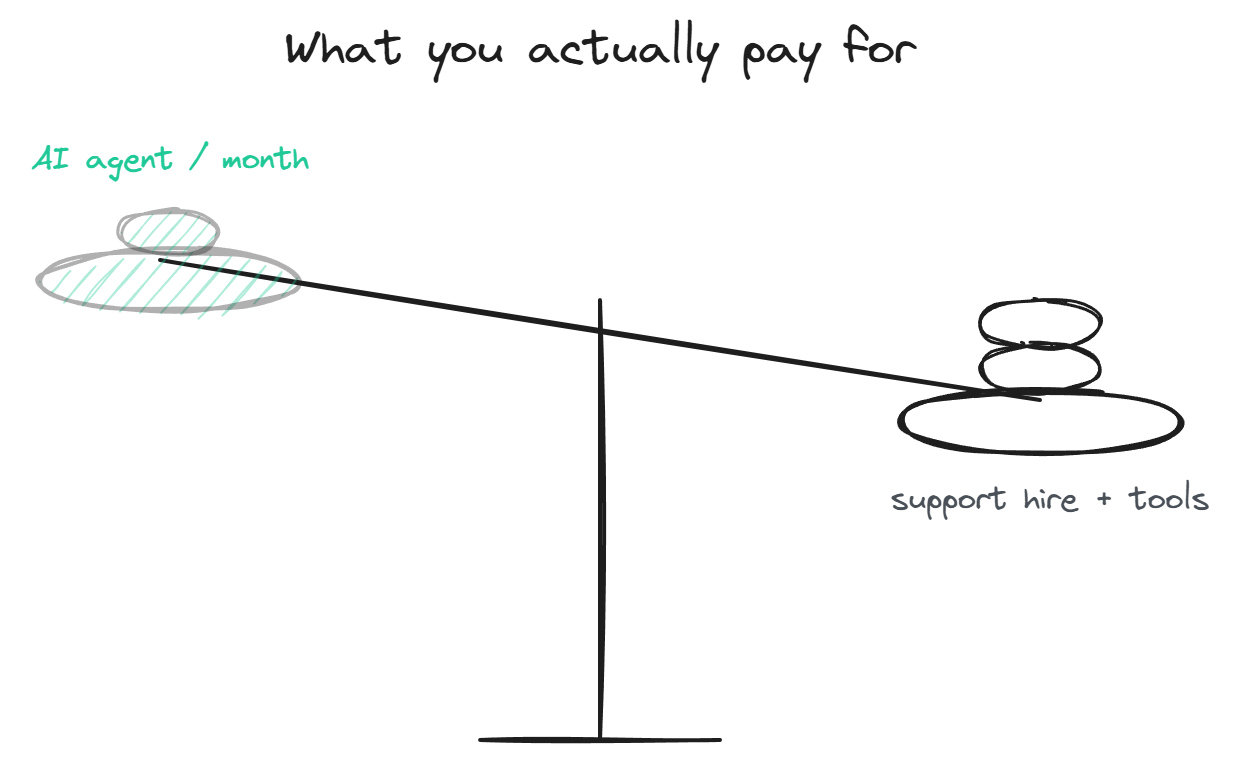
The honest answer to what an AI support agent costs is that it depends on three things: how much volume you run through it, how many workspaces and how much knowledge you need, and which tier matches that usage. Most buyers want a single number, but a single number would be misleading, because a solo founder running a few hundred conversations a month and a growing company running tens of thousands are in different worlds. This page breaks down the pricing models you will encounter, what actually drives the price up or down, and how to compare the cost against the alternative of human support so the number means something.
The pricing models you will see
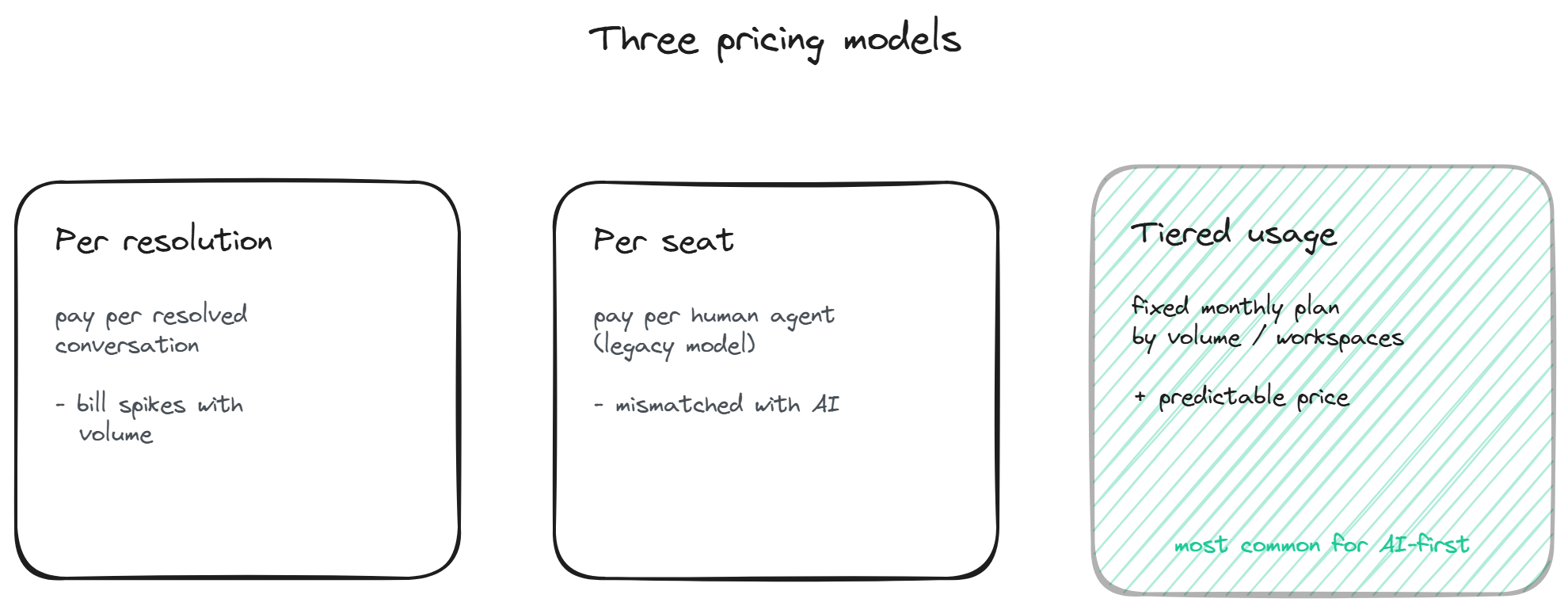
Three pricing models dominate the market, and they are not equally favorable for the buyer.
- Per-resolution pricing charges for each conversation the bot resolves. It sounds fair (pay for outcomes) but it has a perverse property: the better the bot works, the more you pay, and a volume spike becomes a bill spike. It also creates fuzzy disputes about what counts as a resolution. Some vendors use this model, and it can work, but you should model your volume carefully before committing to it.
- Per-seat pricing charges per human agent, a holdover from the legacy support-tool world. It maps poorly to AI, because the whole point of an AI agent is to decouple support capacity from human headcount. Paying per seat for a tool whose value is reducing seats is a mismatch, though some legacy vendors bundle AI into per-seat plans.
- Tiered usage pricing charges a fixed monthly price for a tier defined by usage limits: monthly conversations, number of workspaces, knowledge-base size, and similar. This is the most common model for AI-first tools and usually the most predictable for the buyer, because you pick the tier that fits your volume and the price does not spike when the bot works well. The trade-off is choosing the right tier and moving up as you grow.
What drives the price up or down
The variables that move your cost are worth understanding before you compare quotes, because the same product can cost very different amounts depending on your profile.
Volume is the biggest driver. More monthly conversations means a higher tier, across every pricing model. A startup with low volume sits in a low tier (sometimes a free one); a high-volume company pays more. This is why "what does it cost" has no single answer.
Knowledge and workspaces drive the price for multi-tenant or multi-brand needs. A single business with one knowledge base is cheaper than an agency or a company running several isolated workspaces, each with its own knowledge and configuration. Knowledge-base size and the number of trainable sources also factor into tier limits.
The actions side matters where the bot does more than answer. A bot that only answers questions is cheaper to run than one executing actions through connections (booking, order lookups, ticket creation), though the action capability is often where the value is. The build vs buy page covers how this compares to building the action layer yourself.
If that trade-off is still open, it is worth settling when to build vs buy before you line up quotes, since a custom build rarely lands at the subscription number it is compared against.
What rarely drives the price, despite buyer worry, is the language model itself. Most tools bundle model costs into the tier, so you are not metered on tokens directly. The pricing abstracts that away into the usage tier.
How to compare it against human support
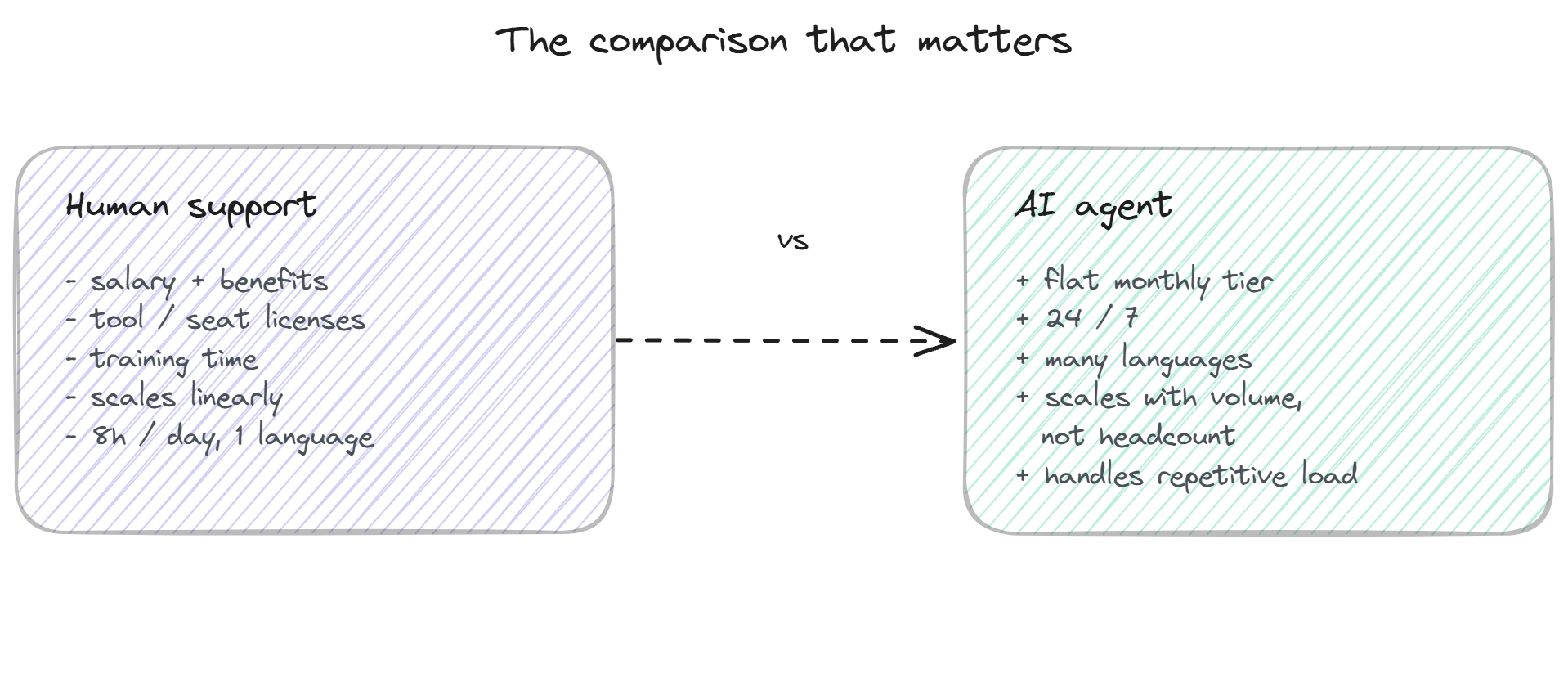
- The number only means something in comparison to the alternative, which for most buyers is human support. The comparison is not "bot versus human" (you will keep humans for the hard cases) but "bot plus lean team versus larger team."
- The human side of the comparison includes more than salary. A support hire costs salary plus benefits, plus the seat licenses for the support tools, plus the ramp-up time before they are productive, plus the management overhead. And it scales linearly: double the volume, roughly double the headcount, with each person covering one timezone and usually one language for part of a day.
- The AI side is a flat monthly tier that covers the repetitive volume around the clock, in many languages, scaling with volume rather than headcount. The honest comparison puts the bot's monthly cost against the fraction of a support hire it replaces, which for a startup deflecting most of its repetitive volume is often a large fraction. The reduce tickets page covers the deflection math that makes this comparison concrete, and the estimate savings tool lets you model it with your own numbers.
- The comparison that usually surprises buyers is not that the bot is cheaper per month (it often is, dramatically) but that it does things the human alternative cannot at any price for a small team: instant answers, 24/7, every language, consistent quality, no ramp-up. The cost question becomes a value question once you account for what you actually get.
BestChatBot uses tiered usage pricing across four plans (Free, Starter, Pro, Business), differentiated by monthly responses, active workspaces, knowledge-base size, and trainable sources, so you pick the tier that fits your volume and move up as you grow. For pricing details, see plans.
FAQ
- Why can't you just tell me a single price? Because the right price depends on your volume, workspaces, and knowledge needs, which vary enormously between a solo founder and a growing company. A single number would be misleading for most readers. The tiers exist precisely to match price to usage.
- Which pricing model is best for a buyer? Tiered usage is usually the most predictable, because the price does not spike when the bot works well or when volume surges. Per-resolution can work but needs careful volume modeling, and per-seat maps poorly to a tool whose value is reducing seats.
- Is there a free tier? Many AI-first tools, including this one, offer a free tier for low volume, which is often enough for a very small startup to handle its top questions. You move to paid tiers as volume grows.
- Does running actions cost more than just answering? Often yes, because action capability (booking, lookups, ticket creation) is more involved than answering questions, and it is sometimes gated to higher tiers. But the actions are frequently where the value is, so the higher cost can pay for itself.
- How do I compare it to my current support cost? Put the monthly tier against the fraction of human support it replaces, accounting for full cost (salary, benefits, tools, ramp-up), not just salary. Model the deflection with your real volume. The savings tool gives you a framework. For pricing details, see plans.
For pricing details, see plans.
Costs vary by billing structure, so compare the pricing models behind those numbers.
If your volume is low enough that a free plan might cover it, check whether a genuinely free AI chatbot fits before you weigh the paid tiers.