
The Best AI Agent for Ecommerce
Picking the best AI agent for ecommerce? See how a website-first agent handles order tracking, returns, and product questions on Shopify or WooCommerce.
A shopper lands on your store at 11pm with a plain question. Where is my order. Can I return this. Does this run small. On a busy storefront those three questions plus their cousins make up most of the chat volume, and they all share one trait: the answer lives in a real system, not in a clever paragraph. The wrong AI agent replies by guessing, which on a store means a made-up shipping date or an invented return window. The right one reads the real order, answers from your real policy, and admits it when the answer is not there.
This page is about choosing the best AI agent for ecommerce, judged on the jobs a storefront actually throws at it rather than on a generic feature list. We will keep the trade-offs honest, name where our own agent fits, and stay on what BestChatBot really does.
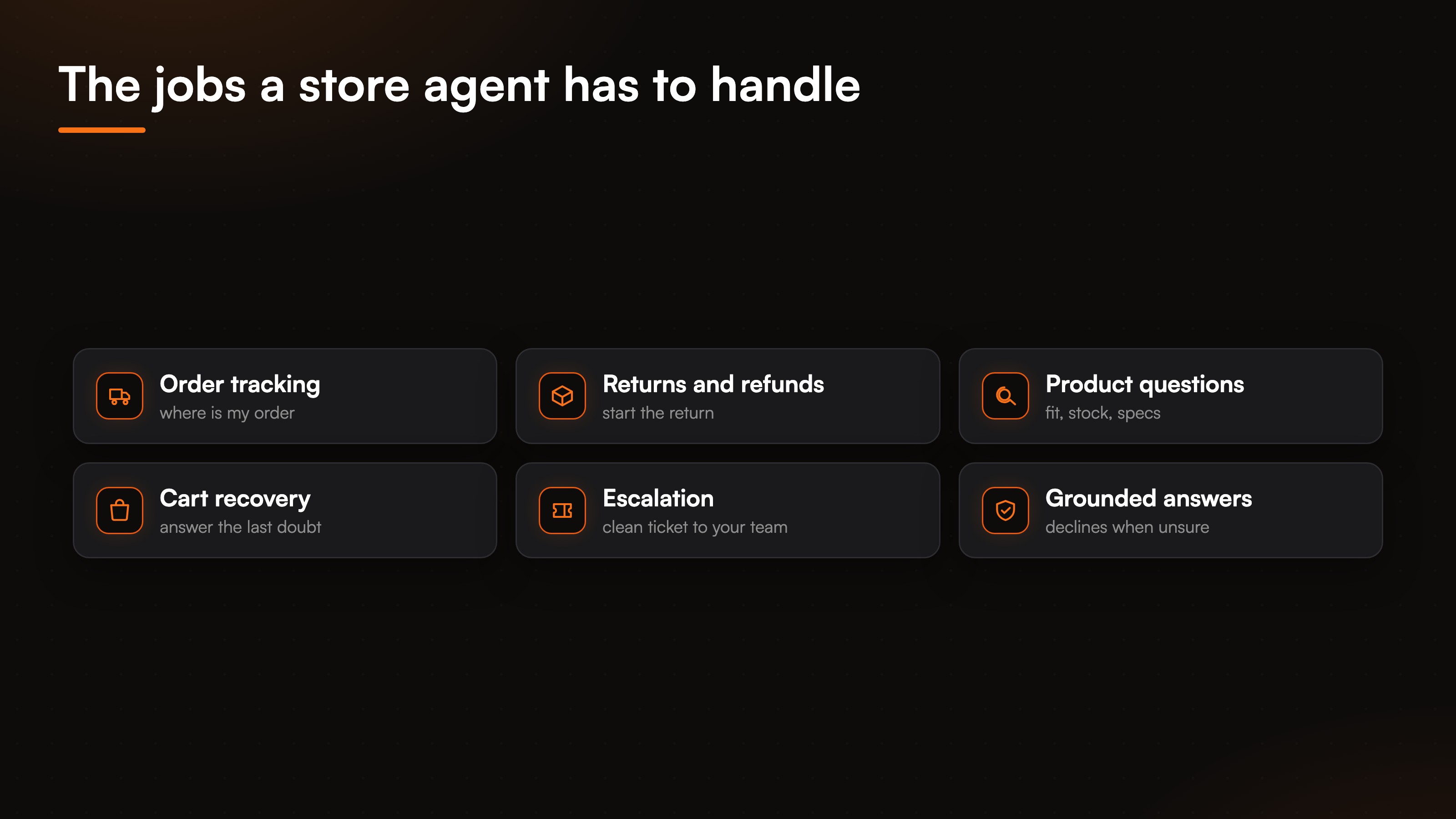
What an AI agent for ecommerce has to handle
A store is not a marketing site with a chat bubble. The questions are transactional, they repeat in a tight pattern, and most of them point at a specific order or a specific product. Rank any candidate against the jobs below before you rank it on anything else.
- Order tracking. The "where is my order" question, answered with the real status, not a link the shopper could have found alone.
- Returns and refunds. Reading the policy correctly, and starting the return when the store allows it.
- Product questions. Fit, materials, stock, compatibility, pulled from the product page rather than imagined.
- Cart recovery. Answering the one doubt that stalls a checkout, in the moment it stalls.
- Escalation. Knowing when to stop and hand a real person a clean ticket.
A generic ecommerce AI chatbot can hold a conversation about all five. The gap shows up in whether it grounds each answer in your data or fills the blank with something plausible. That single behavior decides whether you can put it in front of paying customers.
Where a generic store bot breaks
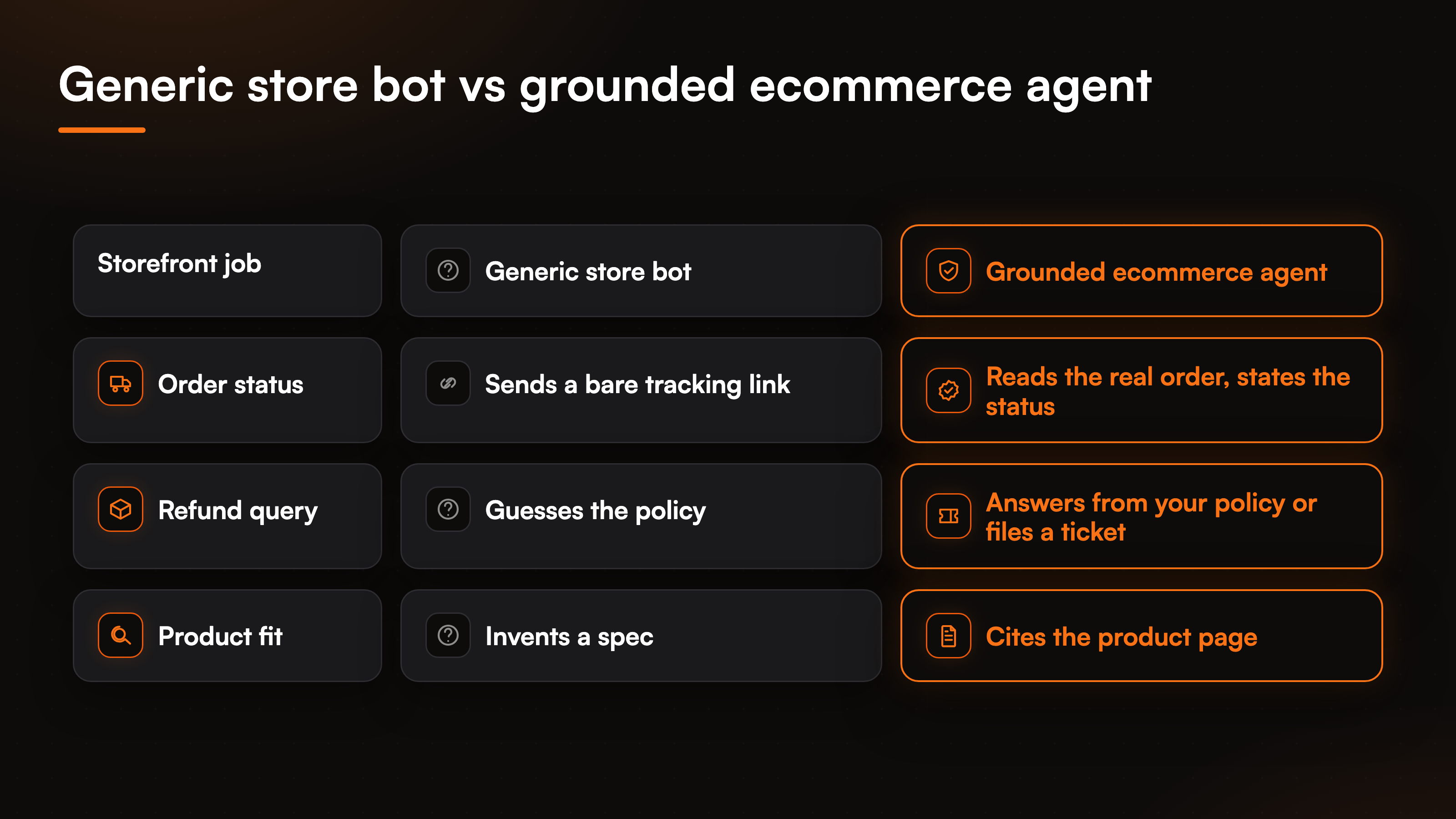
Put a scripted or ungrounded bot on a storefront and the failures rhyme. Asked for an order status, it sends a bare tracking link and calls the job done, when the shopper wanted a status. Asked about a refund, it guesses the policy and sets an expectation you now have to walk back. Asked whether a jacket fits, it invents a spec that is not on the page.
None of these look like errors in a demo. They look like errors three days later, in an email that starts with "your bot told me". The cost of a wrong answer on a store is not a bad chat rating, it is a refund dispute or a return you did not owe. So the real comparison is not which bot chats best, it is which one refuses to guess. Here is the same set of jobs, run by a bot that pattern-matches versus an agent that reads your systems.
Grounded answers plus real actions
BestChatBot is a website AI support agent you train on your own content. Upload product docs and policies, or crawl your store by full domain, sitemap, or single URL, and it answers from that knowledge. When a question falls outside what it was given, it declines instead of inventing, and it can cite the source behind an answer. That decline behavior is the whole point of a grounded setup, and it is covered in depth in our no-hallucination breakdown.
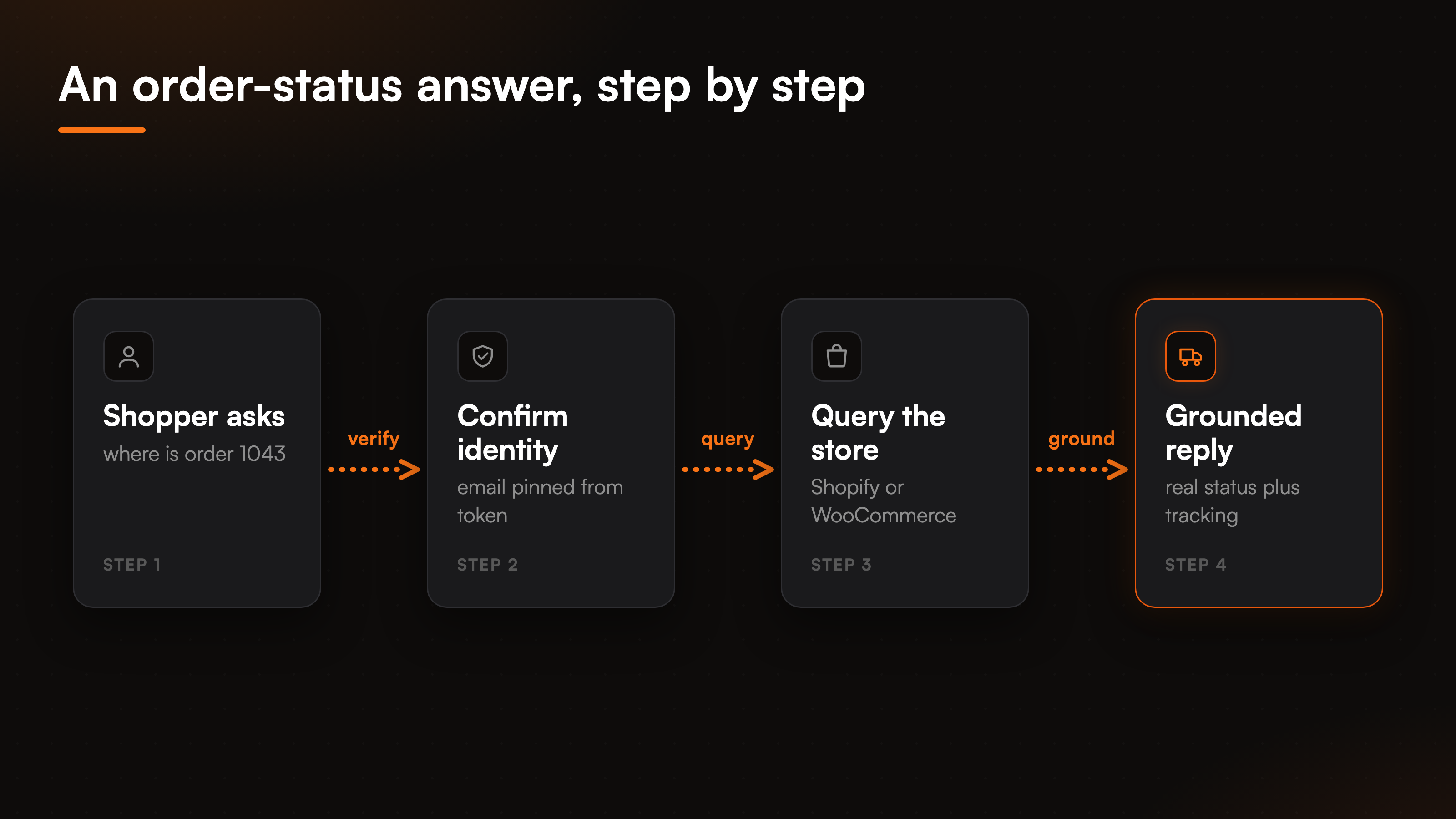
Answering is half the job on a store. The agent also runs real actions through secure connections. When a shopper asks for a status, the agent confirms who they are, queries the store, and replies with the real order state instead of a guess. Actions that touch a specific customer need a verified visitor identity first, and the email and name get pinned from that identity token. That is what stops one shopper from pulling another shopper's order by typing a different address into the box. The same wiring powers AI order tracking, return starts, and any action tied to an account.
Shopify or WooCommerce, one store per category
The connectors are exclusive by category on purpose. You wire one calendar, one support desk, one store, so the agent runs the stack you already use instead of a sprawl of overlapping tools. For a storefront that means Shopify or WooCommerce, not both at once. Run BestChatBot as a Shopify AI agent, or connect it for WooCommerce support, and the order and product actions light up on that platform. Across all categories there are 8 connectors and 29 prebuilt actions covering scheduling, support tickets, CRM, payments, and e-commerce.
Escalation stays honest too. When the agent cannot resolve something, it does not fake a live transfer. It creates a ticket in Zendesk or Freshdesk and routes it to your team's inbox with the conversation attached. Agentic actions run on the Pro and Business plans, while grounded answering starts on the free tier.
| What to compare | Generic store bot | BestChatBot |
|---|---|---|
| Answering | Pattern-matches, can invent | Grounded in your data, declines when unsure |
| Order status | Sends a tracking link | Reads the real order, states the status |
| Store platform | Often none, or read-only feed | Shopify or WooCommerce actions |
| Identity for actions | Trusts whatever is typed | Email pinned from a verified token |
| Escalation | Dead end or vague promise | Ticket in Zendesk or Freshdesk |
| Deployment | Varies | Paste a widget snippet |
What teams see after switching
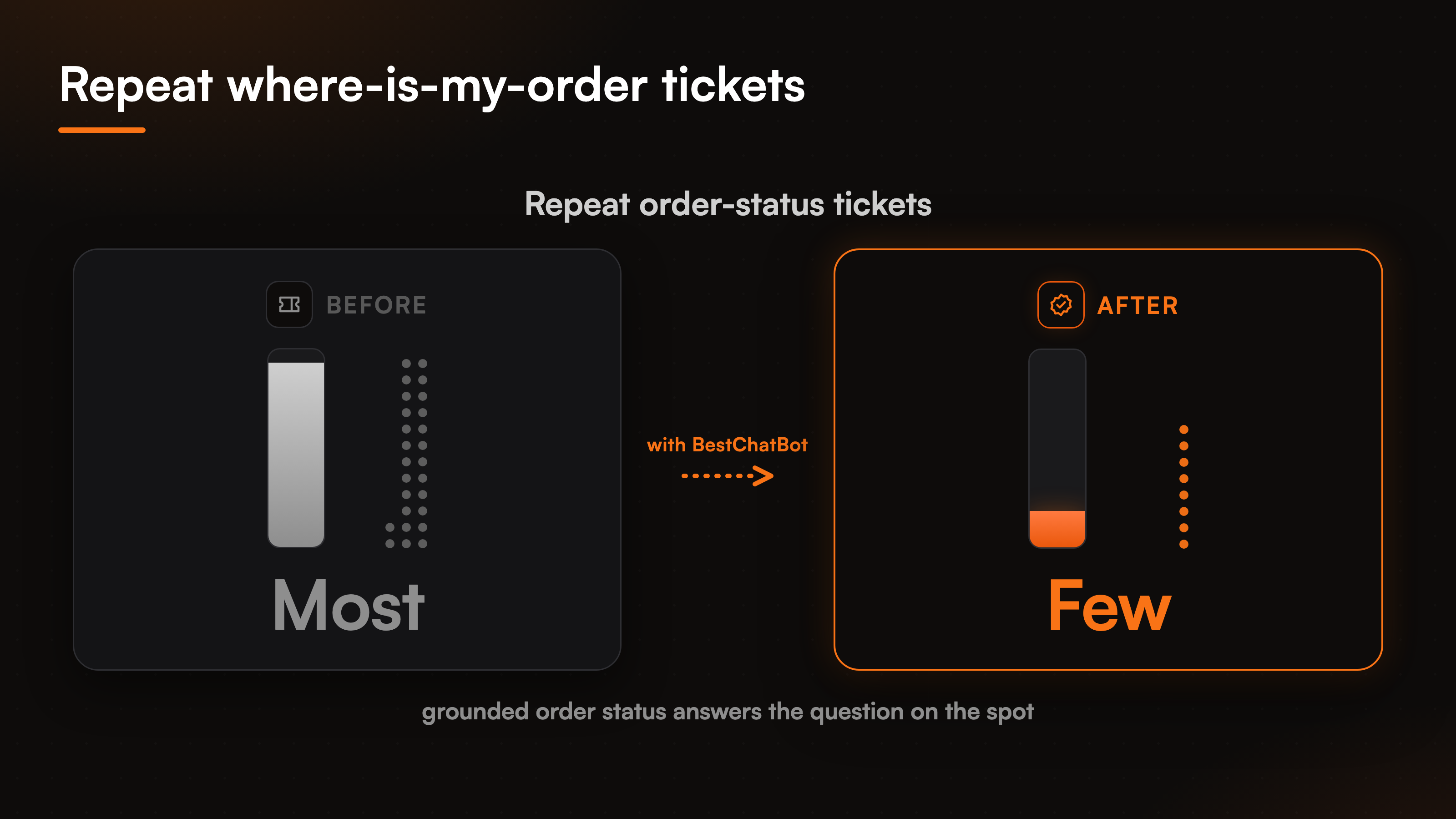
The metric that moves first is repeat "where is my order" volume. When the agent answers the status question with the real status, the shopper stops re-asking and stops opening a ticket about it. The same holds for return eligibility and stock questions once the answers come from your policy and product pages rather than a guess.
We think grounding, not chattiness, is what drives that drop. A bot that answers fast but wrong just moves the work downstream into your inbox. A grounded agent that declines the 1 question it cannot ground protects the 9 it can.
Put it on your store
Switching is lighter than it sounds when the agent installs as a widget. Here is the path we hand ecommerce teams.
- Load your knowledge. Upload return and shipping policies and product docs, or crawl the store. Change detection keeps the content current as pages and prices move.
- Paste the widget snippet on your storefront. The agent answers from your knowledge right away and declines anything outside it.
- Connect your store. Add Shopify or WooCommerce through a secure connection using OAuth or an API key. Credentials are stored encrypted by a specialized provider, never by us directly.
- Turn on actions and identity. On Pro or Business, enable order tracking, returns, and the rest, and require a verified identity for anything customer-specific.
If your evaluation started from a support desk angle, our Gorgias alternative comparison covers that trade-off for stores, and the order tracking chatbot guide goes deep on the status question. For the full ranked set of options, the compare hub collects every head-to-head we publish, and the best AI support tools roundup widens the field past storefronts.
FAQ
What makes the best AI agent for ecommerce different from a chatbot?
A store agent has to act, not just chat. The best AI agent for ecommerce reads the real order for a status, starts a return when your policy allows, and answers product questions from the actual page. It grounds every answer in your data and declines when the answer is not there, so a wrong shipping date never turns into a refund dispute.
Does it work with Shopify and WooCommerce?
Yes, one at a time. The store connector is exclusive by category, so you run BestChatBot as a Shopify AI agent or connect it for WooCommerce support, whichever platform your store already uses. Order and product actions run against that platform once the connection is live.
How does it handle order tracking safely?
AI order tracking runs behind a verified identity. Before the agent pulls an order it confirms the shopper, and the email is pinned from that identity token rather than trusted from the chat box. That keeps one shopper from reading another shopper's order, and the reply carries the real status instead of a bare link.
What happens when the agent cannot answer?
It escalates by creating a ticket in Zendesk or Freshdesk and routing it to your team with the conversation attached. There is no invented answer and no fake transfer. The shopper gets a real handoff, and your team gets the context.
Which plan do the store actions need?
Grounded answering starts on the free tier, so the agent can answer product and policy questions right away. The agentic connectors, including the Shopify and WooCommerce actions, run on the Pro and Business plans. The pricing guide lays out the tiers against your monthly volume.
Ready to match a plan to your store's volume? Start by comparing the plans.
On Shopify specifically? Compare the AI chatbot built for Shopify stores.