
GDPR Compliance for AI Support Agents
A practical look at GDPR compliance for AI support agents: lawful processing, data subject rights, residency, erasure, and the real controls an AI support agent gives you.
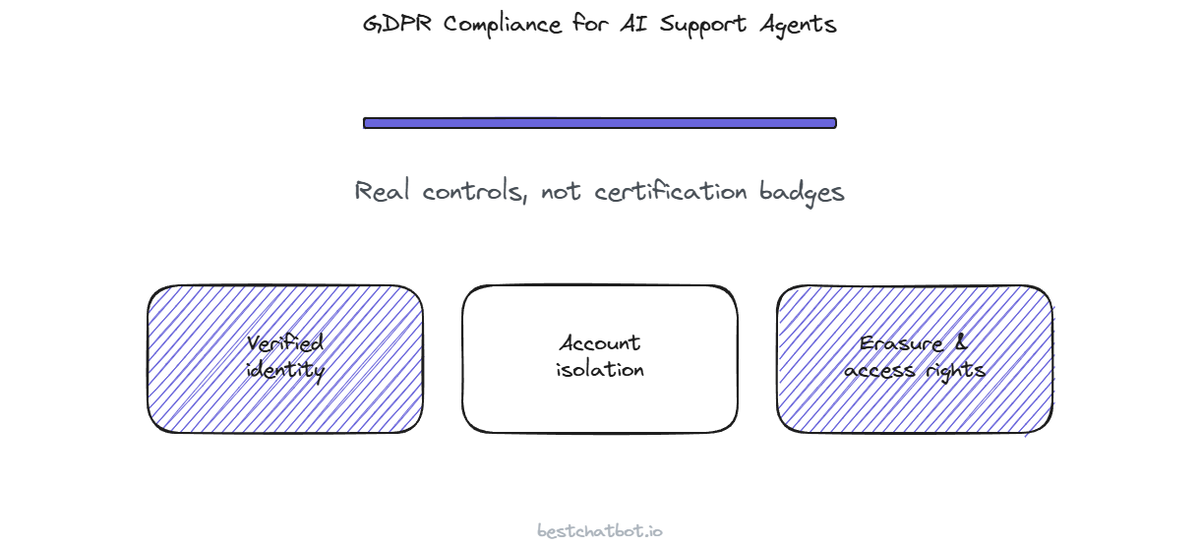
If you run a support widget on a website that serves people in Europe, GDPR is not a checkbox you tick once. It follows every message a visitor types, every account lookup the agent makes, and every record that lands in a database afterwards. The hard part is that an AI support agent sits on top of personal data by definition: names, emails, order numbers, the content of a question someone asked at 2am.
We get asked the same thing constantly: "Is your chatbot GDPR compliant?" The honest answer is that no vendor can hand you compliance in a box. GDPR compliance for AI support agents is shared work. You decide the lawful basis and the retention policy; the platform has to give you the technical controls to honor those decisions. This post walks through what GDPR actually asks of an AI support agent, and which of those controls our widget supports today. No certification badges, because we do not claim ones we do not hold. Just the mechanics.
What counts as personal data in a support chat
Start with the part teams underestimate. A support conversation is dense with personal data under GDPR, far beyond the obvious email field.
When a visitor opens the widget and asks "where is my order #4471", three categories of personal data are already in play. There is what they typed (the message content). There is what the agent reads back to answer them (the order record, the shipping address). And there is the metadata around the session: a visitor identifier, timestamps, the page they were on. GDPR treats all of it as personal data the moment it can be tied to a person.
Here is the distinction that matters for an AI agent specifically. The agent does not only store data, it processes it. It reads a question, decides whether it can answer from the business's knowledge, and for account-specific questions it looks up a real record. Each of those steps is a personal data processing activity you should be able to describe in your record of processing. When people search "ai chatbot gdpr", what they really want to know is which of those processing steps a vendor exposes and lets them control. The good news is the surface is small and knowable. The widget answers from content the business uploaded or crawled, and it declines when a question falls outside that content rather than inventing an answer. A narrow, predictable data surface is far easier to document than an agent that wanders.
Lawful basis and the limits we build in
GDPR says every bit of processing needs a lawful basis. For support, that is usually legitimate interest (answering a customer who reached out) or contract (fulfilling an order they placed). You choose the basis; the agent's job is to stay inside it.
Two design choices keep the agent honest here. First, the crawler that builds the knowledge base reads public pages only. It never logs into a member area or pulls content from behind authentication, so the knowledge the agent answers from is content the business already chose to publish. Second, anything that touches a specific customer's record is gated behind a verified identity. An anonymous visitor asking a general question gets a general answer. A visitor who wants their own order status has to prove who they are first.
That second point is the spine of GDPR access control for an AI agent, so it deserves its own section.
Identity gating: no account data without a verified visitor
GDPR's whole model rests on knowing whose data you are touching. An AI support agent that happily reads out any order number to anyone who asks is a data breach waiting to happen, and it would fail the integrity-and-confidentiality principle outright.
Our widget blocks that path by design. Customer-specific actions require a verified visitor identity, carried as a signed token (JWT) the host site issues for a logged-in user. No verified identity means no account lookup. The agent either declines the account-specific request or stays on the anonymous path where it can only answer general questions. There is no silent fallback that quietly reads someone's data because the token was missing.
The identity also pins the request. When the agent looks up an order or creates a ticket, the customer's email and name come from the verified token, not from whatever the visitor typed into the chat. A visitor cannot ask for "John's order" and receive it, because the agent acts on the identity it verified, not on a name in free text. If you want the deeper mechanics of how that gating works across every action the agent can take, we wrote a full piece on identity-verified actions.
Worth being clear: agentic actions, the ones that read or change a customer's record in a connected tool, are a paid capability (Pro and Business plans). The identity gate applies wherever those actions run.
Data subject rights: access, erasure, and the off switch
GDPR gives people rights over their data, and a few of them land directly on a support agent. Three come up most.
Access. A data subject access request asks what data you hold about a person. Because the agent's data surface is small and the conversation records live in your own account's isolated storage, you can locate a person's messages and the records the agent touched without untangling a sprawl. The narrower the surface, the cheaper the access request.
Erasure. The right to erasure is the one teams worry about most with AI, because they imagine the model has "memorized" the customer. It has not. The agent does not train on your conversations and it does not learn on its own. It answers from a knowledge base you control. So erasure is a data operation, not a model operation: you delete the visitor's conversation records, and if a person's details ended up in the knowledge base, you remove that source and rebuild. Deleting a whole workspace removes its knowledge and its conversation history with it. There is no hidden second copy quietly improving a shared model.
Rectification and restriction. Because knowledge is edited by hand or re-ingested rather than absorbed silently, fixing wrong information is a direct edit, not a retraining gamble.
Where the data lives, and who cannot reach it
Residency and access control are two questions a GDPR review always asks: where is the data, and who else can see it.
On separation, the platform is multi-tenant, and each business's data sits in its own isolated store. Another business on the same platform cannot read your visitors' messages or your knowledge base. That isolation is not a policy promise, it is how the storage is partitioned per account. For the access-control side of identity and isolation, the data privacy breakdown goes deeper into the data surface and who can touch what.
On credentials, GDPR cares about how you secure access to the tools the agent acts on, and our data security measures describe exactly how that access is protected. We never store your connected tools' credentials directly. A specialist provider holds them encrypted and refreshes the tokens, so the most sensitive secrets are not piled up in our application database. OAuth and API-key connections both work this way. If you want the architecture of those secure connections, that is its own secure connections write-up.
A caveat I will not paper over: data residency specifics (which region your data physically sits in) depend on the deployment, and you should confirm the current region for your account rather than assume it from a blog post. We would rather you ask than guess.
A short checklist before you point a GDPR reviewer at it
If a privacy reviewer is about to look at your AI support agent, walk this list:
- Document the processing: what the agent reads, what it stores, and the lawful basis for each.
- Confirm the crawler is pointed at public content only, never gated pages.
- Verify identity gating is on for any action that reads or writes a customer record.
- Set a retention policy for conversation records and apply it.
- Know your erasure procedure: delete conversations, remove a source from the knowledge base, rebuild.
- Confirm credentials for connected tools are held by the encrypted-vault provider, not in plain config.
None of that requires a certification we do not have. It requires controls that exist and a policy you enforce on top of them.
FAQ
Is BestChatBot GDPR compliant out of the box?
No vendor can be "compliant for you," and we will not claim a certification we do not hold. GDPR compliance is shared: we provide the technical controls (identity gating, multi-tenant isolation, deletion, credentials held by an encrypted vault), and you set the lawful basis, retention policy, and processing records. The controls are real; the policy decisions are yours.
Does the AI agent train on my customers' conversations?
No. The agent does not learn on its own and does not train on your conversations. It answers from a knowledge base you control, built from content you upload or from public pages it crawls. That is why the right to erasure is a straightforward data deletion rather than an attempt to make a model forget.
How do I handle a data subject access request or erasure request?
For access, locate the person's conversation records and the records the agent touched in your isolated account store. For erasure, delete those conversation records, and if any of their details reached the knowledge base, remove that source and rebuild. Deleting a workspace removes its knowledge and conversation history together. There is no separate shared copy of the data improving a model in the background.
Can another business on the platform see my visitors' data?
No. The platform is multi-tenant with each account's data in its own isolated store. Another business cannot read your visitors' messages or your knowledge base. The separation is enforced by how storage is partitioned per account, not by a policy promise alone.
Where is my data stored, and is it in the EU?
The agent's data surface is small (conversation records and the knowledge base in your isolated account store) and credentials for connected tools sit with an encrypted-vault provider rather than with us. Data residency depends on your deployment, so confirm the current region for your account directly rather than assuming it.
Trust comes from controls you can point at, not badges. The wider picture of how privacy, identity, and isolation fit together lives on the trust hub, and if you are weighing what the agentic tier costs before you commit, the pricing guide lays it out.
Related on trust: see how the widget handles identity verification with signed JWTs and the guardrails that bound what the agent can do.
More on trust: see the audit trail kept as compliance evidence and how tenant data stays isolated.