
Audit Trail for AI Answers and Actions
An audit trail for AI answers and actions records what the agent said and did, who asked, and what source it used, so every reply and task stays reviewable.
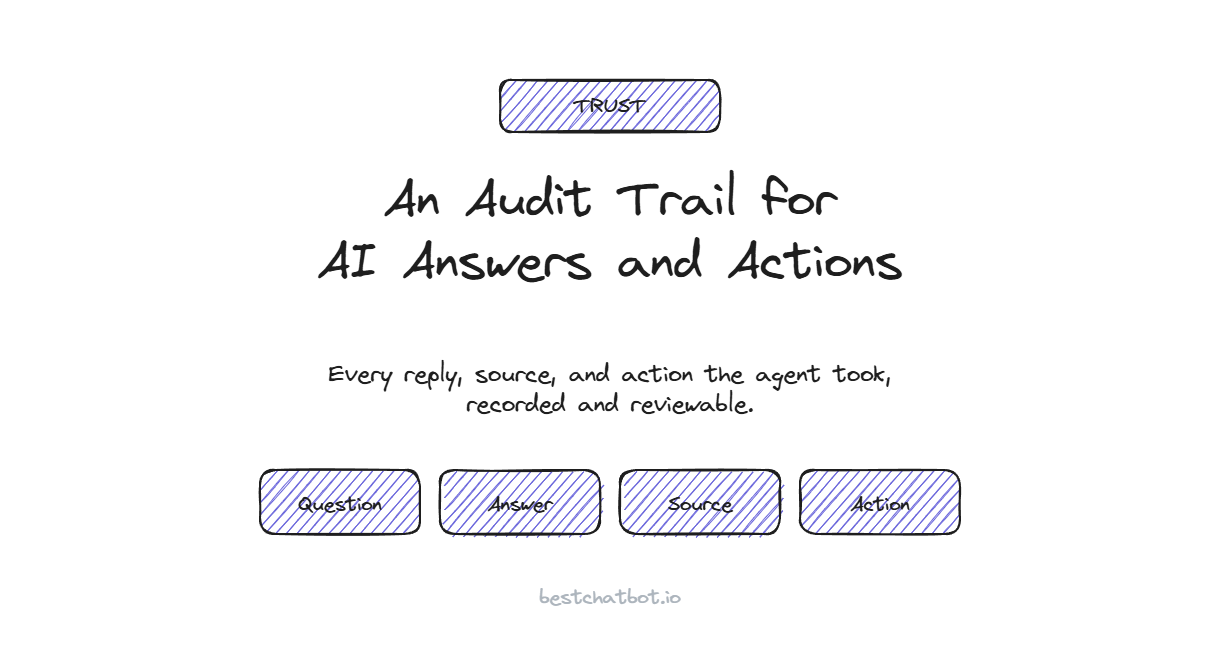
When an AI agent answers a customer or runs a task on their behalf, someone on your side will eventually ask a fair question: what did it actually say, and what did it do? An audit trail for AI answers is the record that lets you answer that without guessing. This AI audit log captures each reply, the source behind it, and every action the agent took, so a support lead, a privacy officer, or you at 2am can reconstruct exactly what happened in any conversation. We built BestChatBot so that record is there by default, not a feature you bolt on after something goes wrong.
This matters more once the agent moves past answering and starts doing. A wrong sentence is a bad experience. A wrong action against a live system is a real-world consequence. A chatbot audit trail that ties both back to a moment, a person, and a source is what keeps an autonomous agent accountable, and it is one of the load-bearing pieces of our wider stance on trust and privacy for AI support.
What an audit trail actually records
An audit trail is not a vague "history" tab. It is a structured record of three things for every turn: what the visitor asked, what the agent answered, and which piece of your knowledge that answer came from. When the agent runs an action, the record adds a fourth layer, the task it executed and the result that came back.
Here is the practical version. A shopper asks about a return window. The agent answers from your returns policy and notes which document it pulled that from. Later the same shopper asks to start a return, and the agent runs that task against your store. The trail now holds the question, the grounded answer, the source page, the action, and the outcome, all stitched to one conversation. Nothing is reconstructed from memory. It was logged as it happened.
We think this is the difference between a chatbot you hope is behaving and an agent you can actually verify. Grounded answers already keep the bot from inventing facts, a behavior we cover in our work on no-hallucination support. The audit trail is what proves, after the fact, that the grounding held.
Why answers and actions need the same record
Plenty of tools log chat transcripts. Far fewer keep a record of AI actions, because most assistants do not do anything beyond replying. Once an agent can book, refund, or open a ticket, a transcript alone stops being enough. You need to see the action and its result next to the words that led to it.
Picture a billing dispute. A customer claims the bot promised a refund and acted on it. With answer-only logs, you see the conversation but not whether a refund was ever issued, so you are back to guessing. With a combined trail, you see the exact reply, the action the agent ran, and the result the connected system returned. The dispute resolves in one read instead of a back-and-forth.
The two halves answer different questions. The answer record tells you whether the agent said something true and grounded. The action record tells you whether it did the right thing in the right system. Keeping them in one place, tied to one conversation, is what makes an autonomous agent reviewable rather than a black box.
Who asked, and why that anchors the trail
A record of what happened is only half useful if you cannot tie it to who it happened for. This is where identity does double duty. When an action touches a specific customer's data, the agent runs it against a verified identity that your site signs, not a name typed into the chat box. That same verified identity stamps the trail.
The effect is that every customer-specific action in the log carries the identity it ran under. A lookup on someone's order shows whose order, pinned from the signed token rather than from whatever the visitor claimed. We treat that pinning as a hard rule across every action, and it is the same mechanism we describe in identity verification for AI support. For the trail, the payoff is plain: you are never left asking "but who was this actually for?" The record already knows.
When there is no verified identity, the agent does not quietly act on a guess. It blocks the customer-specific task or stays on a safe anonymous path, and that decision is logged too. A blocked action is itself an event worth recording, because "the agent refused because it could not confirm who was asking" is the kind of thing a reviewer wants to see. The rules that decide when the agent stops short live in our breakdown of action guardrails, and every one of those stops shows up in the trail.
Where you actually read the trail
A trail nobody can read is just storage. In BestChatBot the record surfaces in your dashboard, in a Response Monitor where your team reviews what the agent said and did across conversations. You can read a reply, see the source it cited, and check the actions tied to that thread. That is what turns a pile of logs into AI accountability you can act on.
That review loop is also how the agent improves, because it does not learn on its own. A person reads the monitor, spots an answer that drifted or a gap in coverage, and updates the underlying knowledge by re-uploading a document, re-scraping a page, or editing it directly. The audit trail feeds that human-in-the-loop cycle: it is both the accountability record and the raw material for making the next answer better. Bounding what the agent is even allowed to do, which we cover in our guide to AI guardrails, keeps that review surface small and predictable.
It helps to be precise about what this is and is not. The trail makes for traceable AI support: a real account of your agent's behavior, scoped to your workspace and isolated from every other tenant. It supports privacy work, identity questions, and dispute resolution. It is not a regulatory certification, and we will never dress it up as one. What it gives you is traceability you can stand behind: a clear, per-account record of what was said, what was done, and on whose behalf. The privacy side of that record, what gets stored and for how long, sits alongside our broader notes on data privacy in AI support.
When a strong audit trail earns its place
If your agent only answers public questions, a transcript covers most of what you need. The calculus shifts the moment the agent acts on live systems or touches customer-specific data. Every refund, every booking, every ticket is a consequence you may have to account for, and "the bot did it" is not an answer a customer or a regulator accepts.
Action execution sits on our Pro and Business plans, and the audit trail rides along with it, because running real tasks is exactly when you most need to prove what ran and why. If you handle anything customers care about getting wrong, a record that ties every answer and action to a source and an identity is not overhead. It is the thing that lets you say, with evidence, here is precisely what happened.
FAQ
What does an AI audit trail record?
For each turn it records the visitor's question, the agent's answer, and the source in your knowledge the answer came from. When the agent runs a task, it also records the action and the result the connected system returned, all tied to one conversation.
How is an audit trail different from a chat transcript?
A transcript shows the words. An audit trail adds the source behind each answer and the actions the agent took with their results. Once an agent can book, refund, or open tickets, the action record is what a transcript alone cannot give you.
Does the trail show who an action was run for?
Yes. Customer-specific actions run against a verified identity that your site signs, and that identity stamps the record. The log shows whose data an action touched, pinned from the signed token rather than from a name typed in the chat.
Are blocked actions logged too?
They are. When the agent cannot confirm a verified identity, it blocks the customer-specific action or stays on a safe anonymous path, and that decision lands in the trail. A refusal is an event a reviewer wants to see.
Is the audit trail a compliance certification?
No. It is a per-account, isolated record of what your agent said and did, useful for privacy work, identity questions, and dispute resolution. It supports accountability, but it is not a HIPAA, PCI, or SOC2 badge, and we do not present it as one.
To see which plan includes action execution and its audit trail, head to our pricing guide.